All Hail the Hake!
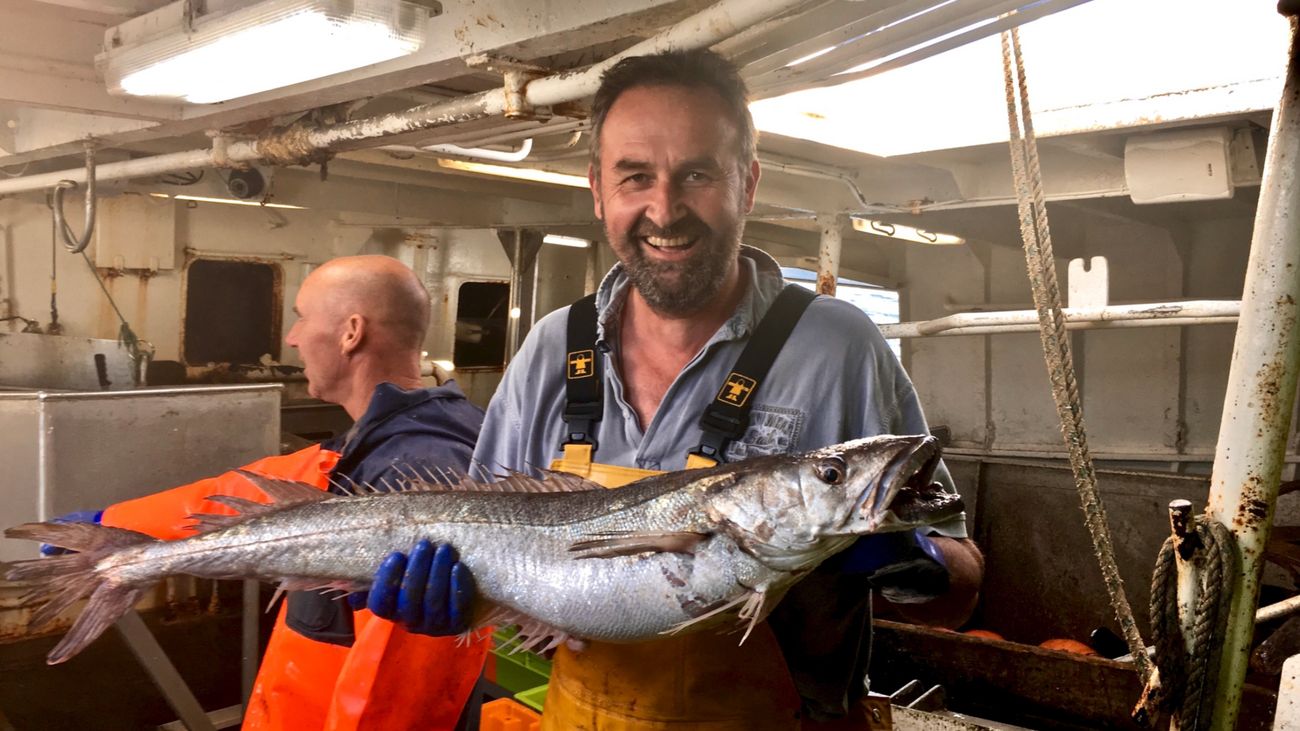
Whilst cod and haddock remain the staples of our UK seafood eating culture, the hake is fast becoming a species that's captured the imagination of chefs and consumers alike. Join me on a trip aboard a Cornish hake netter and its wild harvest.

All Hail the Hake - A Fishing Trip
Traditionally, when it comes to white fish, the UK has exhibited, very much a North/South divide between cod and haddock, with a rather nebulous and wavering East/West line floating anywhere between Peterborough and Newark delineating consumers' preferences.
To the North are the haddock lovers, to the South the swing is towards the cod and with that rather arbitrary division comes the usual goading and self-congratulatory smugness that accompanies any sort of rivalry - think scones (jam/cream first) or perhaps don't! And long has that existed, until......
OUR native British fish stocks, still the envy of the Northern Hemisphere, have traditionally been made up, in part, with what we call the white fish species - cod, haddock, coley (or saithe), pollack (or lythe) and whiting which mostly exist in what the industry knows as a 'mixed fishery' along with that come other demersal (or bottom feeding) fish such as brill, plaice, soles, monkfish, the mighty turbot and a whole plethora of other wonderful species that constitute that mix. Often caught and landed together, the boats are limited by quota on how much of each species they can land annually, the amounts being set internationally by ICES (International Council for the Exploration of the Seas) and then administered locally by either the MMO (Marine Management Organisation) or Marine Scotland.

It's bitterly ironic too, that for a nation of white fish consumers, the majority of the cod and haddock eaten across the some 10,000 or so UK chippies comes from the same waters but landed, often frozen, at sea by vessels fishing out of Norway, Iceland, the Faroes and even Russia. Another shining example of the 'Great British Seafood Paradox' - think of all those langoustines and calamari we enjoy in countless tavernas and bistros across the Mediterranean, sourced from, yes you guessed it, our own fisheries and to the tune of 80% of our national catch departing our shores on wheels or by air, for climes where popular seafood culture demands quality and variety.
The Great Contender
BUT within the incredibly diverse and disparate sectors that form the UK seafood industry, a new contender for fishmongers' slabs and restaurant menus is taking on convention and making huge strides in redefining how we, as a nation of seafood sceptics, approach our, at times rather stilted eating habits.
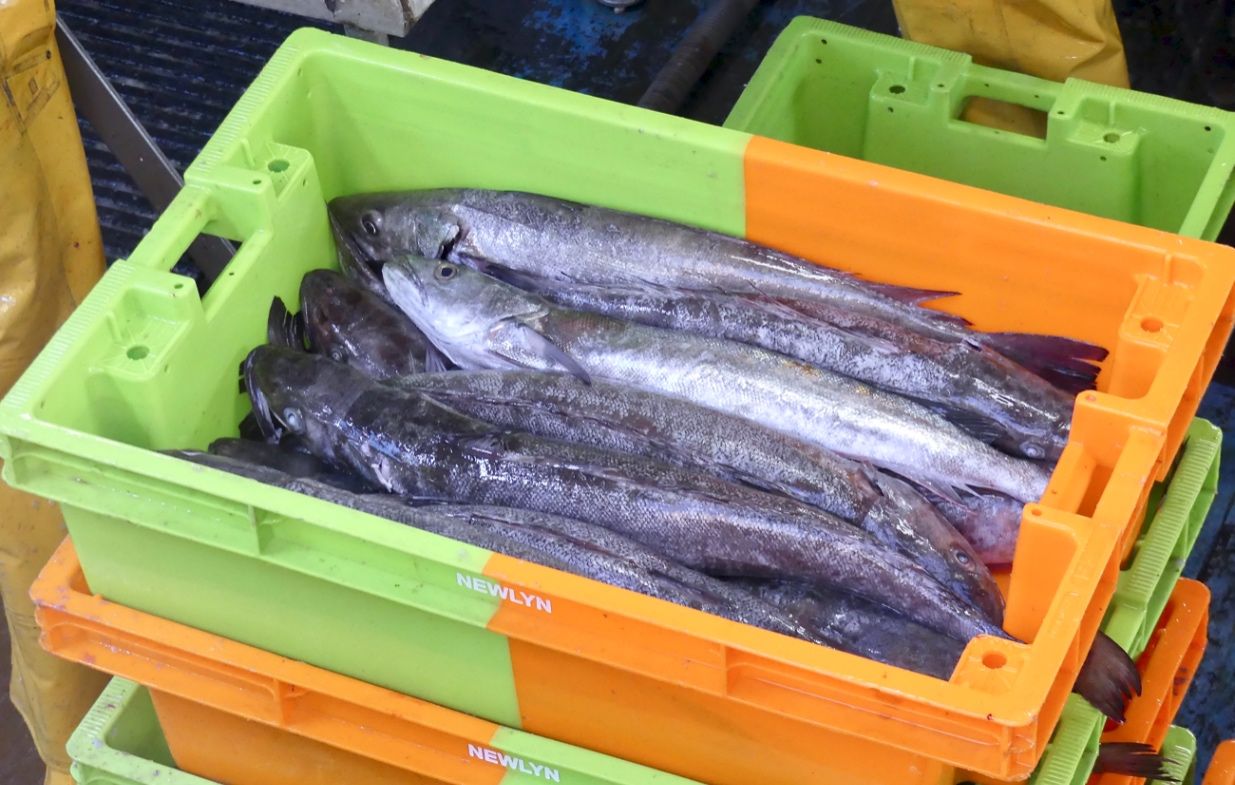
The hake (Merluccius merluccius) has abounded in our waters in the same considerable numbers as its gadoid cousins since trawl and seine netting first became commercially operational. A fearsome creature, the hake in the relatively shallow seas of the British Isles, tends to exist in the deeper water, rarely venturing into the inshore fisheries and into distinct populations - the Northern hake, predominantly the preserve of the Northern North Sea and Eastern North Atlantic and then by contrast, the Southern population which characterises the Celtic Sea landings into the South Western ports of Brixham, Newlyn and Plymouth.
It's only really been in the last ten years, that this incredibly flavoursome and versatile fish has garnered favour amongst those willing to try something new and sustainable. With undoubted pressure on the traditional cod and haddock stocks, a more responsibly sourced and home grown alternative was sought, without having to resort to the imported and often farmed, white fish unmentionables, to satisfy our desire for something tasty and often encased in batter.
Changing the Narrative.
HAVING been fishing for hake for many years, our fleets of Northern trawlers and Southern netters' catch had been predominantly destined for the Spanish market, where the much celebrated merluza has graced the menus of countless restaurantes de meriscos for generations. So important was the market, that really all the landings were at one time destined for export with much of the hake appearing in UK supermarkets coming from places as far afield as South Africa.
A firm and eminently flavoursome fish, the hake is indeed versatile and it's that combination, coupled with increasingly flawless sustainability criteria, that has alerted chefs and fishmongers alike, to the fact that a decent cod alternative exists.
The popularity surge of the British hake has arrived quickly and with good reason. It's sustainability criteria are flawless and that really has as much to do with the diligence, perseverance and passion of those who catch and land it - especially in the far South West than any other factor.
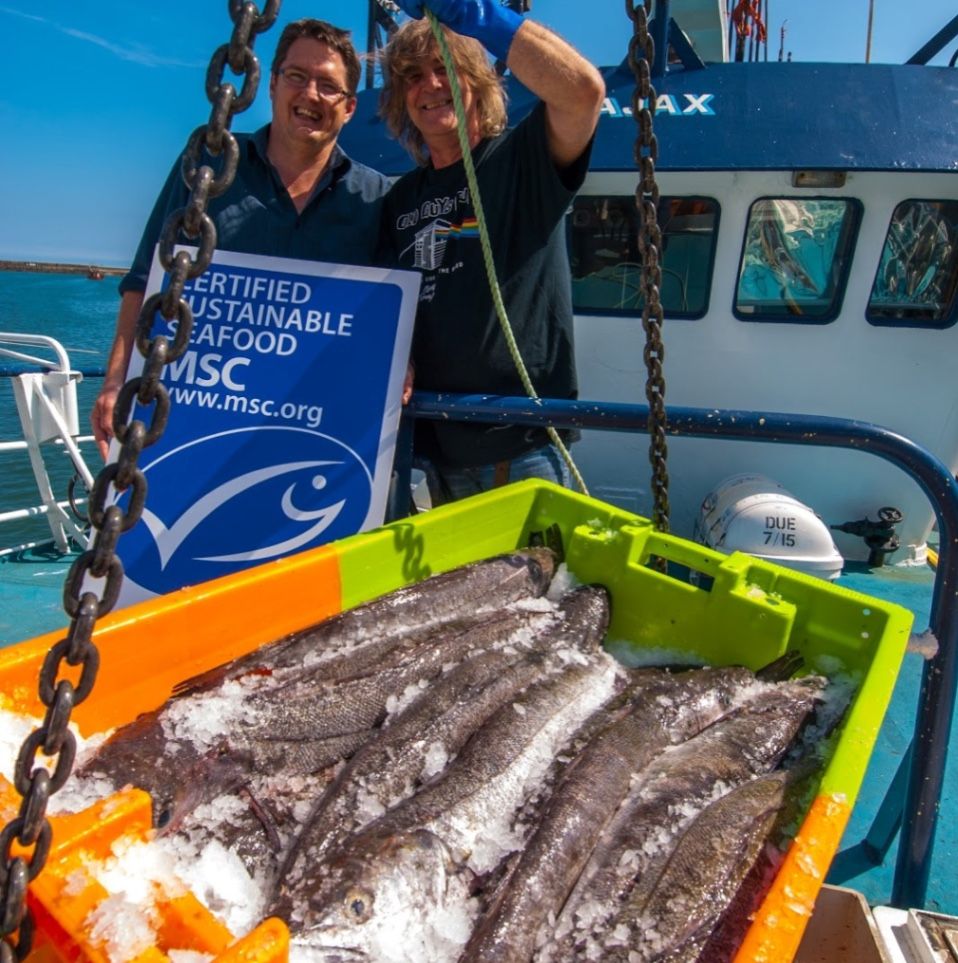
It was the skippers themselves who recognised the potential to elevate the status of this abundant and relatively quick growing fish and started working closely with the authorities - CEFAS, the Cornish Fish Producers Organisation and notably the Marine Stewardship Council, to enhance not just the value of the species, but to actively improve its sustainability and stock management by developing the catch methods to ensure maximum responsibility, resulting in the desired certification.
In 2015 their work was handsomely rewarded and although not a cheap exercise, the work of the Newlyn hake netters paid off, with the much coveted 'blue tick' being awarded for their efforts and a new chapter dawned for the fishery.
An Opportunity Not to be Missed.
I first spoke to Alan Dwan about that time, having embedded myself in the UK fishing industry, keen to expand my knowledge and learn more about how our national catch arrives on our plates and to dispel some of the mis-portrayed goings on beyond the horizon.
My visits to Newlyn had thus far been limited to mostly short day-boat forays from the harbour, potting for spider crab and lobster and seasonal hand lining for mackerel and beautiful green pollack, that lurk amongst the kelp inshore.
A couple of conversations in with this hard drinking, smoking and incredibly passionate Irish skipper, (who'd cut his teeth salmon netting on the Co Waterford coast), he'd convinced me to go to sea with him aboard his vessel 'Ajax' PZ36, owned by legendary local fisherman, Andrew Pascoe, who'd also thrown his weight and vast fishing experience behind the project.
Alan's passion for the hake, verged on obsession. He'd begun his hake career fishing out of Dunmore East in the eighties, with a fisherman called Paul Barlow and with 20 years experience at the hake behind him, I ventured there was no better guy to be at sea with to saturate myself with the knowledge of this unique fishery.
I didn't need a lot of convincing. After a potential date had been agreed, I once again made my way to Newlyn, another trip in a succession of visits that each time forged a stronger and stronger bond between me and this iconic, working town and arrived at the 'Swordy' one of a pair of notorious fishing pubs, situated just behind the fish market (the other being The Star) to assemble my thoughts and gear for going to sea the following day.
We met on the quay early the next morning. The boat was already taking on fuel and ice ready for a 'short trip' to the hake grounds west of the Scillies and as I slung my gear aboard, I was welcomed, albeit with some trepidation, by the rest of the crew, young local guys, mainly in their twenties, tattooed and fearsomely fit from shift after shift of shooting and hauling, often in ridiculously poor conditions in pursuit of their wild harvest.
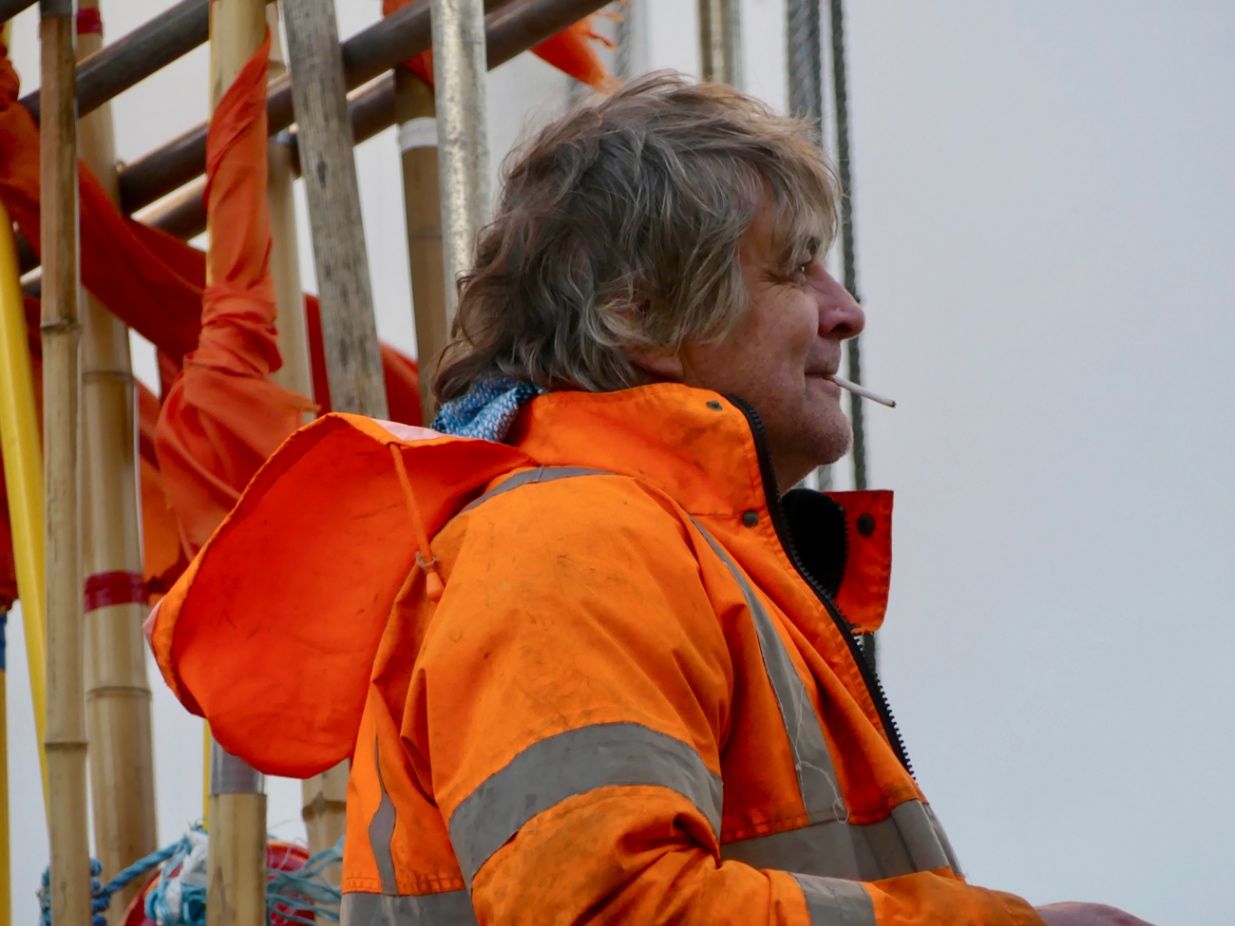
Alan, overseeing the provisioning of the boat, customary roll-up on his lip, looked in his element, reminiscent, I thought of George Clooney in 'The Perfect Storm' readying his sword boat (albeit hopefully not with the same outcome!) It's been remarkable, that over the years, all the skippers I've had the pleasure of sailing with, have emanated the same assured, experienced calm and thoughtful demeanour that defines what it means to be in charge of a fishing boat and its crew, in what is still the most dangerous peacetime occupation.
Away to Sea
Aboard 'Ajax' and gear safely stowed, she slips her mooring and we glide serenely from the quay and out 'through the gaps' into Mounts Bay and on a sou'westerly heading towards the Runnel Stone, the Longships Light and Land's End.
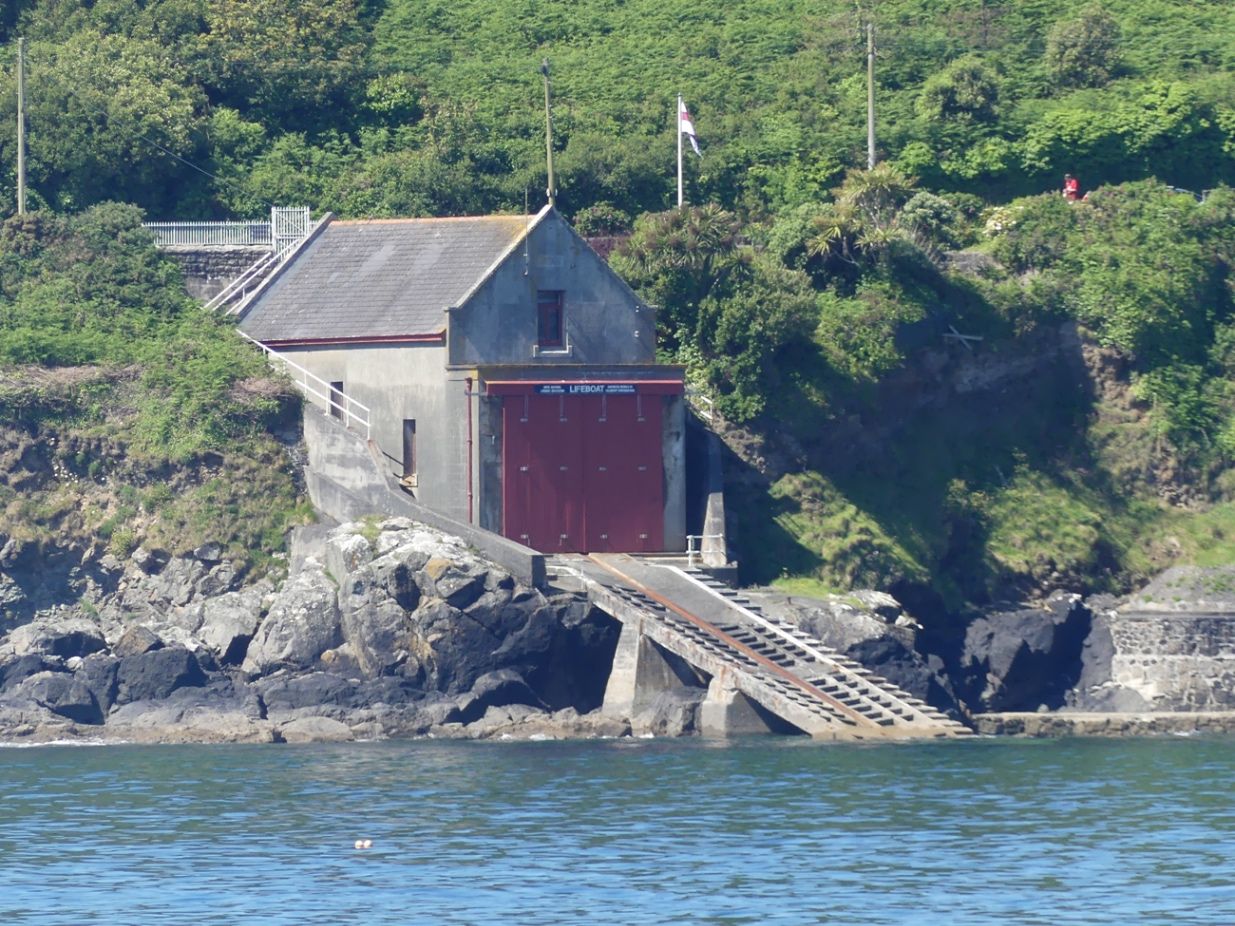
To starboard, another poignant reminder of the terrible dangers seafarers face, looms up, as we pass the old Penlee lifeboat house and slip, where in December 1982, the 'Solomon Browne' made her last fateful launch to the aid of the coaster 'Union Star', never to return, devastating the tiny fishing community of Mousehole. It serves to remind us that the sea is at all times, unforgiving and those who make their living from its depths regard it it with the utmost respect.
Ruminating on this, as we pass by what is now very much a memorial to the lost crew, I can't help but recall the words of Sir Walter Scott
'' It's no fish ye're buying, its mens' lives'
Tater Du lighthouse next and then finally the Longships pass by, as we hit the rolling Atlantic Swell and Alan sets a course for the Scillies, west of which, his gear lies fishing.
On the Grounds
Following a twelve hour steam, we arrive the next day on the hake grounds, near an area called Jones Bank, west of the Scillies and south of Ireland. Here Alan has approximately twelve miles of hake gear fishing which was 'shot' a couple of days days earlier and left 'soaking' whilst the last catch was landed at Newlyn.
The gear consists of monofilament gill nets, anchored to the seabed at intervals, to prevent drifting and marked with fluorescent buoys or 'dahns' which in turn are attached to the nets via and end rope. The nets themselves hang in the water column like billowing curtains supported by a headline of floats and a stretched out by weighted foot rope, ensuring they fish evenly.
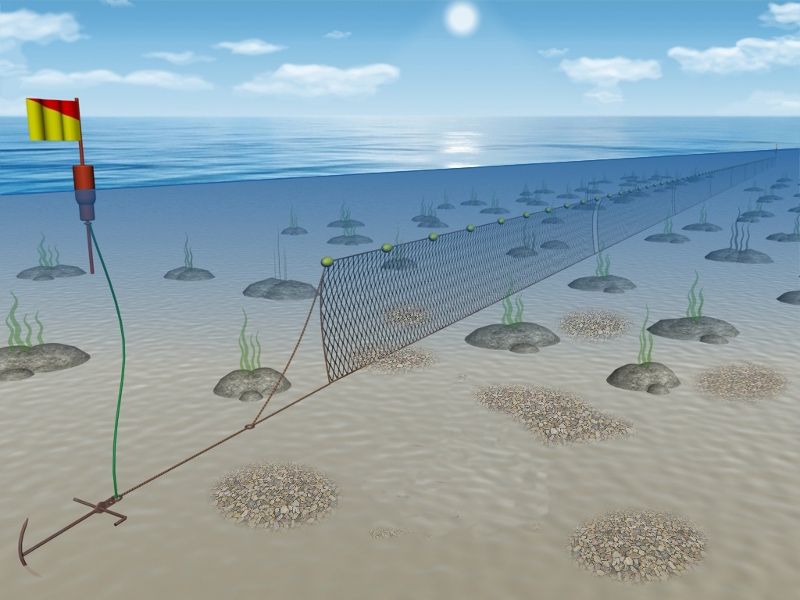
The gear has to be fished generally on the weaker or 'neap' tides. Bigger tides or 'springs' where there is a stronger run are avoided, as the nets won't fish correctly and can end up in a mess.
The hake (and here's the skill of the wild hunter) can be feeding varying levels and it's down to the skipper's experience, knowledge and guile, to gauge whereabouts they'll be and to set the depth of the nets accordingly. A lot of our commercial sea fish species, inhabit banks, shoals and reefs, the contours of which provide ideal habitat for their prey, (in the hake's case, pretty much anything that moves, including each other!)
Whilst in pursuit of their food, the fish encounter the nets, where the size of the mesh (5" for the MSC standard) dictates the minimum landing size of the hake, with only the larger fish being ensnared with the smaller juveniles passing through in a good measure of conservation.
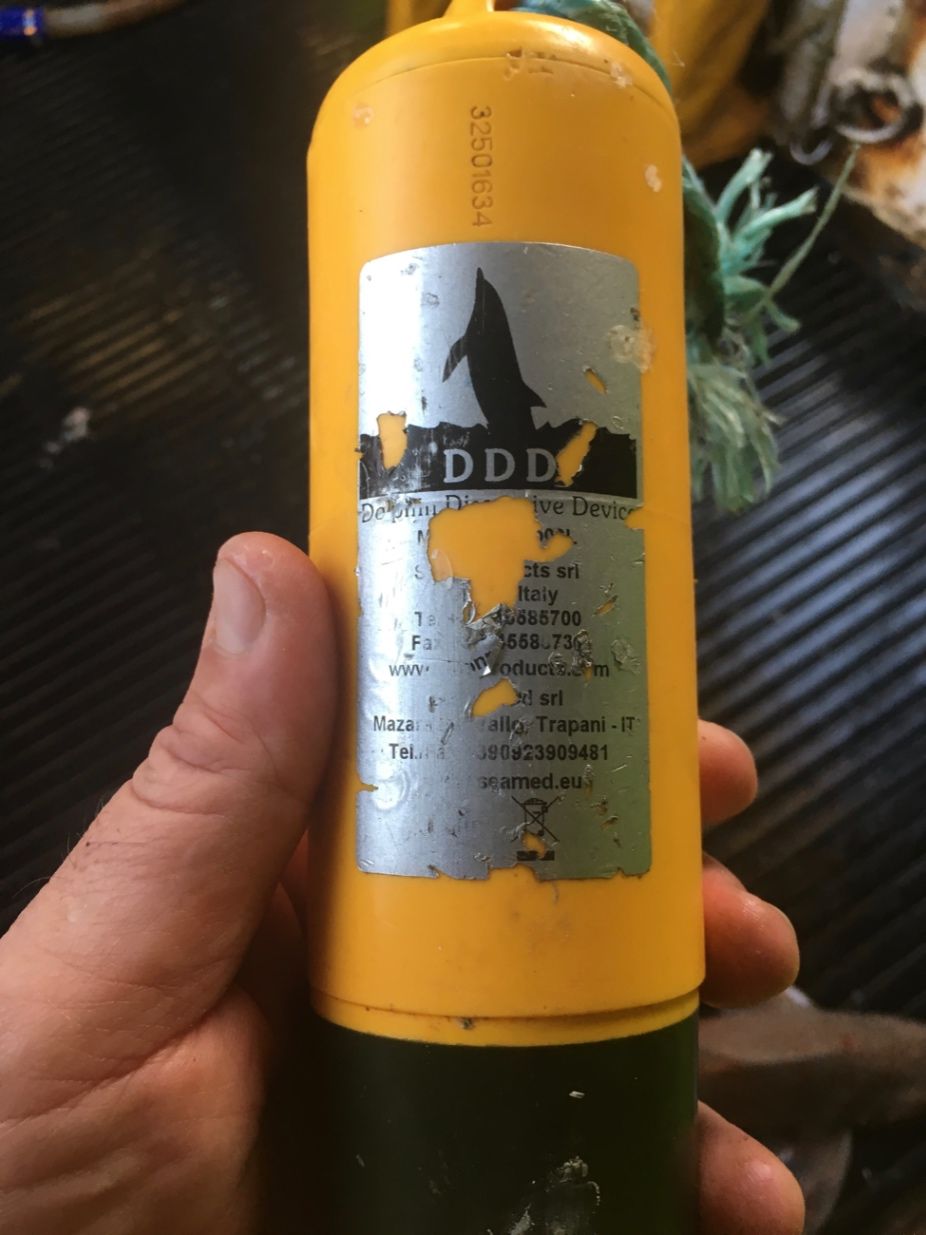
The improvement in sustainability of this species has been hard won and the bycatch - that is the term for non-target species, has effectively been eliminated through responsible best practice, adding to the credentials of the fishery. Cetaceans (whales and dolphins) had been a significant problem, but since the introduction of ultrasonic 'pingers' attached at intervals along the length of the gear, has meant that their inadvertent capture has now been successfully eliminated.
As we prepare for the first haul, excitement builds. It's characteristic of all the commercial fishing operations that I've witnessed, that the anticipation of the catch is tangible and never fails to excite. You never actually know quite what you're going to see!
The gear is located by the skipper using GPS, to identify the marks which he has allocated on the plotter, as to the ends and where the dahns are. Accuracy of marking is paramount as the hauling operation is 24hrs and often in appalling weather.
On sighting the end of the gear, Alan skilfully manoeuvres 'Ajax' alongside, so that the crew can retrieve it by using a grapple on a line, which is thrown across the end rope and dragged up so the guys can detach the dahn, before feeding the rope into the hauler and mechanically winching in, before the end anchor is aboard and safely detached.
Hauling
As the crew and I don our boots and 'oilies' ready for hauling there's still quite a bit of swell running and 'Ajax' lollops and rolls towards the dahn. The guys, displaying perfect sea legs and so very well rehearsed, slip into an effortless routine, whilst clinging onto a bulkhead, at the end of the fish deck, camera in the other hand, I try and keep out of the way, mesmerised by the whole scene unfolding.

The first anchor clanks awkwardly aboard, is removed and stowed and the hauler sighs and groans as metres of end rope spool onto the deck for what seems like an age until the first 'fleet' of nets arrives across the gunwale.
The view via the open hatch on the starboard beam, where the net is fed aboard , alternates between sea and sky, with the occasional white flash of a hovering fulmar or gannet. From his seat in the wheel house Alan can monitor everyone and every second of the operation via a series of CCTV cameras that give him selected views. This affords him the ability to fine tune the process and respond swiftly to snags, fasts or danger.
A long handled double-hooked 'gaff'rests in a holder pointing out through the hatch, ready for one of the guys to hook and retrieve a fish, not secure enough in the mesh, should it be lost at the last moment.
Surely the monofilament net starts to run in through the rollers of the hauler , billowing onto the deck and passed aft to the 'flaker' which untangles and evenly distributes the net into bins in the stern, in readiness for shooting again.
Admittedly, I'm still feeling a little queasy from a fitful night in my bunk, below the waterline where the constant thrum of the engine and whine of the prop shaft, coupled with moving around in pitch blackness and the all-pervading smell of diesel and fish, create an environment I've not really experienced before and certainly not one for the faint hearted....
Fish on !
I'm instantly snapped out of my temporarily inert state, by the cry and then the sight of a gleaming silver bar, shrouded in nylon mesh, which flicks somewhat gracefully over the gunwale and is expertly eased to one side by one of the crew, lest it get dragged into the rollers, thus avoiding any unnecessary damage. The fisherman shakes the net and pulls at the twine to dislodge the fish and disentangle it, where it drops to the deck and is summarily scooped up by another and deposited into a stainless steel channel, where it slithers and slides to the gutting table where First Mate, Matt Price waits, knife in hand and fag on lip. A deft slice through the hake's belly exposes the guts and then with a clutch and twist and another slice, the fish is washed and the entrails deposited out of the scuppers, to the awaiting cacophony of whirling gulls and gannets.
As more fish come aboard, the process becomes quicker with the guys at their stations moving in a sort of well-choreographed, but harsh, industrial ballet, each abundantly aware of each other and their actions in well-practiced harmony.

As the crew work their way along the fleets of nets, fish come aboard in increasing numbers, virtually all hake, with the occasional, haddock, whiting or pollack. On this haul, the nets having been fishing clear of the bottom, otherwise we might have found a few monkfish or larger flats such as brill or turbot. The whole theatre of is metronomic and I learn that when the fishing is very good and the volumes large, (far in excess of what I'm seeing), its not unusual for the guys to be at it non stop, for twenty four hours.
Observing the crew beavering away and with a real adrenaline buzz, I was beginning to feel a bit of a spare piece and one of the lads, Treeve Perry, had sensed this and I was duly beckoned over to don a pair of gloves and get stuck in. I didn't need asking twice and within seconds I was stationed on the hauler, feeding the fish over the side and shaking them out myself.
Being part of the whole experience crystallised a few things for me.
- It's bloody hard work
- It's incredibly dangerous
- They earn every penny they get.
However, getting to grips with the gear and experiencing the physicality and pressure of working diligently at speed (and trying to keep your balance) to remove the fish from the nets' clutches without incurring damage and preserving the quality, is something I wouldn't have missed for the world and which adds a very real and necessary element to the narrative.

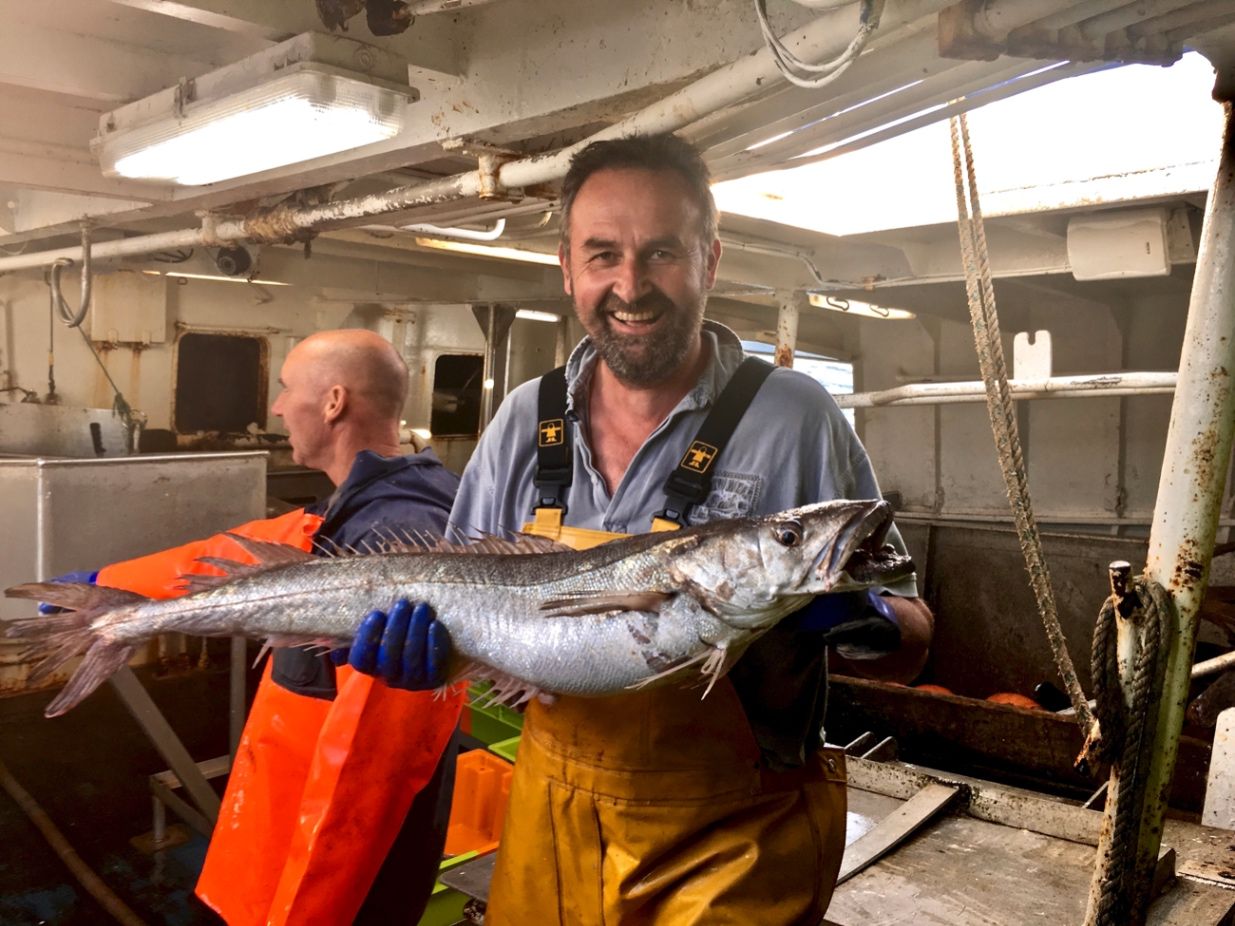
A Flat Calm and Seafood to Die For
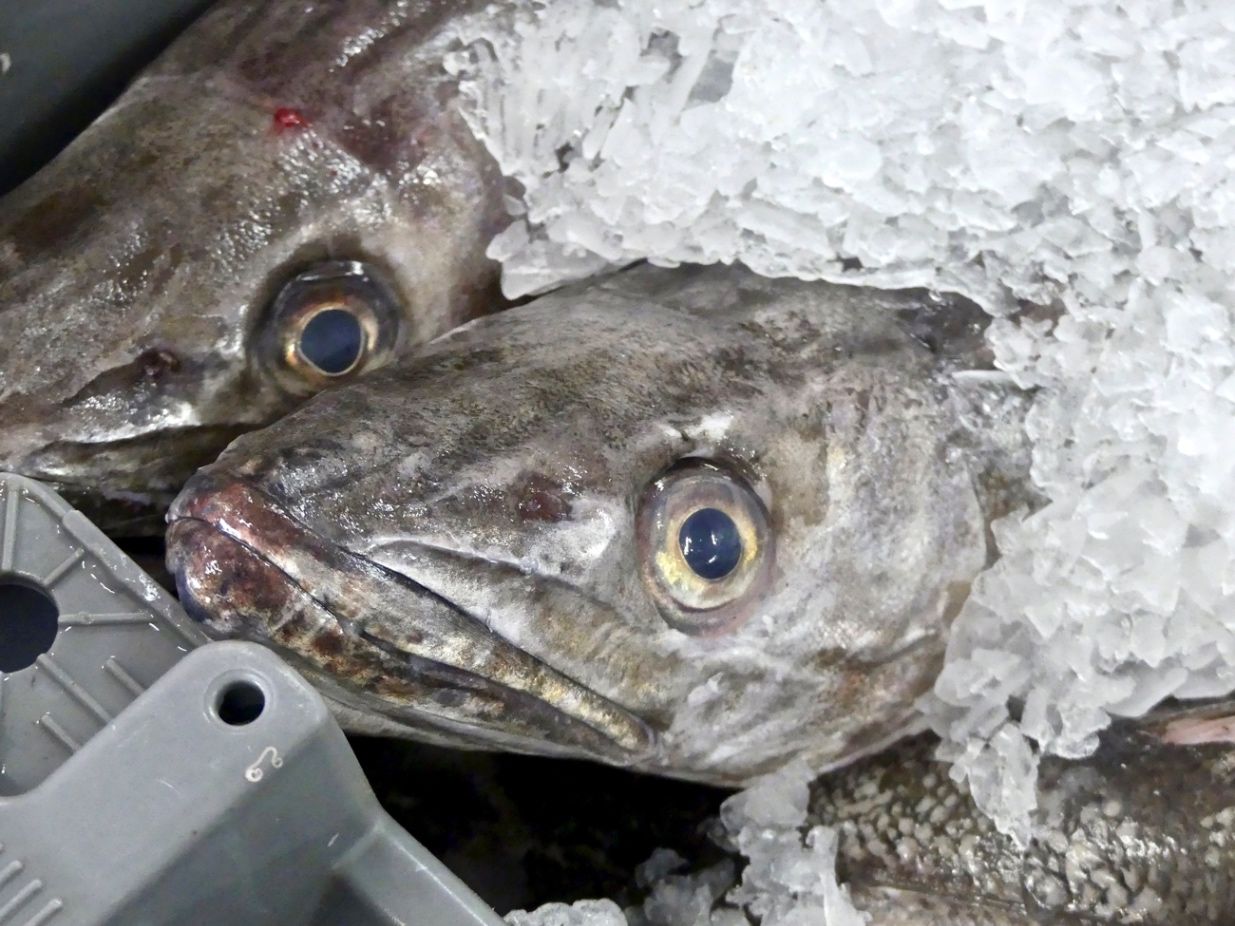
As the day passes, we move from set to set, re-shooting the cleaned gear back where the fishing has been good. The boxes of hake start to accumulate and after each hauling session, the guys descend the ladder to the fish room to pack and ice the catch in readiness for landing to the market.
With the gear fishing again, the crew get some well-earned down time and as the sun descends beyond the bounds of the Atlantic, a glassy calm consumes the seascape, presenting the most incredible panorama.

The next day dawns and as we idle on the oily ocean, waiting for the time to haul again, Alan spots a familiar shape far out on the horizon. Another hake netter - the equally successful 'Karen of Ladram' PW3, skippered by Simon 'Sid' Porter, makes her presence known over the VHF and the two old pals chat away until the Karen is right alongside and the conversation continues within hailing distance.
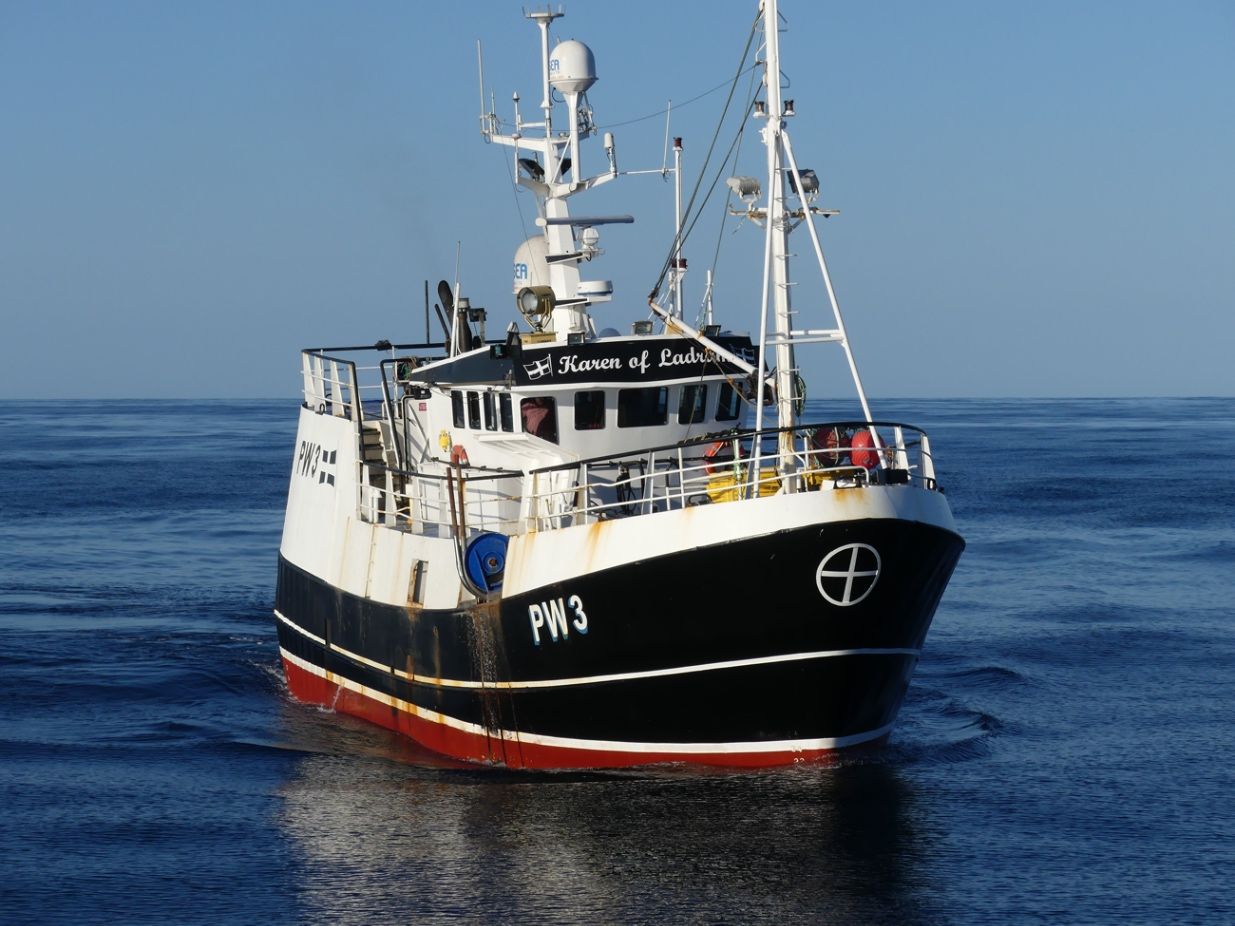
It's extraordinary, that in all this vastness, so far from home, the meeting is reminiscent of a chat at a street corner, as both crews shout to each other over the rails in a hearty exchange of banter.
It's a heart-warming scene and as the conversations draw to and end, Sid opens up the Karen's throttle and nosily she ambles off again, in pursuit like us, of more boxes of prime MSC Cornish hake.
Presently, the hauling recommences and we're back at the coal face, with the nets having fished well and a steady stream of 3-4 kg fish coming aboard, the crew working unfalteringly into the evening on the last few fleets, before we set a course for Newlyn and the market.
Being a seafood writer, naturally, I take every opportunity to sample the delicious and diverse array of fish and shellfish that I get to witness being harvested, invariably cooking myself, if possible. I've eaten our wonderful British seafood, in ports harbours, cities and homes the length and breadth of the UK and it feeds the imagination as well as the soul - part of my raison d'être.
It's eating freshly caught fish, directly from the boat, from 'net to plate' and all the accompanying provenance which is the nirvana for me. This trip aboard 'Ajax' proved no exception, as Matty Price demonstrated his natural ability in the galley. Whilst I was up on deck, writing and editing on that beautifully calm afternoon, he suddenly appeared with lunch - just-landed monkfish provencal, which he'd just 'rustled up'.
Astonished and elated, I sat in the beating sun, savouring seafood that only a few hours before was swimming metres below. It was a defining moment for a food writer and there was more to come.

As darkness fell and I took up residence in the mess deck, having finished filming my final shots, he surpassed himself with supper, dishing up another of his sensational creations, which celebrated magnificently our quarry.
So good was his hake, bacon and potato bake, I seriously suggested he should be writing a cook book. As far as I know he hasn't, but he should. Anyway, as I luxuriated in an incredible amalgam of flavours, sitting alone in the mess , I reflected on the whole commercial process I'd been party to, the environment it conjures and the genuine and unique experiences that emanate from being part of it.
NB: I was so impressed with the hake dish, I cooked it on returning home, but it wasn't half as good......However his original recipe sits on my website along with a short narrative

Landing
Having spent the last three days at sea, absorbing a colossal amount of info, I was on a life time's high and without becoming too philosophical, what I'd witnessed and encountered were defining events. As we began the steam back to Newlyn under the most majestic of skies with dawn enlivening the eastern horizon and the old day receding under a cloak of inky blackness, the crew grabbed some much needed shuteye below and unable to sleep, I sat up in the wheelhouse, yarning with Alan as through the small hours we steadily approached the Cornish Coast.
As the green of Land's End hove into view, the craggy coastline rolling along to port, suddenly the atmosphere aboard shifted again. Every trip is the same, when home is in sight and landing imminent the mood lifts and an air of happy anticipation gathers. Although the turnaround is all too often swift, there's always a chance to meet loved ones on the quay, grab supplies from the town and a brief respite as the vessel is readied for sea once more.
As we motor back 'through the gaps' various craft are coming and going. The day is balmy and bright and the immediate task is to deliver the 135 boxes of hake into the market chiller for grading and icing in preparation for the following morning's auction.

We come alongside and make fast to the quay. Alan's ploy to make a shorter trip seems to have paid off as we're the only netter landing so far, although we know that the 'Karen' won't be far behind.
Once again it's suddenly all go. Alan mans the derrick on deck, whilst three of the crew leap ashore and fetch pallets to the quayside to land the fish on. Down in the fish room, the others haul out the stacks of boxes and attached the hooks which Alan lowers, before craning them deftly onto the quay. The clanks, bangs and shouts, so typical of fishing ports around the UK, merge with the raucous creaking and screeching of herring gulls and black backs, which add to the audio of the backdrop. Commercial fishing in the raw, but a vital part of the story - the reality of the day to day, year-round quest to bring fresh fish to the UK table and with it, the tools for better-informed decision making when purchasing seafood.
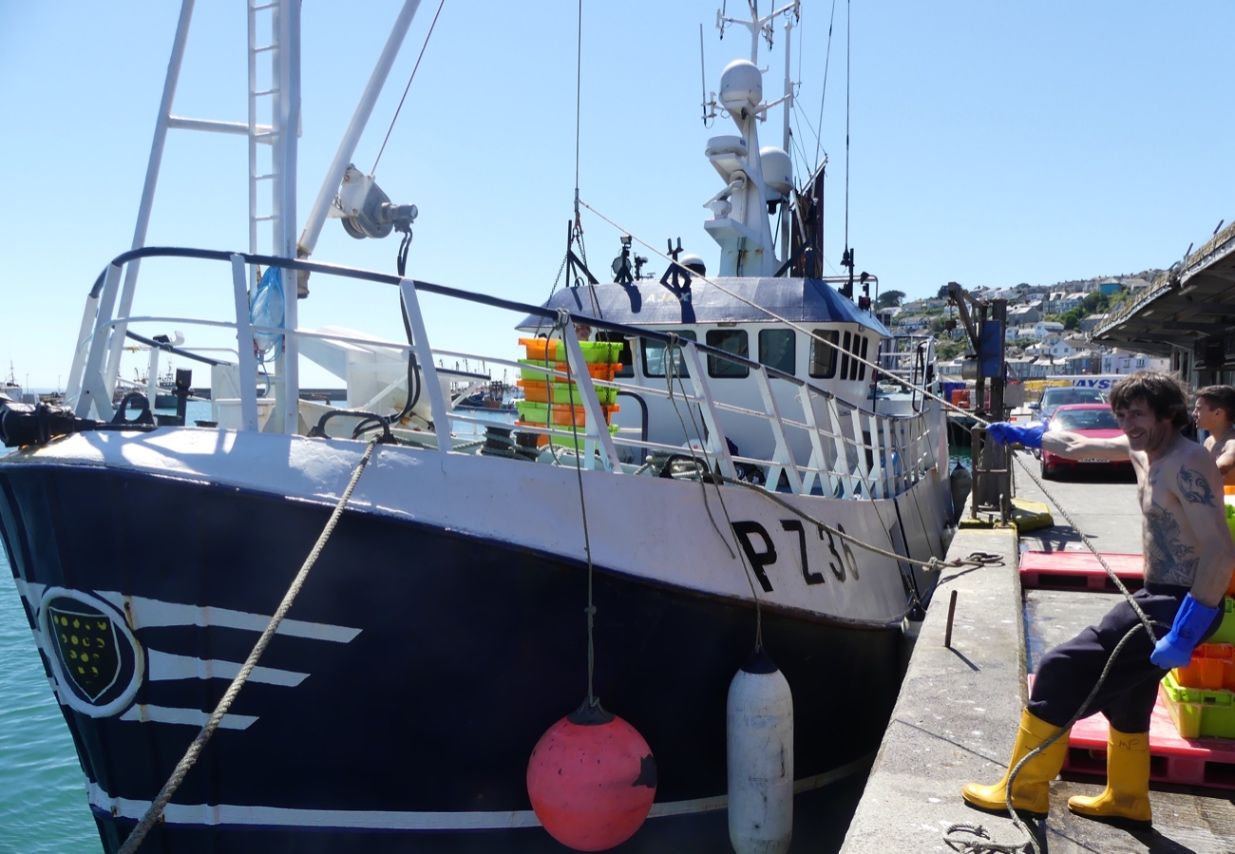
The hake should make good money. The buyers will be keen and armed with the knowledge of its landmark MSC sustainability, 'Ajax's fish will be on the road in a matter of hours, heading up the A30 and thence to all corners of the UK.
With the catch now landed and awaiting the market night shift for grading, we have a bit of time for a few team photos and farewells, as I'm now destined to stay quayside.

It's an odd moment. In my relatively short time afloat, a bond has been formed between me, the boat and the crew and the realisation I'm now back ashore and no longer involved, hits me hard. As the crew cast off once more, the engine growls, they throw their final waves to those ashore and slowly glide out of the harbour and back to work.
I watch her, filming, as she heads back into Mounts Bay and the beginning of her next episode. It's a truly poignant moment and I feel somewhat bereft, having been part of something so special. I wander back through the fish market and up to my room at the Swordy
Tomorrow the market, to see what our catch makes and then I have a story to tell.......
Footnote
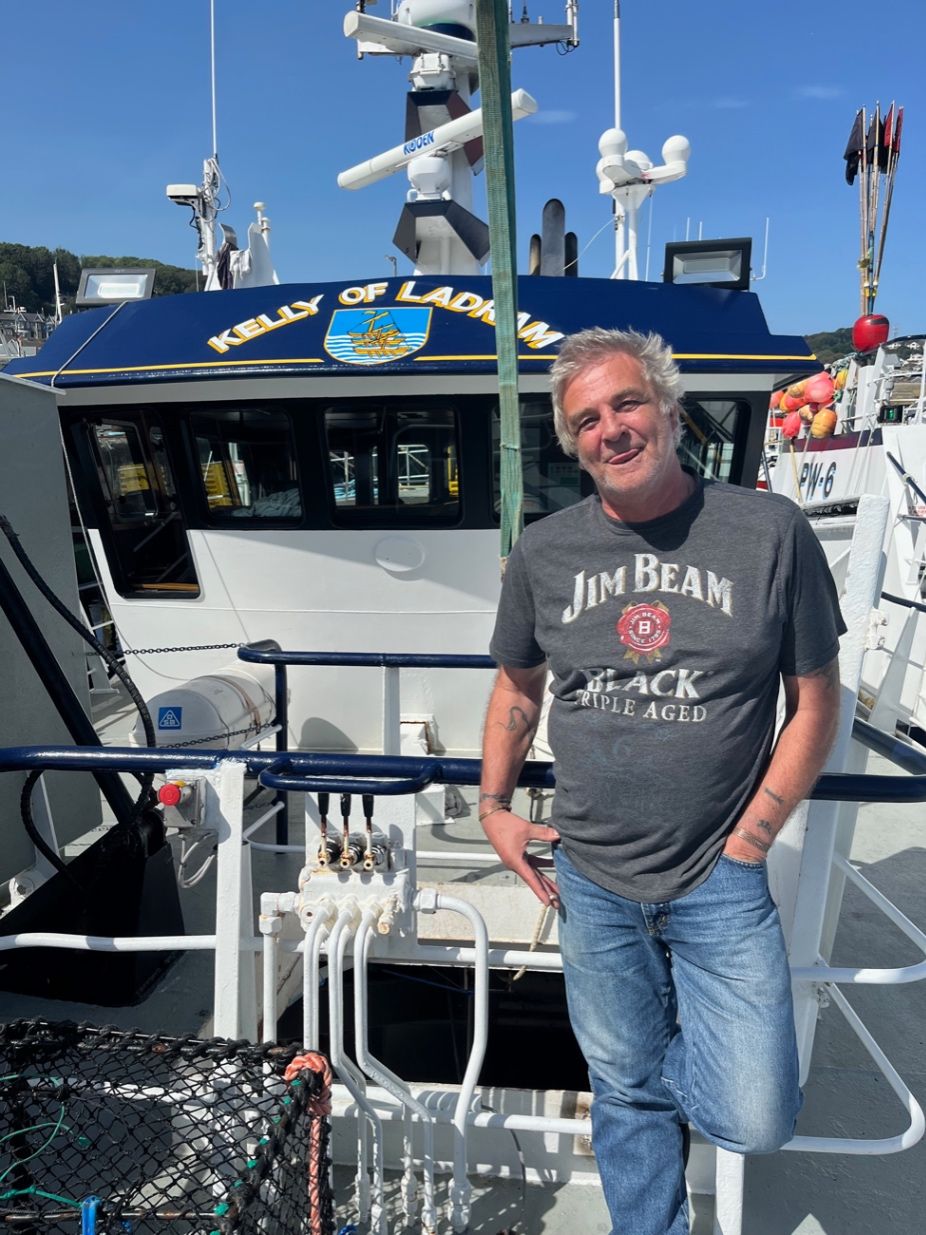
Since this trip was made, Alan Dwan has changed vessels and is now proud skipper of his new charge 'Kelly of Ladram' BM800. A good friend, Alan and I speak regularly and he keeps me updated on the latest goings on in the world of hake and other Cornish fisheries.