Crabs, ringers and gates – anyone for a game of quoits?
There's an ancient rural game played in villages across the North Country which has its origins in the mists of time.


On summer evenings in some parts of the North Country there is a village game older than cricket and not so well known – Quoits. The ‘Northern game’, as it is called (yes, there are regional variations) has been played on village greens and in pub gardens for longer than anyone can remember. And despite its low profile the sport is in rude health, boasting leagues throughout the Dales, North York Moors, County Durham and Northumberland.
Wensleydale alone has two leagues – upper and lower – with teams travelling up and down the dale on weekday evenings to test their skills. Most of the sides are centred on pubs with some hostelries having both A and B teams. Pints are always at hand during play and the evening is sealed with a pub supper laid on by the hosting side.
Quoits was one of the pastimes, along with football, prohibited in the 14th Century lest they interfere with the common man’s practice of archery. When that ban was lifted, it was a popular sport associated with country inns and taverns.
Then, like many games played by the rural working classes, it was transported to the rapidly growing towns and cities of of the Industrial Revolution when the rise of the public house also brought about an increase in pastimes that needed little more than a yard or stretch of green upon which to play them.
It was the Victorians, in the way that they brought order to most things, who laid down the rules of the Northern game. A gathering of interested gentlemen in Stockton, Darlington and Middlesbrough hammered out the rules of the Northern game in 1881, forming The Association of Amateur Quoit Clubs for the North of England. They were printed in that bible for country gentlemen, The Field, in April of that year. Since then, little has changed:
Two pins are set 11 yards apart, each in a bed of clay which is three feet square. The half-inch diameter pin, also called the hob, protrudes three inches above the clay. Teams have seven players and each is drawn against a member of the opposing side. The pair take it in turns to pitch their quoit over or as close as possible to the hob. The first player to reach 21 points wins the game. Northern quoits weigh about 5lbs.
Despite the rules set down for the Northern game, there are other variations. In the Long Game, played in Scotland, Wales and East Anglia, the hobs are set much farther apart at 18 yards and a heavier quoit is thrown, almost double in weight to that of the Northern game.
As for the origins? Some say it is merely a British variation of American ‘horseshoes’. Others demur; if that is the case, why don’t North Country villagers simply play horseshoes? Why would workers in poor rural communities go to the expense of forging iron rings simply for a game? Others point at a more ancient lineage, claiming the throwing of metal rings with accuracy is descended from the discus.
There is also a school of thought which puts the origins of the game as something brought back from France during the Hundred Years War. To add weight to their argument they point out that there is a style of throw known as the ‘Frenchman’.
Whatever its origins, one can agree there is a quiet camaraderie to the game that is found only among country folk; the murmured approval when a ‘good quoit’ is thrown and occasional ribbing when a poorly aimed quoit or ‘crab’ is removed from play. It still tends to be a working man’s pastime – the majority of players of the Northern game are farmers and tradesmen, although a smattering of retired white collar ‘off-comers’ are starting to appear.
In a modern world, where even quoits scores are sent by WhatsApp from team captain to league scorer, there is something timeless about groups of villagers, most of them still in their working clothes, travelling from village to village for an ancient game of skill, a yarn and a pint.
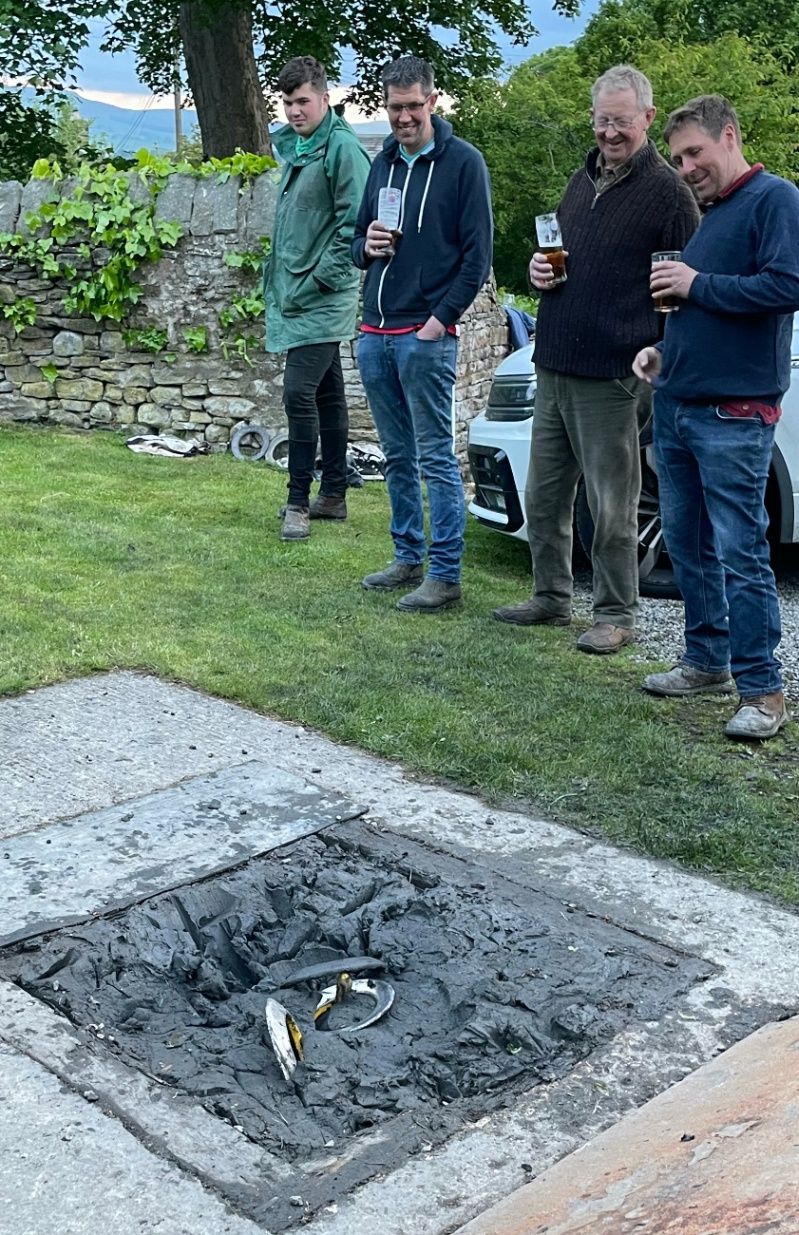
Quoit terminology
A quoit’s outer ring is slightly angled like the rim of a saucer, creating a hill side and a hole side.
A ringer is a quoit fully over the pin or hob.
A crab is a thrown quoit that hits the boards outside of the clay and is removed.
A hole or hill gaiter is a quoit which lands upright in front of the pin, acting as a ‘gate’ and preventing the rival player from throwing his quoit over the pin.
Throws to either side of the hob include a Frenchman and a pot.
Callipers are used by the referee when two quoits appear to be the same distance from the pin.