Days Like These
A reflective journey through winter fields, working dogs, and the solace of shooting days—an anchor for mental wellbeing amid life’s pressures and growing political uncertainty.


The run up to Christmas
The final quarter of 2025 pressed in on me with a weight I felt in my bones. Not just the familiar pre Christmas frenzy, but something denser, more insistent. Brass bands are woven into the British imagination as tightly as mince pies and tinsel, and somehow, I found myself playing twenty two bursts of Christmas music in twenty four days. Add to that the choir concerts, the carol services, the seasonal obligations to family and friends—people I always feel I neglect through December’s first frantic weeks—and the quiet, persistent worry over my parents’ health, and the month became a blur of obligations stacked on top of one another.
Work offered no refuge. The beer industry is always a tempest in December, the supermarkets demanding ever faster output, ever tighter logistics, as though beer itself were a seasonal lifeline. This year, the business sat beneath a metaphorical “For Sale” sign, and the uncertainty seeped into everything. With a new, fairly novice team to shepherd and the looming possibility of unemployment for the second time in a year, I found myself cajoling others while privately running on fumes.
So my days in the field—those small pockets of sky and silence—became not just welcome but necessary. Whether I’m picking up or shooting, the space does me good.

On the Tuesday before Christmas, I stood in a field with seventy yards of space between me and the line of guns. My mind churned through unfinished tasks: the email I might not have sent, the ingredients I might have forgotten, the jobs I might have left half done. Weeks of restless four hour nights had left me hollowed out, running on adrenaline and caffeine, brittle as frost, a breath away from disaster.
The release
Only the dogs anchored me. Bridget, young and sharp eyed, scanned the sky for potential runners with the intensity of a creature born to work. Sadie, older and more dignified, shuffled a few inches farther away, as though proximity to Bridget and me were a mild social embarrassment. Their presence, their purpose, reminded me of my own. Slowly, the mental static began to thin.
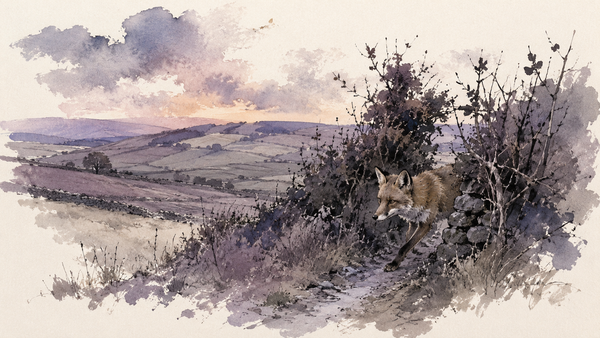
The world around me emerged in layers. The day was cool and bright, but last night’s rain still clung low in the sky, a heavy, lingering cloud that wasn’t quite mist. The sun strained through it, casting an eerie, pewter coloured light across the fields. The hedgerows, stripped back to their winter bones, held tiny birds that flickered in and out like sparks. The air smelled of wet earth, crushed grass, the faint mineral tang of standing water, and the faint musk of damp Labrador.
With barely a breath of wind, the smallest sounds rose to the surface: water trickling through sodden grass and soil, the soft rustle of reeds, the distant cough of a pheasant shifting in cover. Even the silence had texture—thick, damp, and strangely comforting.
Sadie huffed, poised on the edge of a whine, and I caught the reason—the distant, almost imperceptible rhythm of the beaters approaching. The snap of flags, the high whistles, the clack of sticks, all drifting toward us like the first notes of a familiar overture.

Then the first shot cracked the stillness.
What followed was a flurry of wings and sound, birds rising and falling, shots echoing along the line. Bridget streaked out for a long runner, returning with the triumphant speed of a creature doing exactly what she was made to do. The rest of the day unfolded in a gentle blur: quiet conversations, muddy climbs in and out of Land Rovers, the steady rhythm of working dogs, interspersed with moments of stillness where the world felt wide and breathable again. By the time I drove home in the gloaming, we were all tired and damp, but something inside me had eased. I felt steadier. Ready.

Turning a corner
Five weeks later, the darkest stretch of the year was behind us. Work had begun to right itself (a new owner and a glimpse of a future), life felt less frantic, and I found myself once again in that same field, this time as a back gun on the final day of the season. The week’s weather had been relentless, and the ground that once whispered with trickling water now swallowed my boots with every step. The trees, slick with the weeks’ rain, shone almost black against the washed out sky. The birds, sensing the lengthening days, were louder and more insistent, their songs threading through the muffled thud of gunfire despite my ear protection
Bridget was home in season—much to her dismay—so it was just Sadie and me. She sat closer than usual, perhaps resigned, perhaps hopeful, and only huffed once when I missed a bird she clearly deemed embarrassingly easy. The miss reminded me, again, to slow down. To wait. To let the moment come to me rather than rushing toward it.
My shooting improved, but what stayed with me were the in between moments: the woodcock zigzagging through the trees like errant thoughts, the triumphant cackle of a cock pheasant who had survived the season, the faint warmth in the air hinting at the promise of spring. The countryside felt alive in a way that winter rarely allows—quietly, subtly, but undeniably stirring.

Driving home later, boots soaked and dog content, I realised how deeply I rely on days like these. Not for sport, not for spectacle, but for the quiet recalibration they offer. For the fresh air and the movement. For the way the world narrows to a single task, a single breath, and in doing so expands something inside me.
The future?
And lately, I’ve been thinking about how fragile that access feels.
In the UK, shooting sports have become a point of political contention. Some campaigners argue for tighter restrictions or even the phasing out of certain forms of shooting, while many people involved in rural life express concern about what that would mean—not just for conservation or the rural economy, but for the thousands who find their mental equilibrium in these landscapes. For many, days in the field are a form of grounding, a way to reconnect with nature in a structured, purposeful way. Supporters of shooting often say that without this access, without these rituals that draw people into the countryside through the darkest months, something vital would be lost.

I don’t know what the future holds for the sport, but I do know what these days give me: steadiness, clarity, and a sense of belonging to the land rather than merely passing through it.
It’s days like these that carry me through the darkest stretches of the year, through the noise and the pressure, through the seasons when life feels too full or too fragile. They remind me that even in the busiest, most uncertain times, there is still space to breathe.