From Bahamas to Belize: A Fly Fisher's Epic Adventures
Saltwater Fly Fishing Over two Decades and Three Tropical Islands.

by Bob Bradley
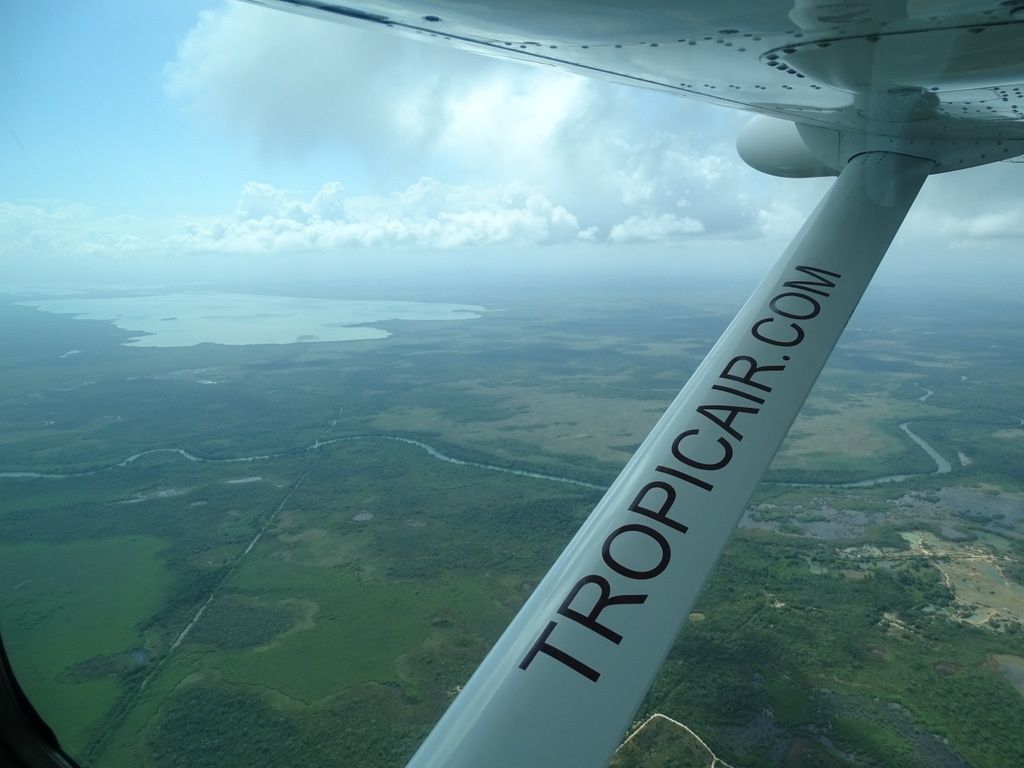
As far as I know Pinder didn’t keep a rod or a reel on his boat. In fact the only fishing gear I ever saw him with was an old buff coloured fly line which he stored wound around an empty clear plastic water bottle of the kind that float in their billions on the streams and currents of the eastern seaboard of America and which seem to congregate in the Gulf of Mexico. There, joined by another huge influx of the same from the Mississippi delta, they mingle along with polystyrene burger boxes, plastic cutlery and a host of other flotsam and jetsam which collects in the huge mats of sargassum sea weed that float around that area to form large plant-plastic composite structures which, if one flies south toward Jamaica or Belize, are visible from the air marring the views for miles around. If you have any doubts about the reality of the much vaunted but less visible damage to the planet caused by such phenomena as global warming or toxic build-up, these rafts of refuse can leave no uncertainty about the amount of plastic we have loosed into the environment in the last five or six decades of our throw-away societies; a truly solid form of carbon pollutant that is set to haunt our grandchildren.
In his off-time, when he wasn’t guiding bone fishermen, which he did most days, or in the evening, when he wasn’t poling his skiff exploring the flats and mangroves looking for fish, Pinder would amuse himself by what we came to think of as rod-less fly line casting. To do this he would moor his skiff at some distant and quiet point of the quay and, after uncoiling the line from the bottle - which, due to the contraction of the line as it dried from its last use, had synched in on the bottle causing it to buckle and so giving it a waist and an ‘hour-glass’ shape - begin a strange dance whereby, after encircling the business end of the line a few meters from its tip with the thumb and forefinger of his right hand, so forming a notional tip-ring, he would begin moving his extended arm in the replicating motion of a fly rod and, having worked out a few more metres of line, he would begin to add short sharp hauls to the dance driving and shooting the line forward in a parody of the perfect fly cast. His stated ambition was to cast the full length of the line which, for this rather whittled and truncated specimen, was probably around sixty or seventy feet; still a pretty fair length even with a rod. I never saw him get close but the overall performance was still pretty impressive but making the characteristics of modern rods and their capabilities pretty obvious.
If Pinder’s rod-less casts had a way to go before they might reach perfection, there was no such doubt hanging over his guiding abilities. On the trip that I am thinking of there were four of us each with a skiff and a guide to ourselves. Jones was an expat Welshman and a horse vet with a practice in Canada; Rosenburger owned a huge chain of DIY shops stateside and Ford was some kind of unspecified executive, all of them had done a good deal of fishing in general and a lot of flats fishing in particular and knew a hell of a lot about bone fish to the extent that they had invested in the ‘Club’ that we were fishing from, a financial arrangement which allowed the local guides to own their own skiffs and kit and to flourish on an international scale and the ‘investors’ a degree of proprietary favour with the fishing. Everyone there knew their stuff but Jones in particular seemed to consistently out-fish everyone else, not in a competitive, show-off sort of fashion, just by hard work and application, what the totally unknowing often call dumb luck but what the rest of us recognise as homework and preparation. When I asked him about his success he gave me one of the flies he was using – dumbbell eyed and tied, he said, with the fur from his yellow Labrador and not a million miles different to my own natural shrimp patterns. I just use these, but then he added, with a kind of twitch in his eyes, Pinder, he’s the real difference, when I come here I want Pinder as my guide and if he is not available, I simply don’t come.
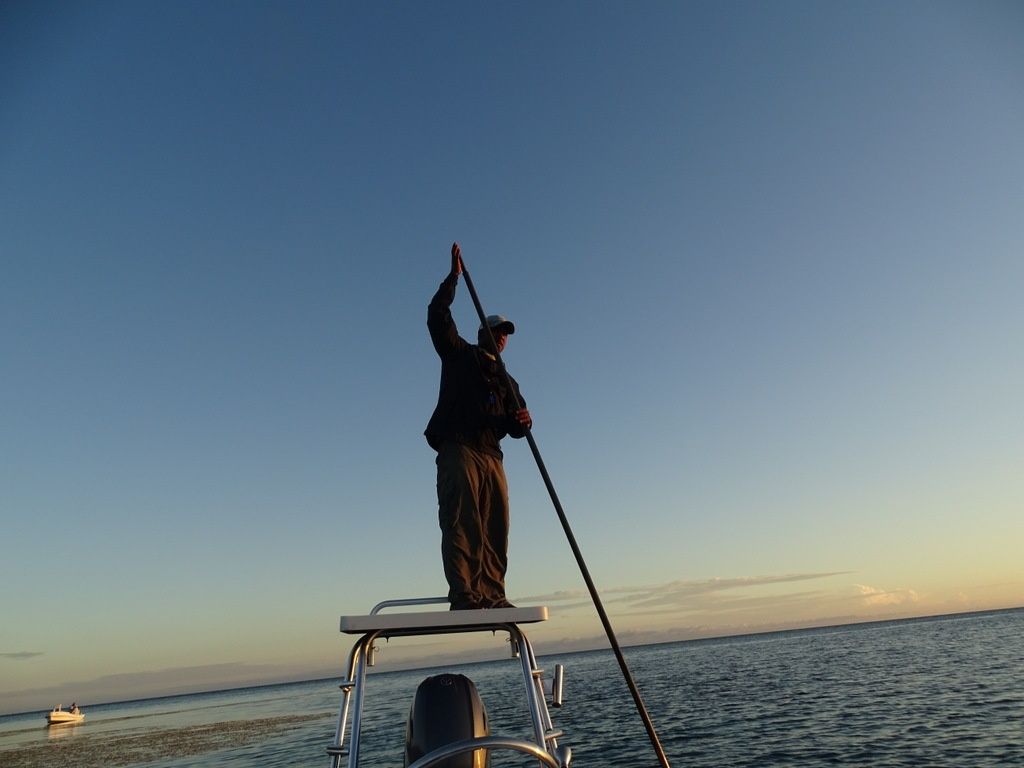
So with one Pinder and four of us, I, at least, felt a little doomed because let there be no doubt, flats fishing, and particularly bone fishing, is highly dependent on your guide. Yes, you deliver the fly and that may occasionally require a longish cast, sometimes in a confounding stiff breeze, although in my experience short-range fishing is as common in bone fishing as it is in any other kind of fly fishing. But as long as you can turn the guides instructions, that may come as something like: bone at ten o’clock, fifty feet, coming in fast – into an accurate cast and get the fly near to the fish without dropping it clumsily onto its head, and especially if you get that fly into the water with a nice clean plop that the bone will detect, and have no fear he will detect it, then you are in with a chance and the fun can really begin.
But the sea is a big place and sometimes simply finding the fish on miles and miles of flat can be a problem. Few guides have Pinder’s dedication to go out in their spare time scouting the water actually looking for fish before their client even gets into the boat. Known as the ‘Ghost of the Flats’ bone fish are perfectly adapted for their environment. I can’t help but think of them as a sort of marine barbel, their flat bellies and powerful fins allow them to rocket along hugging the sea bed; their down-turned mouth can suck up and crunch crabs, shrimps and other crustaceans and their mirror-silver scales perfectly reflect the dappled light of the sandy sea bed or the wavering turtle grass making them nigh on impossible to spot unless you get a hell of a lot of practice, and even then it’s not easy. Remember, fishing from a skiff means that one is casting from a low, flat, platform at the bow of the boat looking obliquely at the water surface; this is usually wind-rippled – flats are breezy places – any clouds in the sky cut out light but also reflect from the water surface – all this makes looking through the water to spot fish almost impossible. So the fish spotting is done by the guide who will be standing five or six feet higher than the fisher; this gives him a much better angle to see into the water. Even knowing where there might be fish, this is still tricky. So it takes a good man to pole the skiff along very gently, constantly scanning the water for signs of fish and, having found one, or even better, a shoal, moving the skiff quietly into place, preferably upwind of the fish and into the sun, whilst constantly telegraphing to the caster the ever-changing direction of the fish relevant to a clock face - which is notionally aligned to the axis of the boat, twelve being the caster and six being the guide - and it’s distance from the caster. These are skills which take some learning.
Pinder was one of the best, and he may still be, although he is of an older generation and this story is set almost some twenty years ago and he may well have retired now. My man was of a younger ilk. I believe that he too is now one of the best – I saw recently that he had won a Bahamian casting competition for guides - but when he guided me, we’ll call him Jack but that is not his real name, had just had what you might call a career change and was pretty new to the game; two weeks before he’d been a bouncer in a cat-house in Freetown! So he had a way to go in the bone-fishing stakes. But lady luck did smile on us and between us we spotted and caught bones even so we never came close to worrying Pinder and the Welshman for numbers of fish in the boat.
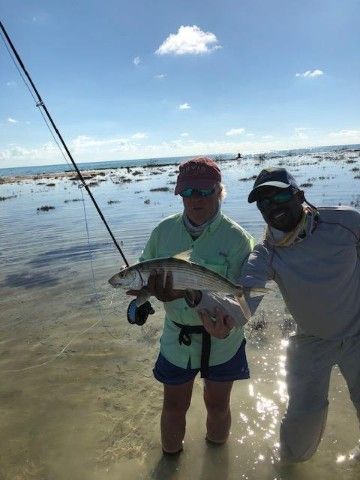
The line between success and failure can be perilously thin and in bone fishing it is often non-existent. One day we were drifting very, very gently along the edge of a mangrove clad mud-bank when we spotted, no more than thirty feet out from the boat at about 3 o’clock, a huge bone, eight or ten pounds easy, nosing along rummaging in the sand. Jack leaned on the skiff-pole and dragged us to a slow halt. The cast was straightforward and the fly plopped cleanly a couple of feet in front of the fish. One short strip and I’ve got the fish’s attention, he starts to move, I can see the sand clouding as his nose moves towards my fly whilst all the time his mouth is working the sand, another longer strip and he shoots forward and eats it. I set the hook and bang all hell breaks loose as he rockets across the bows of the skiff, away from the mud bank across the flat and towards the open sea. The fly line jumps and dances in loose open coils, lifting from the casting deck and flying through my fingers as I stretch out my left – non-casting – hand to clear it away from rod handle and reel either of which it may foul and lock it dead signalling game over. But the fish obliges by pulling out all of the slack and then there is a fierce ‘draw’ as the line tightens, the rod bends and the reel screams. I’ve heard lots of stories where fish are said to run out all fly line and two or three hundred yards of backing; I don’t doubt that some of them are true. Against a tight-set drag, this fish quickly took the fly line and had the gel-spun sliding through the rod-rings as tight as a piano wire which cut a line through the water that sent white spray flying. Not two hundred yards – nowhere near – but a good fifty, yes, two or three cricket pitches, dragging the sunken line. That was enough. One minute the pull was fierce and urgent as the fish flew towards the horizon. The next the hook pulled and he was gone; nothing more than a seconds-long flash and a fleeting memory.
******
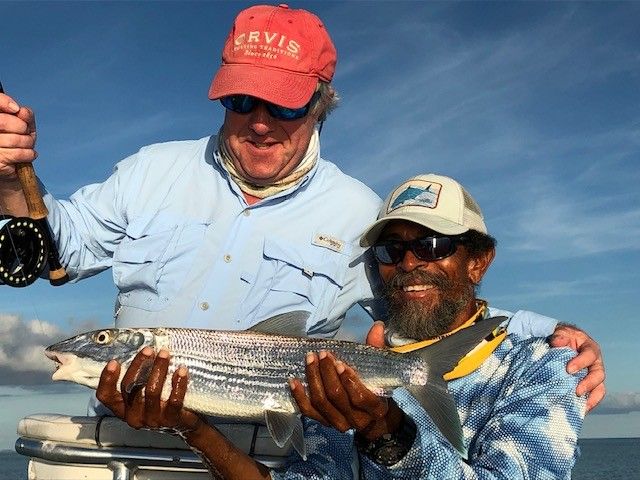
Fifteen years later I’m three hundred and fifty miles south east of Grand Bahama on one of the last tiny islands before the Bahamas peter out towards Turks and Caicos. After too many years chasing trout and salmon in some of the coldest and wettest places on the planet I feel a need for sun and blue skies, sand instead of mud; shorts and cotton shirts rather than wool shirts and waders. Its day one and I’ve already not so much lost, but failed to ‘boat’ three or four biggish bones. I would call it a jinx but the truth is that the new leaders that I have bought especially for this trip are rotten every one, hard to believe but the same story every time: I hook a fish, it runs for the mangroves, I brake the reel and hold him back and ‘ping’ ……. I’m reeling in empty. My boat partner is starting to feel my tension. He throws me a packet of new leaders from a different manufacturer, I re-tie my rig and we start again and at last I boat a fish. Easy. I pose for the trophy shot, our guide holding the fish as if, like the others, it might disappear at any moment - I’d like to know what he was thinking – he is grinning almost as much as me, and so is my boat-partner. The pressure is off - I am back in the game even if not in the ‘groove’.
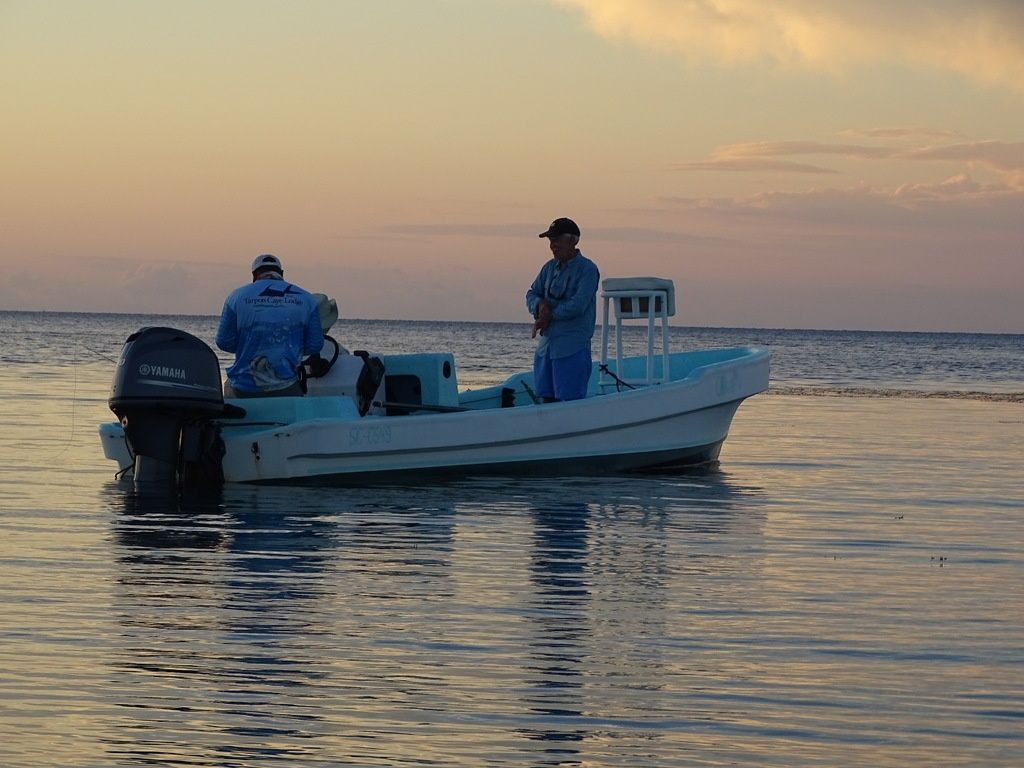
A few weeks later I check into a soulless chain hotel in Miami airport with my son James. It’s ten o’clock at night but, after a long transatlantic flight, our body clocks are set for three in the morning. We are dog-tired to the extent that we can’t sleep; there is no restaurant or bar, just a vending machine in the lobby that eats credit cards and spews tinned beer and Hirschy’s bars. We manage three beers each before we hit the sack only to lie awake in the half neon lit glow of the airport bedroom waiting for either sleep or the annoying chimes of the phone alarms which will herald a set of early flights that will eventually land us in Belize and Tarpon land. Eighteen hours later we sit at a bar on the edge of a sandy beach sipping ice cold Belikin beer waiting for the boat that will take us out to the Quays where we will spend the next week hopefully jumping Tarpon for which this place is famous. The ride out starts gently, a pod of dolphins keep pace with us on our starboard side, their blue-grey back-skin, white-cream bellies, scimitar curved fins and huge eyes all clear in the blue water over white sand. Then they are gone as we accelerate and fly up onto the plane toward a tree line that signals our fishing-camp destination.
That evening we again sit, beers in hand, talking through the prospects for tomorrow with our guide Ernest. The night is clear, warm and still but the bugs are out and as we eventually cross the sand to our cabin we can feel them muzzing around our bare legs. As we climb the wooden steps leaving the sand and the moonlight behind, we can hear the gentle lapping of the waves a metre or so beneath the floor boards, it rocks us to sleep.
It’s the next morning and I’m standing in the skiff watching a huge bait-ball perambulate around the big lagoon behind the cabin and only three or four hundred metres from the shore. Every so often, five or six huge silver fish porpoise, as if clawing their way into the air, hanging momentarily and then smoothly nosing back underwater where, as if by magic, they become invisible only to appear at some other distant point in the lagoon. The smallest of these Tarpon is fifty or sixty pounds, the biggest touching one hundred. As they break the water’s surface and become airborne, their huge silver scales, some the size of drinks mats, glimmer in the morning sun with their overall effect being less that of fish proteins and more like some chromium coated products of the automotive industry. The effect and image is of sleek power; the prospect of hooking one of these fish on a fly rod borders on the terrifying.

James and I take turns on the casting platform in the twenty minute shifts that have become our norm for this style of fishing. After a few hours of casting the powerful twelve-weight rod – three to four times the weight of my normal trout rods - twenty minutes is more than enough. By the end of the week my own casting will be reduced to the forearm only, elbow tucked in as if holding a bible against my side, the way that is still prescribed by some as the perfect style for the dry fly fisherman. This reduced movement will protect my shoulder which will be sore as hell by then and which will stay that way for the next month despite liberal doses of ibuprofen. The flies that we are using are, again by dry fly standards, huge. Tied on 0/2 and 0/4 size hooks adorned with heavy dressings of yellow, red, black, purple, not to mention day-glow chartreuse, or anything else for that matter, they resemble Christmas tree dressings rather fly dressings. These are tied to a 50 lb leader by a loop knot which allows for freer movement of the ‘fly’ than a clinch-knot. An alternative, still attached by the loop method, is an eel like construction made from a soft polymer jelly, and fitted with big dark eyes, known as a gummy minnow. Today we are using the ‘gummy’.
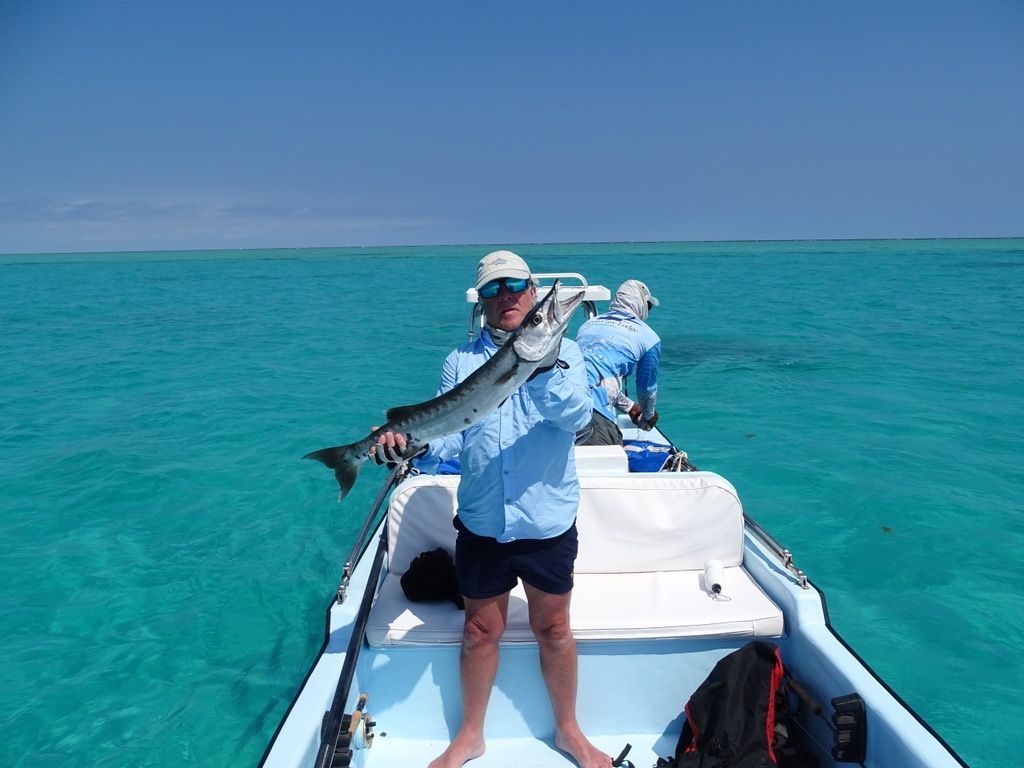
Every now and again, the Tarpon hit the bait ball, stunning hundreds, or maybe even thousands of small fry, which they then hoover up in their gaping and cavernous maws into which one could easily fit a football. Watching this carnage as the water is swept clean of the crippled fry, the thought that our solitary lure is unlikely to attract the attention of one of these virile monsters creeps into the corner of my brain as I complete my session on the platform and hand over to James. During the day we will boat Jack Crevalle, Bonito, Barracuda, Grouper and Boxfish but no Tarpon will take our flies.
The next morning we take a break and head out across the flats making a long run to the next island to try for Bonefish. Mercifully, we shelve the twelve weight rod in favour of two nine weights and break the no Tarpon of yesterday by landing bonefish in an area of flats which borders the biosphere of this island. Despite the conservation area, the foreshore seems littered with beach property plus a heavy sprinkling of restaurants, bars and boat-docks. Coming in too close to the shore adds a holiday atmosphere to the fishing such that, in the early afternoon heat, we moor and head for a bar at the nearest dock. We wander in looking for the barman and find him swinging in a hammock at the back of the property. Back at the bar I order three beers from him and ask if it is OK to smoke a cigar. He grins, pulls out and lights a huge spliff and says ‘sure man, whatever ya want’ and we settle into our beers.
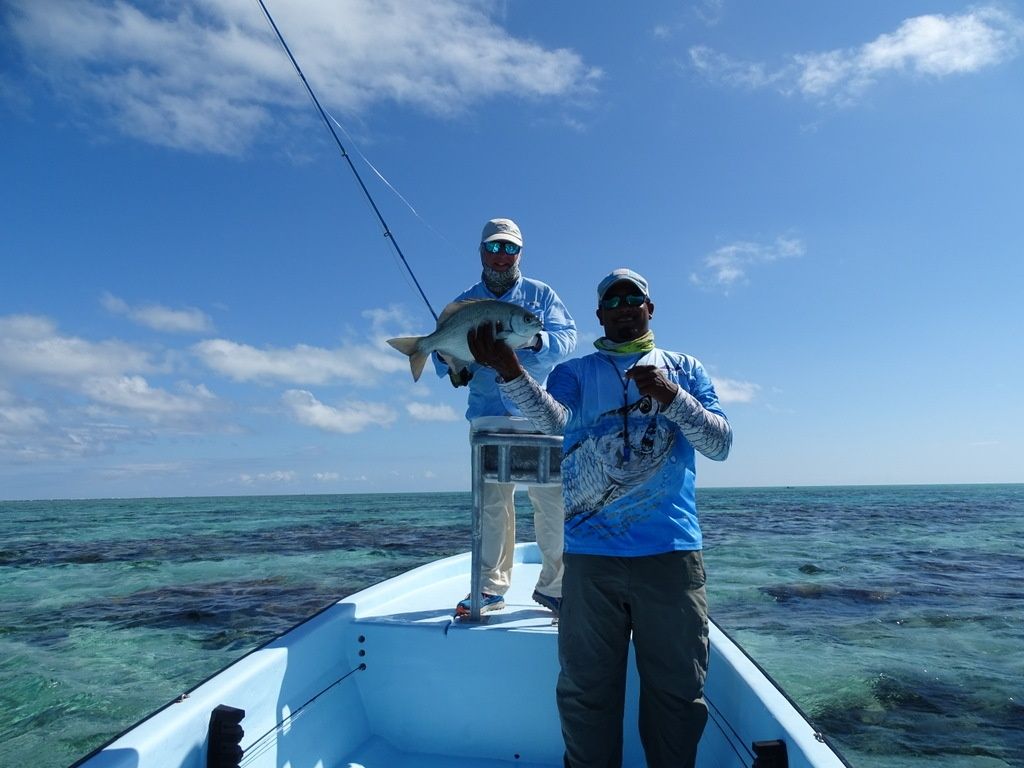
Later in the afternoon, as we run back towards our own quay, we bear away from deeper water to a long strip of reef-flats known to hold permit. It’s not long until we spot scimitar tails waving above water just on the edge of the shallow rocky reef. Ernest cuts the engine and curves the skiff towards the fish coming in downwind and into the sun. We can clearly see six permit nosing along towards us. My turn on the platform, an easy shot, my small crab pattern drops just nice, a little more than a metre in front of the lead-fish. I strip a fraction, little more than a twitch, and the fish just eats the fly, I strip-set and the fish rockets toward us down the side of the boat and into the reef. The tip of the rod bends frighteningly following the direction of the permit into the reef. Then all is solid, the fish has snagged in the reef and I can’t move him no matter how I tighten or slack the line. I know intuitively how this is going to end. But no, suddenly, with one last tightening pull, there is movement and the fish is free, fighting again for it’ all is worth. The nine weight rod bent almost double, eventually the strain starts to tell and the fish gives gently to the boat. Ernest leans overboard and lifts not a permit but a beautiful Bermuda chub into the boat. We are amazed – all three of saw the permit snaffle the crab – I am maybe a little disappointed at its loss but I cannot help but be happy with its replacement, the ‘transformer’ shape-shifting Kyphosus sectatrix especially when Ernest tells me he has never heard of this species being caught on the fly before; we may have a first. We head back to the lodge, if not exactly disappointed, certainly a little confused.