Harvest Merriment and Folk Horror in the English Countryside
How the bright days of summer bring the darkness of ritual, superstition, and folklore to the English countryside.
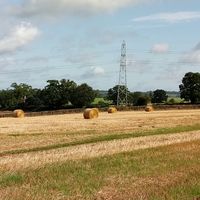

“…let them be merry all harvest-time long” Tusser
August is biting the heels of September, at the time of writing, and the summer has now started its inexorable slide into the mellow days of early autumn.
If June and July are the months when the summer season starts its engines, August is the one where it opens the throttle fully. It’s peak-time for rural tourism, and harvest time for many of the arable crops, that have been ripening steadily during the more verdant and humid, early summer months.
The ‘vibe’ of the English countryside during these often long, hot and dusty ‘Dog Days’ of late summer brings to mind words such as fruitfulness, abundance, ripeness, and so on.
When it comes to the vernacular of the countryside, the English language contains a richness and depth for describing all things rural. This expansive lexicon also gives a sense of the emotional associations we make to the land and its people.
Words like ‘Arcadian’, ‘pastoral’ and ‘bucolic’ fall into the romantic tradition; one which typically sees the rustic way of life through rose-tinted spectacles, where hills roll, lambs gambol, and apple-cheeked children have robust, earthy fun, during summers filled with fresh air and adventure.
Down-to-earth Ma and Pa Larkin-esque figures; designed to give the impression of a folksy wholesomeness, brought about by a life of earthbound toil, are also archetypal of these kinds of idyllic flights of fancy.
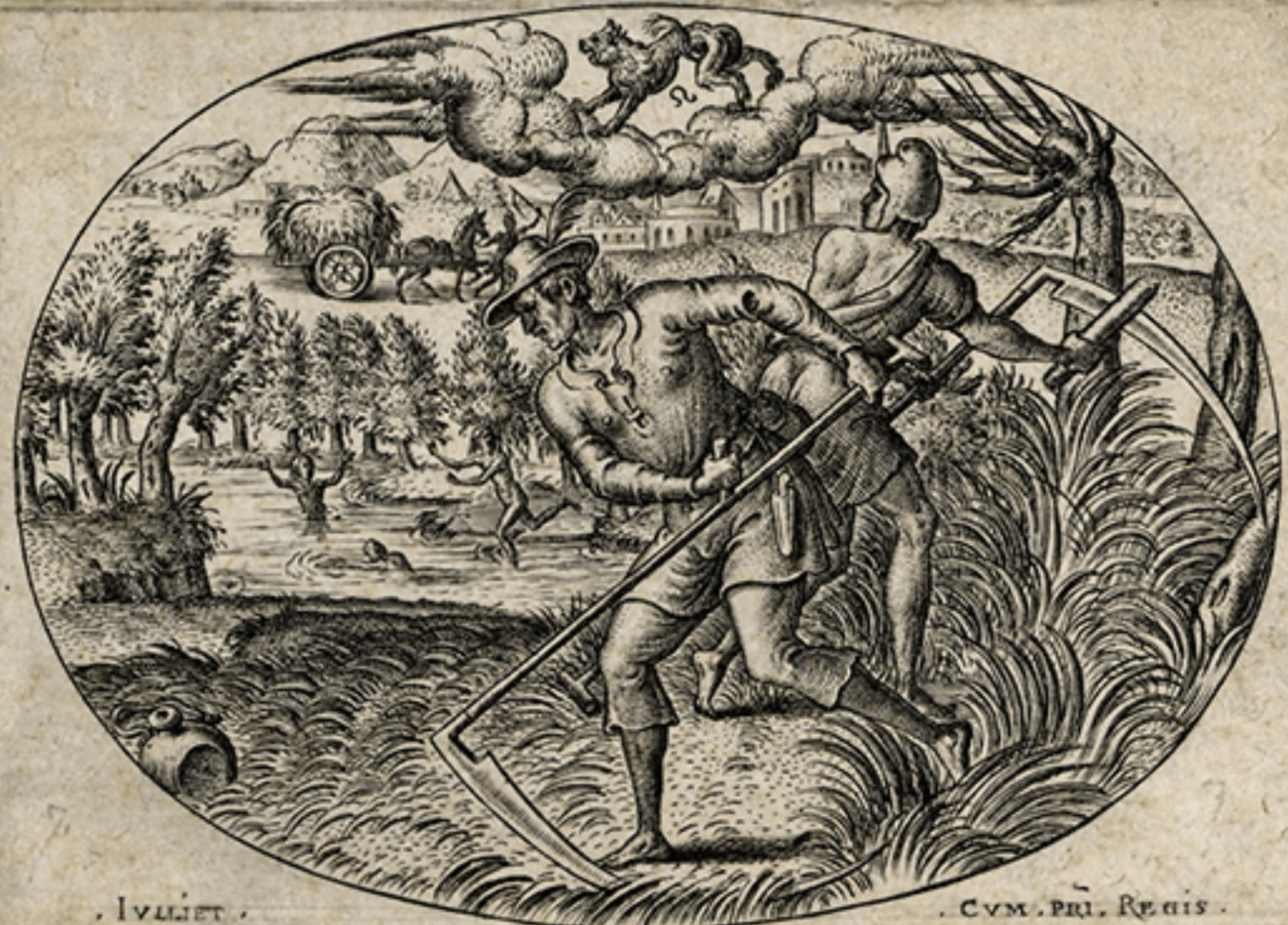
At this bountiful time of harvests, country shows and fetes, your mind is probably far away from some of the more sinister and oppressive descriptors of the countryside; words such as ‘backwater', ‘the sticks’ and ‘hinterland’ which begin to creep into something darker and more forbidding; contrasting somewhat with the warmth and golden light of the season we’re currently in.
But if you allow yourself to wander down those shady linguistic lanes, other words, such as ritual, superstition, and folklore, might also begin to form at the tip of your tongue.
After all, the crops that need bringing in at this time of year have to see the shadow of the reaper and his scythe, before anyone gets to toast a health to the barley mow.
The figure of John Barleycorn is an ancient totem, dedicated to the spirit of sacrifice. Often titled ‘The Corn King’, he is the crop personified, whose job it is to die so that life can begin anew in the agrarian cycle that has sustained most of mankind since pre-history. Over the course of our agricultural existence, and up until relatively recently, it has been common to craft talismans from the stalks and stems of the year’s harvest, to keep and carry over to the next year.
Corn dollies, thought to contain the spirit of the crop, were given safe haven indoors throughout the winter until they could be buried on ‘Plough Monday’ the following year, during the new cycle of sowing, in order to secure the fortunes of the next crop.
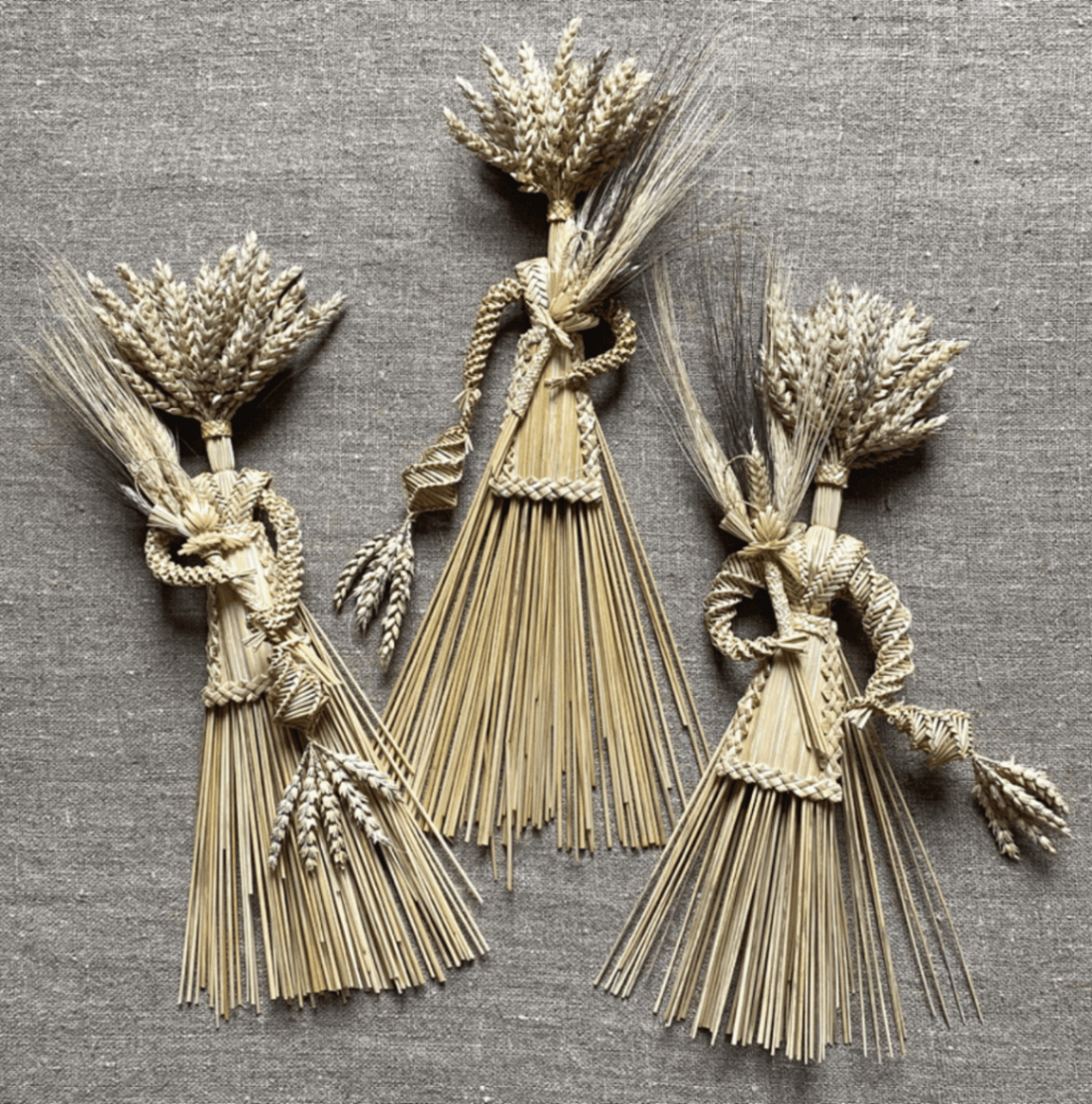
Prior to this more symbolic form of sacrificial amulet-making, it is thought that offerings of a more flesh and blood origin were presented to the old gods, in return for success with the sickle.
Summery execution
The purveyors of any decent folk horror know, and actively lean into, these old tropes of sacrificial harvest rituals. A village’s close community ties, as well as the ossified class structure of Old Britain, which to some extent has been literally set in stone in the layouts of ancient villages and hamlets, where farmstead abuts Manor House, church adjoins rectory, and cottages surround alehouse, also feature as a sinister undercurrent.
In addition to a wealth of adjectives used to describe field and furrow, there is an array of well-worn archetypes, beyond the rosy-hued jolly farmer stereotype, that are applied to rural folks, acting as convenient shorthand in dramatic depictions, or for poking a bit of fun in their more comedic representations (we’ve all seen the big-eared boys on farms, etc).
Many of these less charitable depictions of country types can often be traced back to the febrile imaginations of people who view the countryside more as a recreational playground full of charming fauna and pretty golden fields, than as a dynamic, working landscape; shaped and maintained through the active management of folk who’ve long drawn their living from understanding its rhythms.
The Disneyfied version of rural life getting sullied by the less romantic realities of animal husbandry, food production, and pest and predator control bites hard for these guys, who appear to take their cues about farming and land management from ‘The Tales of Peter Rabbit.’
In their imaginings, the green and pleasant land, to which they mainly flock for weekend walks, is broadly populated by bloodthirsty toffs, and their hard-bitten gamekeepers, whose pedigree names read like a What Three Words location, and whose faces resemble a map of the London Underground, sketched in spidery broken capillaries, and who would like you to get orf their land.
Or by gouty and dyspeptic, shotgun-toting old farmers, much like famous agriculturalist, and walking advert for Allopurinol, Jeremy Clarkson; who would also like you to get orf their land (unless explicitly invited onto it)
Then there are the ‘locals’; those denizens of small, closed-off communities with small, closed-off minds, many of whom may be blood relatives, who openly display an innate distrust of (if not a downright hostility towards) the ‘outsiders’, who invariably don’t understand their ‘country ways’. (This latter trope having been most notably invoked to comedy perfection in The League of Gentlemen’s murderous shopkeepers Edward and Tubbs, with their “local shop for local people”.)
The fiends in the furrows
Now don’t get me wrong, I think most of these depictions are wildly exaggerated grotesqueries, but they are arguably aggregated around some small nuclei of truth. Though caricatures, folk like these do exist in isolated pockets of the country, I’ve met some of them! But it’s the idea of these characters being a widespread reality which has given rise to a mythology of pastoral weirdness which, when coupled with notions of rural hostility, hands down a received wisdom about the countryside, often leading to most of its inhabitants being pigeonholed into these clumsily sketched stereotypes.
It’s true that we have in the past been famed as a nation of eccentrics, with many of our more quirky pastimes taking place in the pastures of Deep England. This in turn has gifted us with our own distinctive brand of rural strangeness, much of which revolves around themes of harvest, hunting, and sacrifice, and the peculiar festivities we’ve created to celebrate them.
Now hugely popular, the term ‘Folk Horror’ (a previously niche subset of literature, T.V, and film) covers a broad and fairly nebulous category of pop culture, where all of those neuroses, and the unease which the agrarian life strikes into the heart of modern, urban man, is evoked for thrills.
A typical plot device in this genre usually revolves around having a couple of oblivious urban rubes drop into these landscapes, where the past refuses to stay buried, and there’s more than a suggestion that the future fertility of the land is only guaranteed by the spilling of blood. Usually theirs.
There’s plenty of fear in the fens, badness on the broads, fiends in the furrows, and menaces on the moors for the incautious townie, who blows-in to the countryside in pursuit of quiet leisure, unaware of the dark underbelly of ‘old ways’ and archaic practices; “the pattern beneath the plough” as it were, which long ago wove together the threads of rural life.
Nowt so queer as Folk (horror)
As a turn of phrase ‘Folk Horror’ is said to have been coined back in the dim and dusty early 70s by a critic who, charged with reviewing a key and arguably foundational work in the canon: ‘The Blood on Satan’s Claw’ came up with the term. This is a film in which the plough literally does unearth a long-buried evil, which afflicts the inhabitants of the surrounding settlement in some truly grisly ways.
The term was later revived as a descriptor in the 2010s by Mark Gatiss (of previously alluded to ‘League of Gentlemen’ fame) who, in his ‘History of Horror’ nominated this film, together with two other iconic theatrical releases: The ‘Witch-Finder General’, and ‘The Wickerman’ as being the lynchpins of an unholy celluloid trinity, representing the birth of this genre.
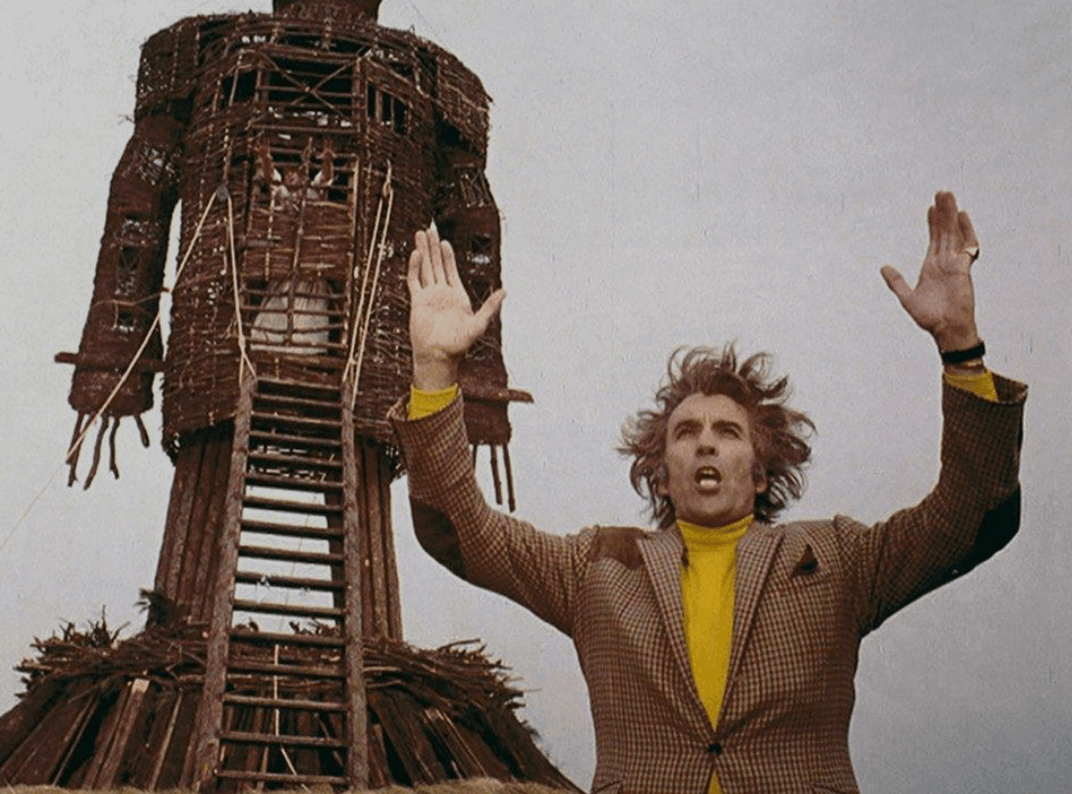
Unlike more standard horror flicks, where the mood is set via the pathetic fallacy of bare winter trees, stormy weather and a general sense of seasonal drabness, the folk horror habit is to jarringly place all of the unsettling paranoia and disturbance in a context of summer sunshine and fruitfulness. It heightens the fear and confusion to have the weird and uncanny aspects of ‘The Olde Ways’ playing out to a backdrop of birdsong, wildflowers and rural idylls. In folk-horror land, this might necessitate a procession of mask-wearing villagers chanting ‘Sumer is icemen in’ as the sun sets on a scene of bucolic beauty, which invariably signals that someone isn’t seeing the sun rise again, as infamously demonstrated in The Wickerman.
Summerisle, both the name of the fictional island and its eponymous gentry, where Wickerman events take place, demonstrates the sunshine season being unsubtly invoked as central to the community’s ceremonial practices for guaranteeing the soil’s fecundity.
Ari Aster’s ‘Midsommar’ is another fine, yet terrifying, example of the use of this season’s unsettling and claustrophobic tendencies to render the horrors of the midsummer festivities, around which the plot revolves, all the more troubling.
Midsummer as a calendar date has long been depicted as a time of high eerie in the English countryside. The Perpetual Almanack of Folklore cautions its readers on the eve of this day to: “protect [their] houses, byres and beasts against fairies and evil spirits…” as they abound on this night, as it’s alleged to be “the most uncanny and dangerous of the year”.
Midsummer madness
Also known in antiquity as Johnsmas Eve or St John’s Night, in many rural areas the superstitious custom was to build great pyres on hillsides as the sun set, to ward off any phantoms or sprites, who may be lurking with ill-intent. It’s still common to see old cottages with a shrub or two of the St John’s wort growing nearby, as a botanical insurance against the evil eye. On Midsummer’s day, you’d have been well advised to turn your coat inside out, in order to avoid being led astray by Robin Goodfellow, that mischievous puck who rides high on the season’s heat-induced delirium.
Another source of harvest-based anxiety comes in the form of crop blights; specifically ergotism, which has been known in times past to cause mischief among rural populations. Usually brought about by damp conditions at the point when the head of a grain crop is ripening, or from too aerobic conditions in grain storage silos, this fungal imposter has been held responsible for inducing population-level hallucinations and hysteria.
An outbreak of it has been posited as the most likely cause of the mass-hangings and burnings of suspected witches, during the Salem panic in 1690’s America. We take for granted nowadays the high cost and energy intensive methods for grain drying that growers use, often leaving them out of pocket at the end each harvest, to avoid this sort of crop-ruining catastrophe. Maybe the real horror story here is the little return most farmers see for the Sisyphean task undertaken to raise a crop each year, in the face of ever-increasing production costs, climate instability, and yield prices that have remained near static for the best part of two decades?
Reaping what you sow
The tools of the harvest probably bear some responsibility for their associations with horror and calamity, which characterises a lot of anxieties, old and new, surrounding the harvest season. The sickle, pitchfork, and scythe have all been appropriated as symbols of either disastrous communalist agricultural policies, village vigilantism, or death itself, respectively, so it’s little wonder that the sight of them can summon an involuntary shudder.
Modern equipment, while probably having a slightly lower injury rate per usage, though being no less lethal, can still strike fear into the hearts of many of us of a certain vintage. Anyone who attended a rural primary school in the 70s and 80s, would more than likely have been made to sit down and watch the public information film ‘Apaches’ every year, in the week leading up to the summer holidays. I’m sure this was done as a well-intentioned insurance policy to secure our safe return to the classroom the following academic year, but such endeavours have spawned entire bodies of work dedicated to the lifelong negative impact these warnings engendered in their tender-aged viewers.

It’s not all doom and gloom, though. Harvest time in days of yore was usually greeted with excitement and good cheer. In his superbly researched 1950’s book titled ‘Ask The Fellows Who Cut The Hay’ famed folklorist George Ewart Evans details the pre-mechanised modes of crop-gathering, recalled during interviews with retired old farm workers employed in the late nineteenth, and early twentieth century.
In the chapter entitled ’Taking The Harvest’ he states that: “Under the old community the harvest was the climax of the year, not merely an incident in the more mechanical and depersonalised round on the farm as it has become today.”
It sounds like, for all the endless toil required to bring the crops in, a merry old time was had by all. Typically, such a gargantuan task, coupled with a short window of opportunity, would require the efforts of the whole village. The term ‘taking the harvest’ refers to a formal process, whereby the workers from every farm in the locale, plus any seasonal workers of more temporary residence, would meet in the kitchens of each farmhouse to agree a contract of work. In many cases this would result in an agreed period of “twenty four fine days” the wording allowing for any period of inclement conditions to stop work without affecting pay. In addition to a wage, each man or boy would be granted an allowance, which would usually take the form of a Coombe (four bushels) of wheat at a reduced price, a free bushel of malt (most households engaged in home brewing) and a few pounds of mutton each week.
The workers would elect a man to negotiate the terms and conditions of the contract, and he would be known as the ‘Lord Of The Harvest’, becoming for that short period of time the most important member of the community. He would usually have a second in command, referred to rather whimsically as the ‘Lady Of The Harvest’.
The signing of these contacts, and the settling up process at the end, after the contract had been satisfactorily fulfilled, would result in festivities known as ‘Harvest Frolics’. The second frolic, marking the end of the harvest would be funded by the ‘largesse’ collected over the course of the harvesting period.
“Crying Largesse’ as it was known was a custom with roots in antiquity. Shakespeare’s contemporary Thomas Tusser wrote in his ‘Five Hundred Points Of Good Husbandry’ of 1573:
“Grant harvest lord more by a pennie or twoo
to call on his fellows the better to doo:
Give gloves to thy reapers, a larges to crie,
and dailie to loiterers have a good eie”
In a ‘Letter from Norfolk’ dated 1826, the unknown author writes:
“It is general practice on the first day of Harvest, for the men to leave the field about four o’clock and retire to the alehouse, and have what is here termed a ‘whet’; that is a sort of drinking bout to cheer their hearts for labour. They previously solicit any who happen to come within their sight with, “I hope, sir, you will please to bestow a largess upon us?” If the boon is conceded, the giver is asked if he would like to have his largess hallowed; if this is assented to, the men all “holler largess” at the tops of their voices.”
The women and children of the vicinity would be employed as ‘gavellers’ and ‘binders’, where the cut crop would be raked into rows, and bound into sheaves ready for ‘stooking’. The smaller children would sometimes be given sturdy sticks with which to patrol the fields for rabbits. Any bunnies caught fleeing the scene would be treated to a swift bonk on the bonce, and would go to the pot as an added harvest bonus.
Women and children (usually girls as the boys were considered too roguish for such work) would often also be tasked with the process of ‘gleaning’ once the harvest had been brought in. In Ewart Evans’ book, where events take place in the Suffolk village of Blaxhall, it was customary for the local church sexton to be paid a few shillings extra to ring the bell at harvest time; once at 8am then again at 7pm, signalling the window of opportunity for the gleaners to gather the fallen grains from the fields, once the crop had been cleared.

Use your loaf
August 11th in the old calendar marks the eve of the Celtic celebration of ‘Lammas’ - Loaf mass, the start of the harvest season, since moved to the 1st day of August. You should start seeing the Harebell, or ‘Harvest Bells’ growing wild now. Considered unlucky to pick, these pretty wildflowers have an association with the mystical hare. This time of year often brings the added headache for farmers of hare-coursing, which can render large swathes of arable crops un-harvestable, as the sighthounds which pursue their quarry are often followed at high speed by the ‘longdog’ men’s cars, irreparably damaging and flattening the ripening grain. This particularly ugly form of rural crime has seen a spike in recent years, piling more stress and worry onto a situation already dogged by the expense and uncertainty brought on by the vagaries of the English weather, and temperamental farm machinery.
On a more upbeat note, you can look forward this month to wild blackberry harvesting, if you haven’t already begun, as well as damsons, plums, and the first of the autumn raspberries and winter squashes coming into season.
The 24th brings the feast of St Bartholomew, or Bartlemas. He is the patron saint of butchers, tanners, and leather workers. Since he was apparently martyred by being skinned alive, this seems like a fitting tribute, and a reminder that things could be worse!
It’s usually about now also that the first chill of autumn can be detected in the air, so enjoy the last of the summer’s warmth, as the dog days are nearly over.
Happy harvesting!