Hounds or Rifles: Which is more Humane?
Deer don't die from being hunted by hounds - if they escape, they recover quickly. Shooting may be quick, but no matter how good the marksman, there is always a risk of wounding.


The recent Position Paper by the British Deer Society on hunting deer with hounds is a bit of an own goal. Although Bateson and colleagues measured haemolytic changes in chased deer and declared hunting stressful, they failed to demonstrate cause and effect, that these changes result in long-term stress or deaths. Cortisol levels and capture myopathy are an uncertain science. Despite the blood chemistry, hunted deer that escape are not found dead the next day and carted deer survive for many outings. Some of these deer, such as ‘Compton’ in the 1790s, became famous for the repeated runs they gave. The reality is that chased deer do get tired and do show changes in blood chemistry, but they don’t die; they recover quickly, and, more to the point, they recover completely.
Shooting, however well it is conducted, always has a wounding rate. Bateson and Bradshaw measured blood cortisol levels in both hunted and ‘clean-shot’ deer and rightly concluded that hunted deer were more stressed. It’s not surprising that blood parameters change during exercise; that is well known. Their study was valid within the limited scope they set themselves and has been taken as a vote of confidence for shooting. To some extent you can design a study to prove anything you want. Their study was flawed because it did not put their findings into a perspective. You cannot extrapolate from their study and say ‘Hunting bad, shooting good’. They measured the blood parameters in clean shot deer and, unsurprisingly, the results were ‘normal’ for a resting animal. But they didn’t measure the same parameters in shot deer that had escaped wounded. Had they done so, it would show a very different story. They looked at one parameter – pursuit stress – without examining the other one – wounding rates.
In a later paper (Welfare aspects of culling Red Deer Cervus elaphus) they claimed: 'Extensively hunted deer did not differ from severely injured deer in measures of muscle disruption: in hunted deer measures of red blood cell damage and psychological stress were higher. Hunted stags killed during the rut showed markedly higher levels of measures of blood and muscle cell disruption, psychological stress and fat reserve mobilization than stalked stags killed during this season. Estimates of wounding rates by stalkers showed that 11 per cent of deer required two or more shots to kill, 7 per cent took 2—15 min to die and 2 per cent escaped wounded.'
What they don’t take into consideration is how long these wounded deer survive and suffer. Longer term stress, such as wounding or maiming, is far more significant than short term physical tiredness. The Natural England 2003 Report on Current and Future Deer Management Options https://www.yumpu.com/en/document/read/11535614/current-and-future-deer-management-options-natural-england concluded that of 70,000 – 100,000 deer shot, about 2% escaped wounded. These were ‘own data’ from the deer shooters themselves; other estimates on deer and elk show wounding rates of 10-30%. The 2017 BDS Training Manual states ‘As an indication of acceptable standards, 95 out of every 100 deer fired at should be “killed outright” ie be “brain dead” in under two minutes’.
Current estimates of the national deer herds total 2 million, with up to 750,000 needing culling this year. That could mean 15,000 walking wounded deer in a best case scenario. Yet not culling is not an option either.
Hounds reduce suffering
Looked at from this perspective, hounds are clearly far more humane than rifles. Hounds have a zero ‘escaped wounded’ rate. Further than this, about 28% of the deer caught by the staghound packs were injured in some way, mostly through traffic collisions. Of this 28%, 20% had gunshot wounds. The hounds did a huge service in reducing this suffering. This is important.
It is easy to imagine that all shooters are as conscientious as the members of the British Deer Society. Sadly, not everyone is. When I lived on the Quantocks many years ago I twice found the remains of poached deer – heads, feet and gralloch, left by lampers. Here in west Wales more recently we had two sika stags appear on the farm. I was happy to see them and let them be, but they didn’t live long before our neighbour shot them both with a 12 bore. As Shakespeare wrote: ‘When night dogs run, all sorts of deer are chased’.
A study of wounding rates with rifles
We did a study on Wounding Rates in Shooting Foxes in 2005 https://www.cambridge.org/core/journals/animal-welfare/article/abs/wounding-rates-in-shooting-foxes-vulpes-vulpes/BB80017CB323E5C08259F1D574AF5327 . Further details can be found here: https://www.falcons.co.uk/wp-content/uploads/2019/12/Wounding-rates-in-shooting-foxes.pdf There were significant wounding rates with the rifle regimes shooting at static ‘foxes’ and the various shotgun regimes exceeded one wounded fox for every fox shot dead. While there are some skilled and judicious ‘marksmen’ (97% of firearms certificate holders are male), shooting has a measurable wounding rate however well it is conducted.

Australia, which has massive pest species problems, has looked into the wounding issue more closely than we have in Britain. (for example Sharp, T. and G. Saunders. 2011. A model for assessing the relative humaneness of pest animal control methods (Second edition). Australian Government Department of Agriculture, Fisheries and Forestry, Canberra, ACT. Printed by: New Millennium.) The RSPCA in Australia have come out against the use of shotguns because of wounding rates in waterfowl and bird shooting. There is a big body of research into wounding rates.
Bradshaw and Bateson went on to say: ‘Overall, we judged that the welfare costs associated with hunting red deer were higher than those associated with stalking,...’ I don’t accept this statement because of the length of time a shot-wounded animal suffers – days or even weeks. But in a real world it is probably impossible to improve much on a 2% wounding rate. An alternative is some kind of hybrid activity, for example a stalker having a dog that is not just capable of tracking a wounded deer, but is capable of bailing it up even if it is one of the 2% that has run a long way. Another approach, in use with roe deer and with fox gunpacks, is to find and flush the deer using hounds and have waiting guns shoot them. The problem with this is that it is not humane to use shotguns for larger deer, however large the shot size, and using rifles on moving targets is not wise either.
How to improve welfare in hunting?
Bradshaw and Bateson concluded: ‘… reducing the welfare costs associated with hunting was much less feasible than reducing those associated with stalking’. Rising to the challenge of reducing welfare costs associated with hunting with hounds, perhaps we can learn from our ancestors, such as as Gaston Phoebus and William Twici , who hunted before firearms, long before Beckford appeared on the scene. Just as now, they used lymers, talbots or what we now recognise as bloodhounds. These low-scenting hounds found and raised the chosen deer in the same way that tufter staghounds do now. But instead of laying on a whole pack of staghounds, as hunting was before the ban, they uncoupled some fast gazehounds – various types of large greyhounds, refined into the Scottish Deerhound and the Irish Wolfhound. These are capable of outrunning the deer in a much shorter distance than the modern staghound. In this way they could hunt the deer effectively without too long a chase and with no risk of wounding. Maybe we need to think outside the box and adapt a little?

Bow hunting
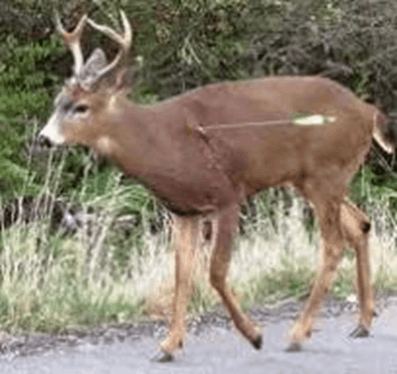
In the 1950’s I used to watch people practising with the long bow near our village in Cranbourne Chase. I loved the romance of it, the gleaming yew bows, the arrows speeding down the woodland rides. We’d be inspired to make our own bows out of coppiced hazel. Hunting animals with a bow is now illegal in UK but it has a strong following in North America. The ethos behind this is that it takes a lot more skill to hunt with a bow than with a gun. For sure, some bow-hunters then back-pedal and use every possible gizmo and aid they can, but bow-hunting is still not easy. Bows swing the balance more in favour of the prey. The problem is though, that arrows are not very humane compared to a rifle bullet. It is very hard to kill an animal stone dead on the spot with an arrow. It was this welfare issue that led to the bowhunting ban in UK in 1965.
Deer as pests
The difficulty is that deer stand at the crossroads between ‘game’ animals hunted recreationally and ‘pest’ animals killed for ‘management’. By relegating deer from the status of ‘game’ managed by the whole community, to ‘pest’ managed by individual shooters, the door is opened to all sorts of inhumane practices. Pests have a hard time. The International Humane Trapping Standards set a very low bar for fur-bearing animals (stoats!) and as far as rats are concerned, just about anything goes. Deer numbers have exploded in recent years and in some places the deer are treated as vermin, hunted with thermal imaging scopes and their worthless corpses left to rot. Efforts are being made to expand the venison market and I am sure there are conscientious stalkers who achieve a high kill rate; if an animal is wanted for its meat, or for its head, there is a motive to find the carcase. But once relegated to the status of ‘pest’, the objective is simply to kill the animal, one way or another. This is where welfare issues creep in.
In recreational hunting, the aim is to maximise the ‘man/days’ of hunting and minimise the kill rate, keeping the two in a fine balance. In pest control the opposite pertains: minimising the man/days and maximising the kill rate, keeping the two in an economic balance.
For myself, I back natural hunting methods every time. Apart from house cats (which are another story) natural predators, such as hounds and hawks, do not wound. The prey is either caught and is quickly killed, or escapes unscathed, resuming normal behaviour very quickly. The prey has the chance to use all its evolved skills to elude the predator and one gets a fascinating insight into these natural predator-prey relationships. Of course the burgeoning British deer numbers could never be controlled solely by hounds, but shooters should be modest in their claims for comparative humaneness. At the very least one should have one or more dogs on hand capable of finding wounded animals.