How do salmon survive in small spate rivers?
The success story of a small river in Northern Iceland where one man controls the whole system and how he brought it back to life.

The regeneration
Seven years ago, when Teddie negotiated a lease with three farmers of a small seven km river in Northern Iceland the run was down to around ten fish, and salmon were nearly lost from the catchment. Different from many of the UK rivers water quality and temperature were not the problems. The question was simple – How do we help the fish? A straightforward question I think we sometimes forget.
His first action was to check how we the fishermen are part of the problem. Immediately he introduced catch and release and no worming or spinning.
Secondly, he set about predator control principally around mink and seals. Since most of the fish are concentrated in just ten small pools the parr and smolts are particularly susceptible to attack. Note there are no otters in Iceland, the mink being an invasive species, a relic from previous fur farms. Interestingly, the kelts stay under the ice all Winter in these pools and apparently, mink are capable sometimes of finding access via an airlock to swim down and take chunks out of the torpid creatures.
Seals are a problem since the small river has no estuary as such, it simply spills into the open sea, and seals hang around at high tide in August and September. As usual with natural predators, it is the final straw in an already depleted resource that causes the problem.
With human and animal pressure reduced, there was an urgent need to increase the amount of parr in the river. The next step may be considered controversial by some but as I said at the beginning of this article we need to help the fish. Some fish were stripped of their eggs and milt, which were mixed together in a bucket, and placed in gravel above a natural waterfall barrier, increasing the overall spawning area and reducing competition among the fry and parr.
The result after seven years is a run of approximately one hundred salmon and according to the Government fisheries department, based on water capacity, a small surplus can now be harvested due to the fact there will be too much competition both in spawning terms and the amount of food available to the fry and parr. Note this is a very small river and it is estimated only fifteen quality hens are required to keep the population sustainable.
How it sustains life
When you first come across the river you cannot believe it can hold fish of up to fifteen pounds. In fact, standing at the river mouth in the summer you would question if there were a river there at all.
However, last week we walked and fished the whole seven km in one day and got to know and understand its secrets and its unique ability to sustain life.
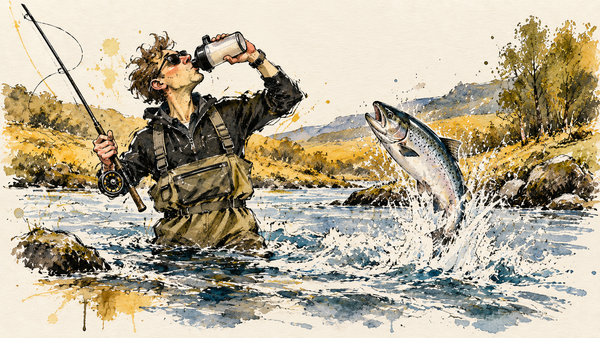
The first pool we came across was shallow with little flow and no obvious salmon lies. “Cast across to the grass bank opposite,” said Teddie in a window no more than four feet wide. Sure enough, a salmon of about 8lbs leaps out and takes the fly. It was followed by three more and then it all went quiet. Walking across the river we looked at the grass bank and the deep undercut which gave the fish the sanctuary they needed to survive only one km from the sea. No undercut and there would have been no fish.
There were no more grassy banks as we walked upstream as it became increasingly rocky and as we checked each pool it soon became clear that without the pots below the waterfalls, there would be no capacity to hold fish. Rich dark and hidden oxygenated water. Somewhere to wait it out for further rain and spawning time. Most of the waterfalls were the result of a hard volcanic dyke cutting across the valley and in one series of three pools, each only a rod length square were half a dozen fish. The two deepest pools each had large overhangs and you could look down and see the black volcanic gravel cleared of any algae by the constant movement of the salmon jostling for space in and out of a large protective rocky overhang. But perhaps the most extraordinary pool was a mere four-foot by four-foot of one-half boiling cauldron and the other half a slower back eddy. In between with a weighted monkey fly we hooked three fish. The ability to survive there, the speed to see and take a fly, and leap out of the water was amazing. But then, these fish are survivors we just need to give them a helping hand.