Overcoming Bias: Balancing the Discussion on Gamebird Releases
Debunking the myths of gamebird management and its effects on the countryside is difficult in the public forum.


It is right that a civilised society reflects on all its activities including shooting, but it is equally vital that any reviewing body delivers balanced and evidence based decisions. Currently though, it is increasingly difficult to know who is or isn’t biased, and whether or not there are alternative agendas. You may be aware that last year, as a result of the impact of Avian Flu, DEFRA performed a number of risk assessments. One of these considered the release of gamebirds from the standpoint that it might impact our wild birds. Our sector was given a matter of hours to review the multi-page document before a brief consultation. It was very uncomfortable reading for a number of reasons, but principally it gave zero consideration to the benefits of game management.
It must be difficult to govern a population of 60 million, the world is undergoing so many changes, and at such a pace. Adding to the pressure, keyboard warriors have become almost tribal, waiting for the next national outcry to feed on, pressurising the uncertain into seeking salvage on one side of an argument or another. Polarisation is endemic, turbo charged by social media. Individuals and institutions can tumble in days.
Organisations and political parties are vulnerable, and they have to be vigilant. Tragically our tranquil countryside hasn’t escaped this, and it is instead becoming a battlefield between town and country. This division is detrimental on so many levels, so it is infuriating that some seek to gain popularity by sensationalising our activities, for example: to drive a relatively naive reader to believe that it is best for the countryside that driven game shooting should be stopped. Individuals and pressure groups often inflate issues that generally that aren’t of much interest to the general public to serve their own purpose. It seems that the RSPB and Wild Justice for instance, rely on this practice. They use emotive words to embellish their headlines, which are an obvious ploy to increase financial support. How else can they continue to fundraise without damming stories?
With this in mind I thought it might be interesting to focus on a couple of topics that get thrown at us; and consider just how can we protect ourselves?
Firstly, for decades the table has been set against us, the Walt Disney backstory that “The hunter is always the bad guy” is now firmly imprinted in the general public’s subconscious, which has been convenient for our detractors to build on. To enhance their story, such authors then choose emotive words such as “Non-Native” when referring to pheasants for instance, and go on to explain that the millions of game birds that are released have a damaging impact on our countryside.
So, let’s start, with Non-Native.
Arguably pheasants were introduced to the UK by the Romans with their campaign into Europe 2000 years ago. There are however more substantial records that show that pheasants became “naturalised” in Great Britain around AD 1059. Certainly whether it is 1000 or 2000 years of environmental impact that pheasants have imposed on us, it clearly hasn’t led to a widespread negative footprint, on the contrary, gamebird management has fundamentally shaped our countryside for centuries. If you were to consider that in 1970’s for instance, farmers were being paid to grub out hedges to make larger, more efficient fields, our valued gamebird ultimately helped to maintain our ancient landscape and the countryside would look very different today without its influence. It is difficult to imagine a traditional country scene without the splendour of a cock pheasant and his harem. In fact it is a ubiquitous image in many a household shop, on a cushion, curtain, dish, painting or postcard.
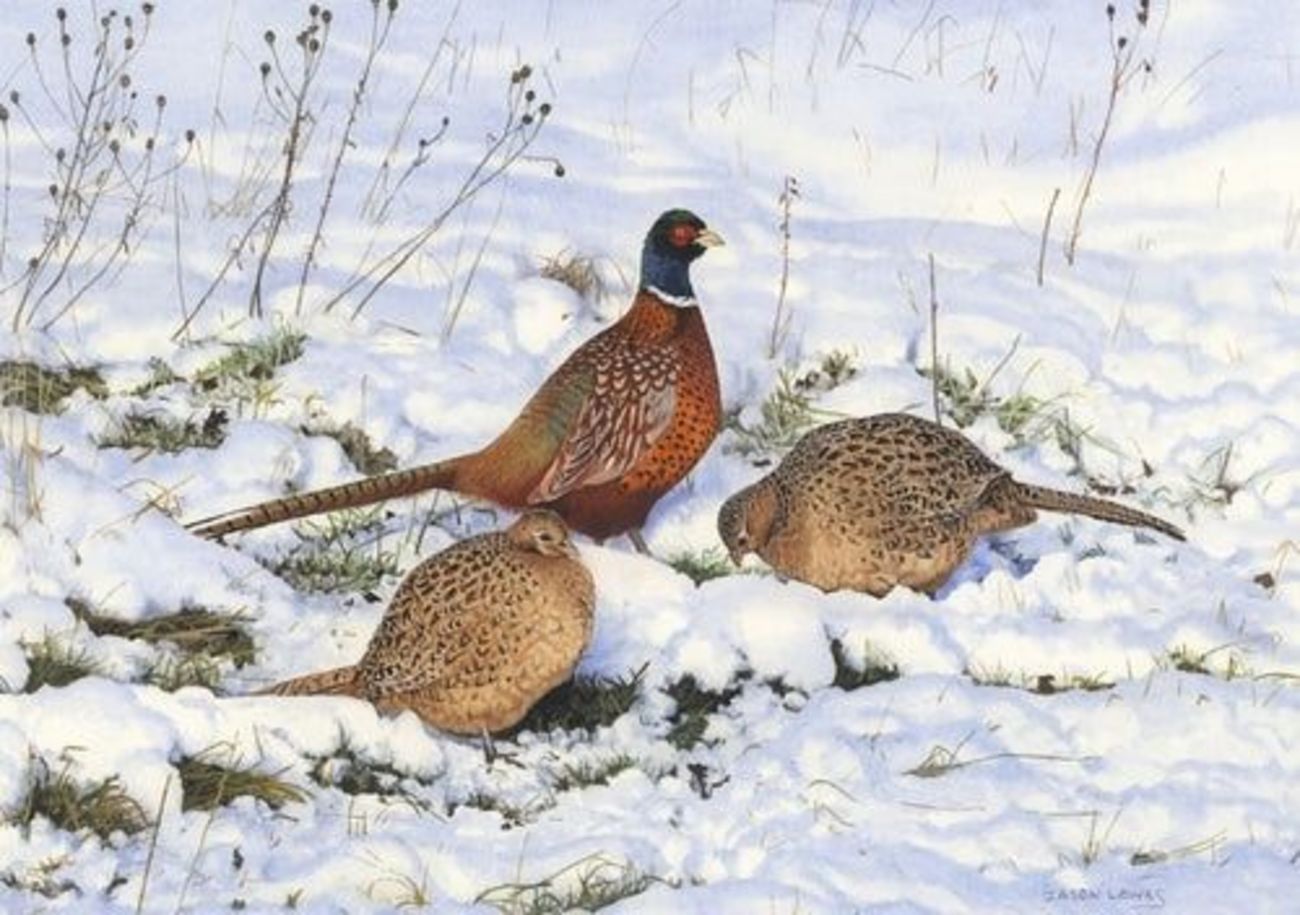
At what point can we say that it has been adopted by the British public because it clearly has. We are not talking about an invasive species that is damaging in the way that signal crayfish, or grey squirrels are. So, whilst it may not be indigenous, it is wrong to suggest or imply as they do, that it is an invasive non-native species in the UK, the humble pheasant fulfils all the criteria to be called a naturalised species and that is how it should be described.
The impact of the millions?
It is very difficult to say exactly how many birds are released in the country, for obvious reasons, but I believe it is significantly less than the 50 million often bandied around. Work is continuing on refining these figures. Certainly, our sector along with every other, needs to reflect on how we manage any negative environmental impact, in this day and age our society expects it. Principally this is why the shooting organisations that make up Aim to Sustain recognise the importance of high standards across the board, and are currently promoting to us all to engage with self-regulation (please speak with your chosen shooting organisation about what you can do). Ultimately this is how we can defend our sport.
If we are accepting that there is a trade-off required, and where the benefits do not outweigh the negatives, then we must recognise that further limitation is required. Being voluntary, this will reflect the true character of any shoot owner/game farmer and the respect that he has for his stock, environment and the sector as a whole. It is imperative that we are mindful of what currency needs to be considered: it is social, economic, habitat and bio-diversity focused? When compared to other outdoor activities game management arguably delivers more of the last than any other. Game management is practised on over 60% of the UK land mass, delivering over 2 billion pounds into the rural economy where it is sorely needed by rural businesses, and hundreds of thousands of man hours invested in the development of new habitats per annum, without which our bio-diversity index would surely crash causing drastic damage to our flora and fauna. As I’m sure you will agree, the social aspect (despite often pedalled propaganda) is wide-ranging and inclusive of all walks and ages of life.
Our story that is backed by GWCT science
Much of the beautiful British countryside looks the way it does because of the humble pheasant. Over the last one hundred and fifty years, far more woodland has been retained, planted and managed on farms where there is an interest in pheasant shooting. Landscapes with shoots have a more extensive and diverse hedgerow network. This is not opinion – it is scientific fact. Many of our Agri-environment measures promoted by Government like wild bird cover, beetle banks and conservation headlands, have their roots in game management. Releasing gamebirds into the countryside does not happen without the habitat management – to do so would be futile – as futile as talking about the impacts of releasing gamebirds without talking about the environmental enhancement that it is integral to the process.
The constant barrage that famers and country folk face in recent years is taking its toll, sadly we are seeing the very people that have shaped the countryside that we all enjoy becoming understandably despondent, some even feeling they can’t see a future. Our governing bodies desperately need to recognise this and encourage all stakeholders to come together, and jointly build a future that fulfils our fundamental needs and at the same time put more value to our natural habitats and support those that are actively involved in maintaining and improving them. Please don’t leave it to someone else, we all need to work together and sell our story.