Rewilding or Ruin: Who Knows Best, Nature or Humans?
A call for a good discussion

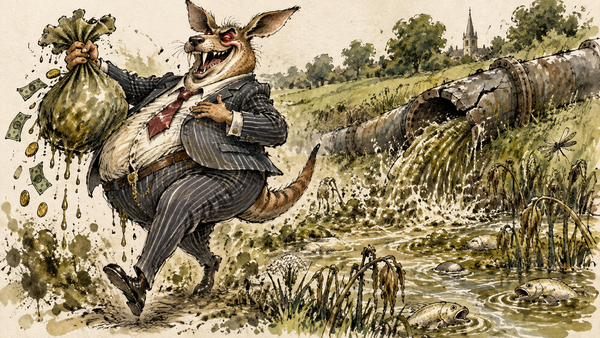
I enjoy reading Scribehound, especially those articles that are applicable to issues and matters that concern all of us, not just farmers in Britain. The most recent article by Ian Coghill on the power of Net Zero is an excellent example of an issue that is widespread and very international. I can assure you that we have the exact same nonsensical arguments going on in the United States. While Ian, quite rightly, points out the silly role played by Government, he kindly leaves out the “charitable organisations” who have little or no interest in resolving the issues but regard it as an excellent way to raise more money from an uneducated Government and even worse, in my opinion, from the unsuspecting general public. Where those Pounds/Dollars/Euros etc. end up is more mysterious and is often not all dedicated to the cause that was advertised of saving us from eternal climate doom. I try to follow the problems with the water companies, their disgusting dumping of sewage in rivers and streams and how little the Government seems to be interested. One thing I find sad about Scribehound is that by and large those who read it all agree with each other. I would think that Ian’s article could generate a very interesting and enlightening discussion with the proponents of planting trees to save us from death by CO2. I have fairly pronounced political opinions, which I think are right in the middle, my American friends think I am a pinko liberal commie and my Dutch friends regard me as a right-wing nutcase, so I feel quite confident I am indeed in the middle, but I always try to figure out the reasoning of those I disagree with. I read right-wing publications, not with pleasure but it enlightens me on their thinking and the same with ultra-left news sources, which give me just as little pleasure. The one opposing voice I can recall on Scribehound is when the subject of Rewilding comes up, and unfortunately the only person who disagrees with everything written seems to be afflicted with the arrogance of some scientists who are always right and everyone else does not know what they are talking about. It would be a great idea for those who are becoming biologists, ecologists, etc. to have to work on a farm or be an assistant gamekeeper or walk along a country vet for a year as part of their Master’s or PhD preparation.
A good example of the ongoing scientific nonsense the animals, plants, birds, etc. have to deal with is the idea of our rewilding friends about bringing back the elk. Their extinction is blamed on overhunting, although this happened somewhere between 3,000 and 4,000 years ago when Britain was populated by about 100,000 Neolithic people, 90% of whom disappeared, most likely to disease, possibly the bubonic plague, and then were replaced by the (disease -carrying ?) Beaker people who practised agriculture. That interesting development gave food for thought on another theory for elk extinction, in order to plant their maize, these newcomers deforested Britain, so there was no food for the elk. The fact that climate change, disease and such did not just affect humans but also animals, trees, plants, etc. does not enter these scientific minds or is discarded as facts that get in the way of a good theory. It would be very interesting to find out how these hunters with their spears managed to extinguish all the elk, and while they were at it also the bison, the aurochs, the lynx, the wolf, the brown bear, etc. all of whom have become prime candidates for reintroduction to make the M1 a truly wild motorway.
I am rather mystified why there is no movement afoot yet to reintroduce the straight-tusked elephant, woolly rhinoceros and saiga antelope, all of whom were found on the British Isles at one time in the distant past, while I find it outright discriminatory that no nature-loving organisation makes even the slightest effort to use Neanderthal DNA to recreate this species so they can be reintroduced on the Salisbury Plain and take their rightful place in the Scottish Highlands. I even read the opinion of a highly learned person that it was actually the 18th century deforestation that was the death knell of the elk, which I must admit greatly confused my limited mathematical abilities.
I think it would be great to hear on Scribehound from those who disagree with me and explain why they feel that rewilding is a good idea, while the population is 68 million people, most of whom have very little knowledge of wild animals, while the land is full of roads populated by killing machines called cars and motorbikes, and where highly technical hundreds of thousands of acres of agriculture abound, the practitioners of which are not enamoured by visits from bears and bison, with large herds of woolly sheep who are very upset by wolves passing through, etc. While they are at explaining this, I would also like to find out how these “wild” animals will be so well behaved that they stay put where they are released and why a wolf will not climb over fences as they do in The Netherlands, how a bison and a bear will not trample their enclosures and will not be found hundreds of miles away, if they are not killed by a car that is. I think that this could lead to a healthy discussion. Next I would like to hear on Scribehound from those who are against hunting of any kind, be it on horseback, with a gun or rifle, a pack of beagles, or whatever, and denying that the majority of these hunters actually love nature and all that goes with it, and very actively work at improving the landscape, environment, living conditions, guard against too much predation, etc. Maybe we can add in a paragraph on coarse fishing, where the prey is dumped in a steel net and after showing off the catch it gets dumped in the bin outside. Although also a type of hunting, it seems not to arouse PETA. I can think of a few other subjects that would make such a very worthwhile discussion, but what I would like to understand most of all is why these scientists and urban animal lovers who let their cats roam outside to kill 59 million songbirds, are convinced that humans can do a better job at regulating than Mother Nature, because I happen to think she is better at it and maybe we should spend our energy on trying to figure out whether she needs any help and what and where that is. I hope these discussions will be respectful and enlightening for both sides.
I have to admit that before writing this, I spent a week in Alaska, followed by a visit to Nova Scotia, both locations where there is a lot of room and plenty to eat for elk, brown bear, black bear, lynx, wolf, beaver, you name it. I did not see any Lynx, they are very good at hiding from us, but I did see bear, beaver and elk and they looked happy and healthy, as did the sea otters, whales, bald eagles, kingfishers and others that belong in those places. While in these incredible places I was reading the book LIVING WITH LYNX by Jonny Hanson, which I learned about here on Scribehound. I thought it interesting although often confusing, but it does make one reflect on things and in my case it created the urge for a good discussion, hence this piece.