Substitute prey in fieldsports
Clay pigeons, electric hares, drag hunts - can these substitutes work and where is the meeting of minds? Are we doomed to 'kissing our sister' or can we instill a measure of unpredictability?


Most fieldsports, fishing excepted, have substitute prey in some shape or form. Shooters have clay shooting (which has about the same number of participants as game shooting), hounds have trails and drags, greyhounds have dragged lures or motorised hares, even cats have their fluffy toys and dummy mice, and humans have footballs.
Why we use these substitutes raise a number of philosophical, psychological, sociological, practical and economical (I can’t think of any more long words) questions. Take shooting for example. For me a ‘hunting’ experience is about going out into nature to find potential quarry, possibly with the aid of a dog, perhaps getting a shot or slipping a hawk, retrieving downed game, taking it home and eating it. I‘m not a particularly social person so am just as happy to be out alone as in company. I’m not a fan of driven shooting in so far as usually someone else finds the game, another retrieves it and another uses it for food. There is little left beyond firing the gun at a target, in which case I could as well go on a simulated day using clays.
Out hunting, for me it was all about following the hounds as they work, with everyone focussed on the fox, our pilot. There may be a blank draw, or a patchy line or a screaming hot scent, but everything hinges on that. The rest is peripheral. Substitute the fox with a dragged lure of some kind guts the whole thing of its meaning. Of course many, if not most, hunt followers hunt to ride, but I am one of those who rides to hunt. I don’t go in for heroic leapings over vast hedges, in fact a lot of the time I hardly notice my horse at all. We just go for it. But then I hunt in the Welsh or Northumberland hills where we have obstacles of our own to fell the unwary.
While the hounds have their scent lures, Hunt horses too have their own substitute activities, ranging from Point to Points, to Hunter Trials, events, shows and Pony Club games. Nowadays a ‘pointer’ no longer needs a Master’s certificate showing it has been fairly hunted. There has been a gradual disconnect.
Coursing, post ban, is in a jam; many go over to Ireland. I’ve never been that gone on competitive coursing, but each to his own. Riding to galgos in Spain is more my thing, a sharp dash, trying to stay in touch, big arable fields and the occasional strategic drain. Riding to salukis in the desert is good fun too, although it is not always wise to crest a dune at speed, only to find oneself well and truly airborne. We’ve hosted saluki racing here in UK, with heats chasing a dragged lure, but I must say it doesn’t do a lot for me. On the other hand, pointing a rabbit in snow-pressed bracken on a wild winter hillside with a lurcher, followed by a tail-ruddering, hand-brake turning, snow-spraying sprint is surely worth going out for. A couple of rabbits in the bag, although a bit of a burden, make a lovely body warmer on the way home.
But greyhounds racing a motorised hare around a track? Not for me. Surely the betting is the main motivation.

Gundogs (more properly ‘game dogs’ – we falconers developed them long before vile saltpetre came on the scene), also have their substitute in gundog trials. These have evolved a modus all of their own and both dogs and techniques have been refined specifically for the trials. Speed, style and control are the order of the day; all that peeping and arm waving and intensity are not really for me. I will watch out for my dog roding up to come on point but I don’t go all day long with my whistle clenched grimly in my mouth, and if a spaniel speaks up on a rabbit in a thicket, that perks me up no end and I will quickly make sure I’m in the right spot, either for a shot, or to slip a hawk. I don’t want an automaton and, as I am often assured by those who know me, we are loved as much for our misdeeds as our strengths. My enjoyment is in seeing the animals interacting together.
Increasing pressures on hunting
All fieldsports, especially ones that need a lot of country such as hunting and crow hawking, are finding increasing pressure from urbanisation, especially in the south. Trail-hunting does at least enable Field-Masters to keep the Field on ground where they are welcome. Predictability has its compensations.
But it is this predictability that turns what was a ‘sport’ (in the old sense of the word) into a ‘game’, which gradually develops its own rules. From there, to give it back some spark, the game becomes a ‘competition’ with prizes, and sponsors, and in some cases, betting. The activity has come a long way from its origins; it has been tamed.
Falconry of course is not a single activity; it has many disciplines. It uses many species of raptors to hunt many species of prey using a variety of flight styles and terrains. Trying to flush a moorhen from a marl pit for a Harris Hawk is very different to my own sport, crow hawking on horses on the fells. Training, entering and maintaining a team of crow falcons is no easy matter. So some years ago, exploiting advances in modern technology, we developed robotic crows or ‘rocrows’. They are radio-controlled models with hidden electric ducted fan motors so that they can be safely caught by falcons high in the sky. We fly the falcons to them every non-hawking day during the season. To make such a model, all components have to be first designed on computers and then the parts made in China (UK cannot compete). There is always a minimum order of several hundred, so we had to set up our own factory in UK to assemble them, and then sell them to other falconers. Gradually we developed a competition (the Hunt Race) based around how we train hunting falcons. It is designed to test all elements of a hunting falcon: a quick start, it’s climb rate, stoop speed, strategy, and footing ability. Now, after six years of racing, we have recently formed the British Falcon Racing Association (www.britishfalconracing.co.uk ) and we have just completed this year’s races at Vowley (www.vowley.com ) just south of Swindon.
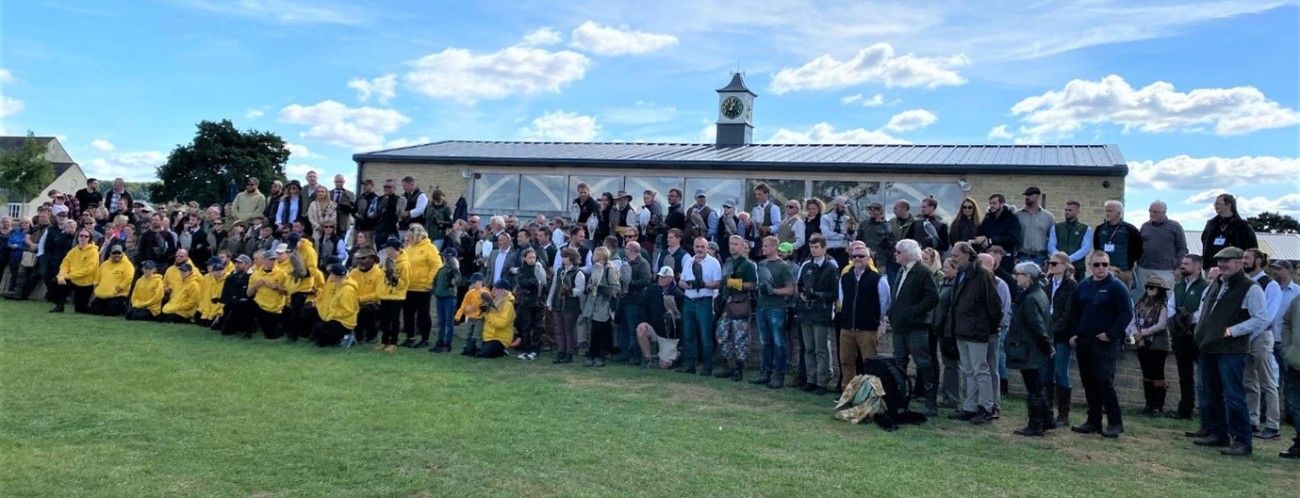
Of course, unlike dogs, falcons operate in three dimensions, not two. The whole sky is their element, right up into the cloud base. The pilot on the other hand is down on the ground, trying to decipher from below what is going on high above. He has to judge relative distances, wind speeds, and evasive strategies. It is a battle of two minds, as well as bodies. And so a new sport is born. Some of the pilots emerge afterwards incapable of coherent speech, having just been hunted down and ‘killed’ by a falcon in her own element.
An interaction of minds
It is this two minds thing that is the key to substitute prey. The fox is a clever operator. Convert him into just a line of scent and what are you left with? This is particularly evident in saluki racing in which the lure is dragged along a zigzag course. So it turns at each pully point, but that turn is automatic; it is not in response to the approach of the dogs. There is no mind there, no interaction. To a casual observer it might emulate a real course, but to the cognoscenti it is mechanical. Sight hounds, like us humans, hunt primarily by sight, so we can empathise with what is going on. Falcons too operate by sight, but in three dimensions and high up. We can understand and follow what is going on, but it stretches us. Scenthounds on the other hand, function in a world that is totally alien to us.
As a substitute prey for us humans, clay pigeons can to some extent emulate a bird that flies relatively straight, such as a pheasant. But they slow down and fall whether you hit them or not. They do not dodge and swerve. There is no meeting of minds. For a simulated driven day you might find it more stimulating to take a lesson from the field archers and have a walking course, with a bolted rabbit or two, an unexpected woodcock glimpsed through the trees, and a starburst of pigeons surprising you. There is a lot of scope for some more imagination in clay shooting, try going off piste a bit. And of course there is no wounding rate; the clay is either hit, or missed. You just need to get a dense even pattern up there and not worry about penetration.
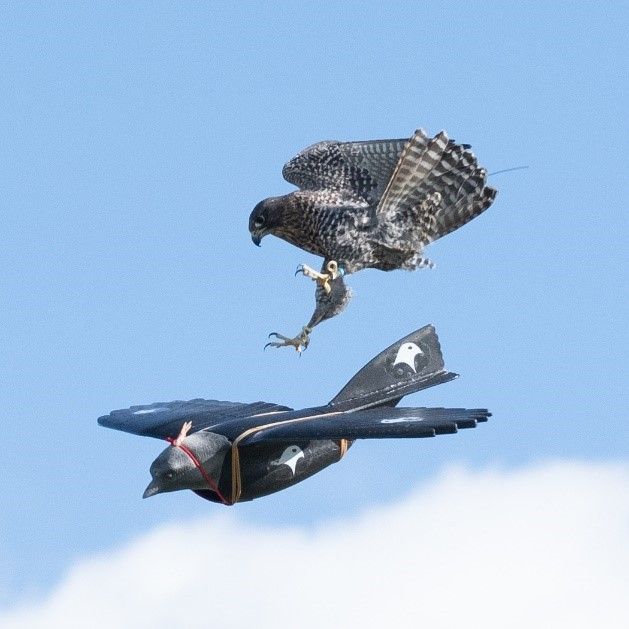
One thing I discovered by piloting rocrows for falcons was that my eye becomes trained to watch the rocrow intently, as well as the falcon’s body language as she hunts me. My mind and eye learned to go into slow motion. I get used to being under pressure and usually (not always!) can think cooly, focussed on what I am doing. When you are out rough shooting, there is always a ‘fluster’ element. You are momentarily, even when shooting over a point, taken by surprise by the flushing of the prey and then quickly judging its distance, speed and other factors such as branches in the way, and safety to shoot. An experienced person quickly makes all these mental adjustments prior to firing the shot a second or two later. But if you are still in ‘fluster’ mode when you come to fire, all the adjustments will be incomplete and you may miss. I found that by piloting rocrows my mind learned to act more rapidly so that a real flying bird appears to be in slow motion and becomes easier to hit. When we are young we are taught to aim for the head and I think the benefit of this is not so much to keep in front of the bird as to teach you to focus on the bird more intently rather than see it in a fluster of wings or trailing tail.
Substitute prey have their detractors and disadvantages but they have some benefits too. Many of these benefits have yet to be understood or fully exploited. One has to go right back to fundamental questions, such as ‘What, specifically, do I enjoy most in my sport?’ The answers will be many, varied and personal. For trophy hunters, how much of it is about the experience and how much of it is about bringing home a trophy, with its bragging rights? If there is a ban on importing trophies, now there is an option to scan them and 3D print them back at home; substitute prey, post-mortem. I suppose there would be a temptation to swap the files before printing, or touch them up with CAD software, to make each set of horns a bit more impressive. Or you could do away with the rifle and substitute a camera, with the aim of taking sufficient shots from different angles so that a computer can re-construct a 3D image. The same animal could be ‘shot’ many times, like a trophy carp, becoming a challenge and a myth. And if you don’t need to kill it, you could ‘shoot’ endangered species. But why stop there? A bit of tweaking at the design stage and you could ‘shoot’ imaginary species. You could slay a dragon! Welcome to computer games…
For Hunts in the south and east, quite apart from the hunting ban, there are practical difficulties that make hunting more and more difficult. More busy roads, more houses, and more people. On top of this, much of the landscape is taken over by organised shoots. In a shooting ‘industry’ the old tolerance of foxes by keepers and the relationship between hunting and shooting, start to fail. Thermal scopes mean that keepers can depress fox numbers more than ever before, and urban foxes start to outnumber rural foxes. Even if the ban was lifted, could Hunts feasibly manage in such a scenario? Of course, there is no saying that the releasing of pheasants will be allowed to continue, in which case the days of driven shooting are numbered. There will be fewer jobs for keepers, and then the pendulum may swing the other way and foxes have free rein to impact all forms of wildlife. Bye bye partridges and curlews.
Thinking outside the box
For these Hunts, perhaps it is time to take trail hunting more seriously and develop it as a sport in its own right. German Hunts have operated this way since the last war, so there are templates there to look at. When a drag is being used, ‘hunting’ can take place at any time of year, and where the horses go can be controlled to minimise damage. There is no longer a need for early mornings in the autumn. Scent has always been a mystery and fruitful source of discussion, but with trail hunting one has control not only of the line to be taken, but also the strength and position of the scent. There is a lot to be learned and experimented with here, so much we don’t really know. What scents are most odorous, or least? A drag that momentarily touches the ground or vegetation presumably leaves molecules on the damp surfaces, and these continue to ‘evaporate’ out into the surrounding air where a questing nose can detect them. And air scent: do these molecules simply float along with the breeze, like Pooh sticks in a river? Or do some of them ping around?
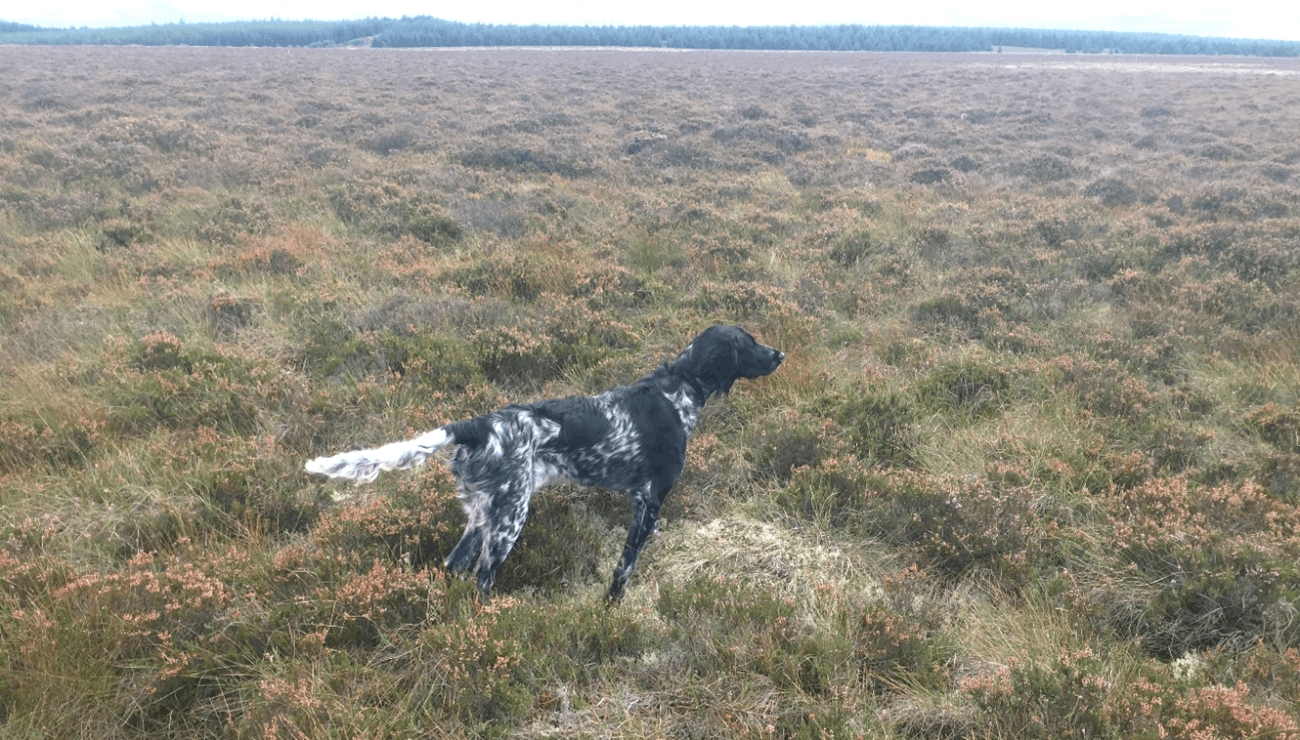
We have two dogs, a lurcher and a Munsterlander. Their beds are exactly 21 feet from the kitchen work surface. If my wife opens a sealed packet of food from the fridge – black currants or cheese for example – they stay asleep. But if she unpeels a carton of raw minced meat they jump up and run to her immediately. I mean immediately, as fast as they can. There is no way the scent of the meat could have been blown across the room to them so quickly. The moment that the meat was exposed, scent molecules must have pinged their way straight across to the dogs, and presumably all over the kitchen, and the dogs could detect even these few molecules. What an amazing scent world they must live in!
I’ve been out with a Bloodhound pack, on foot, out of curiosity. It was a disheartening experience. But I can see potential there. Maybe it is time for the Hunts to sit down, go back to Square One, use some imagination and come up with a sport that can flourish in modern southern England. For example, what about using a drone to lay the scent? In falconry, some people use quadcopters to tow a lure on a line for the falcon. A drone like this could tow a scented lure on a 10 foot line, touching the ground some of the time, leaving air scent the rest of the time. One can pre-set the drone height above the ground so that the lure just flicks along the surface here and there in big arable country. Rather than a rag which could snag, a short length of soft cord can carry the scent. One can also fly FPV (First Person View) so that the ground pilot wearing goggles can see what a camera on the drone is seeing, even some distance away. He can head for a gateway, or he can slip over a hedge. He can flick across a field of roots, a bog, a stream or up a woodland ride. He can make it as easy or as hard as he likes, and stay on ground where he is allowed, his exact track recorded by GPS. The quad would not be emitting its own scent, as does a human scent layer on foot, ATV or horse at ground level. There is a world of opportunity out there if one has imagination and is prepared to embrace technology.
That of course sets the scene for the hounds and Huntsman and gives a raison d’etre to keep our beloved bloodlines and packs. The Field Master may, or may not be, in ‘the know’ of where the lure has been. It won’t be a continuous line, rather a broken necklace of ground and air scent. The Field Master must know where horses will be welcomed or allowed, but not have a route planned out at the beginning of the day. To keep in touch with the hounds the Field must take their own line or lines. In other words, one brings back some unpredictability to the whole scenario, which ultimately is the essence.
If trail hunting is to continue, using packs of fox hounds rather than blood hounds, then the whole activity needs a thorough shake up. How many hounds need to be kept in kennels? Could summer Fun Rides become trail hunts? What’s in it for the farmers? Is it an event simply to give riders a jolly, if so, why have hounds at all? The circle has almost turned back to the origin of point to pointing, or ‘steeple chasing’.
One thing is for sure: we have to adapt if we are to survive in an increasingly urban landscape and society. If game rearing was banned, what would shooters do? Life is full of ‘vestigial structures’, such as the lapel buttonhole on a suit jacket. In fifty years’ time will all fieldsports just be substitutes and anachronisms? There is increasing opposition towards recreational fieldsports, but also a massive ignorance of all the various issues surrounding wildlife management as well as our cultural heritage. I examine some of these in my book ‘Hunting Ethics: A Personal Journey’, due out in February.