Taking the Sin out of Syndicate
Want to go shooting but have no land. One answer is to join a Syndicate. Resident or roving, its all about managing expectations and how not to alienate everyone.
It is not unknown that whilst idly relaxing with chums over a pint and a pickled onion, or toying with a sliver of crumbly Stilton and half glass of Taylors in some friendly hostelry, someone around the table who had previously appeared quite sane suggests that you might join them, and others of a similar bent, in a new shooting syndicate for the next season.
Those who have been placed in this ego-massaging position by a person who they had hitherto looked upon as a chum with a brain will recognise the scenario. It might be that you and your colleagues have been brought together to shoot game by the initiator of this scheme.
You may have just endured a dingy day when the sun never rose, shot over some patch of weed-strewn benighted bog or a driven day over hedgerows that had no obvious sporting provenance beyond your modest contribution to the keeper. A modest contribution mirrored almost exactly by the modest showing of winged prey that said keeper had managed to chivvy into the air for your pleasure.
Perhaps you and your chums had just finished shooting a January day on ground that you knew was good for a couple of hundred plump feathered friends, yet by unhappy circumstance or gross ineptitude, had yielded only half that number over your guns at any shootable height. Or again, you may have enjoyed the largesse of a mutual friend with a small estate, where a professional team had given you five drives of the most stunning ringnecks interspersed with fizzing partridge and a lunch to die for, with a bag beyond your wildest dreams, albeit within responsible limits.
Guns doing it for themselves
Possibly fuelled by the presence of seasonal bonhomie, the need to plan for next season or the nagging, arrogant belief that ‘it can’t be that difficult to get good shooting can it’, came the question, ‘Why don’t we do it ourselves?’ Here, gentle readers, it is best to analyse what you might be getting yourselves into.
The definition of syndicate is revealing. ‘An association of like-minded persons convened to promote a common purpose, interest or enterprise, especially an enterprise requiring a large amount of capital’. The key words here are ‘common purpose’, ‘interest’ and ‘large amount of capital’. If you and more importantly, your fellow conspirators, can tick all three boxes, then you are in with a fighting chance. If not, forget it and take up philately, phishing or the ancient Chinese boardgame of Go.
Resident or Roving
Broadly speaking, there are two types of syndicate; resident or roving. The resident syndicate is, as its name suggests, comprised of a team of guns who lease a piece of ground and shoot as many days over it as the ground and/or their collective wallets will support. Finding suitable ground at an affordable cost is not easy and requires the provision of references of financial ability and probity to the landowner and the employment of a keeper with a cottage and a vehicle, unless the syndicate members are able, fit and willing enough to do the keepering themselves.
The former requires good man management skills and enough knowledge to recognise whether the keeper is working for the syndicate, the landowner or himself. The latter requires even better management skills and, in my experience, only works for as long as the few members who have the time, interest and geographical proximity to keep getting cold, wet, tired and nervous, are prepared to do it. Having been there myself, I observed that inequality of labour was a sure recipe for blowing friendships apart and whilst some syndicates apparently work happily on the basis that everyone brings something different to the table, be it sweat or sterling, these are potentially uneasy relationships.
The second is the roving syndicate, which again as its name suggests, is a team for whom peripatetics are as important as bag size. It’s not that they get bored by shooting the same drives ten times a year in roughly the same order. Just that most guns are naturally inquisitive, like to see how things work in different parts of the country and for whom travelling is second nature.
A brief scan of the electronic interwebby thing will reveal many companies versed in buying and selling shooting, some of which will offer to incorporate the enthusiastic tyro or newcomer into their own roving teams, but be aware.
This can mean being thrust into the social milieu of complete strangers whose names, manners, safety record, spending power, nationalities or other important provenances are only discovered once one has rolled up the drive of some far-flung and generally expensive estate and begun the battue.
Thus may the man of modest means, equally modest over and under fowling piece and only his mother tongue to support him, fervently hoping his day will exclude those who by their personal habits or wild disregard for safety have absolutely no mates at all, may find himself in the midst of a group of well heeled high rollers with pairs of best English side by sides, who raucously shout at each other in indecipherable tongues, whilst not allowing anything to fly past. Not anything. And not for us!
Brothers or Sisters in Arms
The second type of roving syndicate is much more amenable and follows the original premise of brothers or sisters in arms, if not parentage, doing it for themselves. Which is where we came in, amongst the pickled onions and port, if you remember.
Setting up such a roving syndicate is not the work of a moment. Whilst it also requires the application of funds on a regular basis, visiting established estates where the panoplegic infrastructure of host, keeper, rearing pens, feeders, drinkers, vehicles, suppliers, vet’s bills, beaters, pickers up, game cart and other paraphernalia is in place, takes at least some of the risk out of what is an inherently risky business. The roving syndicate guns need to understand that most estates with proper shooting agreements require payment in two tranches, probably April and August and that is when they will have to cough up. But we are getting ahead of ourselves.
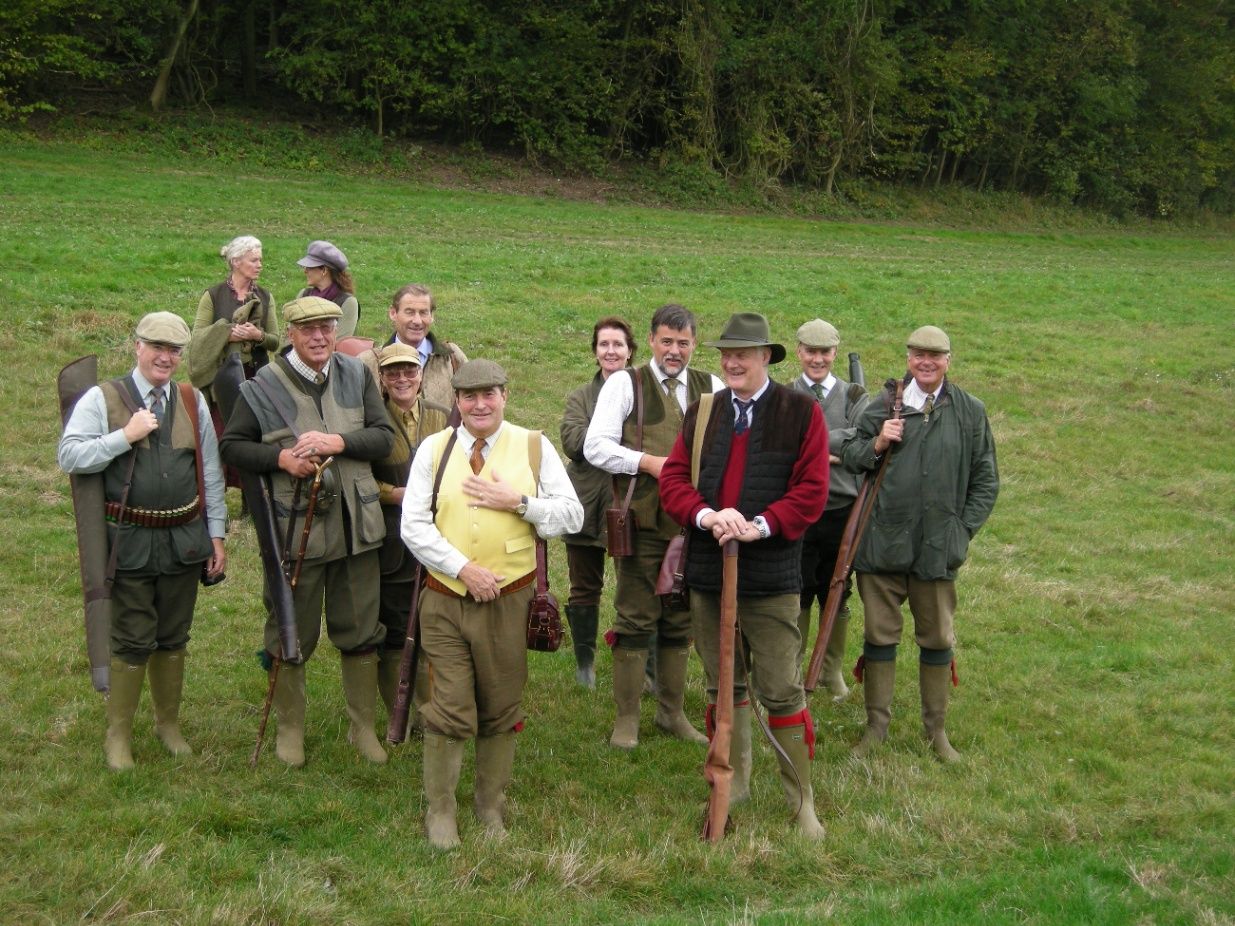
Normally speaking, the person who massaged your ego in the first instance, dripping honeyed words into your shell-like at the festive lunch table and topping up your claret glass the while, will have said much the same thing to another ten or twelve friends or acquaintances. They know that given the law of averages, they can gather enough guns to pay for and then shoot the season ahead, but it is best to get some sort of commitment and manage expectations. Put bluntly, anyone thinking of starting up a syndicate needs to know three things of their putative guns; that they are safe, solvent and fun; very little else matters.
For anyone deciding to form and manage their own roving syndicate, who actually has enough friends who met all three criteria, and doesn’t mind that they have elected you to become their shoot captain, for which read ‘unpaid organiser’, in the few minutes that you were out of the room on a comfort break, it is still sensible to ask them what they want to do. Take the precaution of sending them a questionnaire to concentrate minds.
What, Where and From Whom?
Simple questions should elicit a consensus of ideas for numbers of days, type of shooting, whether near or far and projected spend, allowing you to plot and plan for the first of your wandering years, but having discovered what your team want to do, you have then to deliver it. This is where many potential syndicates fall at the second hurdle, as it is one thing to read about the best shooting estates but quite another to first locate and then secure a day on them, or indeed more modest ground. The question will quicky arise should you do your own research and book direct or just revert to the plethora of silk-tongued agents and welcoming websites?
Knowledge is power and in earlier years it behoved you to first buy the relevant magazines and research amongst the classified advertisement section. And not just among the adverts for let days. Some of the best leads come from the estates advertising for staff and from personal recommendations so ring people up and ask. Only once in twenty-two seasons of planning, was I ever rebuffed, and that by a particularly precious Hampshire estate owner who loved to get in front of any camera but who declined to engage ‘because we had not been introduced by a mutual friend’. Pompous, or what.
At this point, you will have a group of enthusiastic guns eager to play on one side and on the other, a list of estates, farms, quarries, bogs and other ground that at first sight meet the criteria. It is at this point, mostly between January and March, that the shoot captain earns his corn for it is then that he will visit each and every possible venue and walk the ground with their owners and keepers. Only then will the advantages, suitability and shortcomings of each reveal themselves in glorious or gory detail.
That first visit sets the tone for the relationship that follows and is critically important. At the end of it, the shoot captain will know if it is right for their team and will probably have shaken hands on dates, size of day and cost. When the shoot captain has completed all his visits he should begin to bring things together in some rough order, designed to give the guns the variety of shooting that they expect and deserve. He will then confirm with each estate his understanding of the detail of the day to be purchased for there is nothing so nebulous as a verbal agreement and it does no harm to get things recorded, as after all, you will soon be spending other people’s money.
Calendar Secured, but what now?
So, you have your calendar secured, but what to do now? Using your best descriptive powers, construct a chronological list of dates, details and costs and wing this out to your guns, with an invitation to select which days they would like to subscribe for. No money changes hands at this stage and application is clearly on the understanding that the shoot captain allocates people to days. This is occasionally akin to nailing jelly to the ceiling in a fog, but it mostly sorts itself out and all guns stand the same chances.
It is at this point that the question of payment emerges as the shoot captain confirms with each gun what his or her calendar will be and calls for payment. Fifty per cent in April and August is the norm and gives the syndicate a measure of control to accommodate the unhappy matters of avian influenza, bluetongue or foot & mouth potentially screwing up everyone’s ambitions.
The following months see invoices come in, payments go out and the occasional re-shuffle of allocated days as one syndicate member discovers he will be in Barbados or New York or Ulan Bator. If a member cannot shoot on an allocated day, they must let the shoot captain know and he brokers its onward sale. It is no more acceptable to discover on the morning of the shoot that you have a new face in the line than it is to have your guns complaining directly to the shoot staff about anything during a shooting day. Everything needs to funnel through the shoot captain for that is his role, as organiser, arbiter and diplomat. Guns may come and go but the shoot captain’s reputation is on the line for ever.
Contact is all
The diligent shoot captain will probably talk to the estates at least twice during the summer to probe for and exchange knowledge and pay when required. Approximately three weeks before the appointed day, two important missives will be written. One will be to the estate confirming names of guns, numbers for lunch, dietary peculiarities, whether loaders or 4x4s are required and any other details that will make the estate’s organisation easier.
The second will be to each gun, confirming who is shooting, where and when, accompanied by a description of how to find the shoot lodge, bothy, baronial hall or pub where they are to foregather. From that moment onwards, much in the nature of descending the North Wall of the Eiger on a tea tray, the die is cast and the words ‘gods’ and ‘lap’ apply. Fog, snow or natural disasters aside, it is left to the guns to meet promptly, shoot nicely, eat tidily and leave in good order without goosing the host’s wife.
Thanks to The Deserving
The final piece of the administrative jigsaw comes on the following day, when the shoot captain writes to thank the host and his team of beaters, pickers up and the ladies who drove the kitchen for their help in delivering a seamless day of good sport and victuals. If the shooting was as good as the cordon bleu lunch with its Margaux and Mersault then it is a fair bet that you will want to return, but if the lunch was immeasurably better than the shooting then perhaps not so much. All this decision-making is but grist to the mill of the experienced shoot captain for as each day is ticked off one season’s schedule, he will be closer to refining the running order for the next season and keeping his syndicate free of sin and happily on the road again.