The Stalker In The Woods
Deer stalking in the Welsh wilderness and discovering what it really means to eat meat.

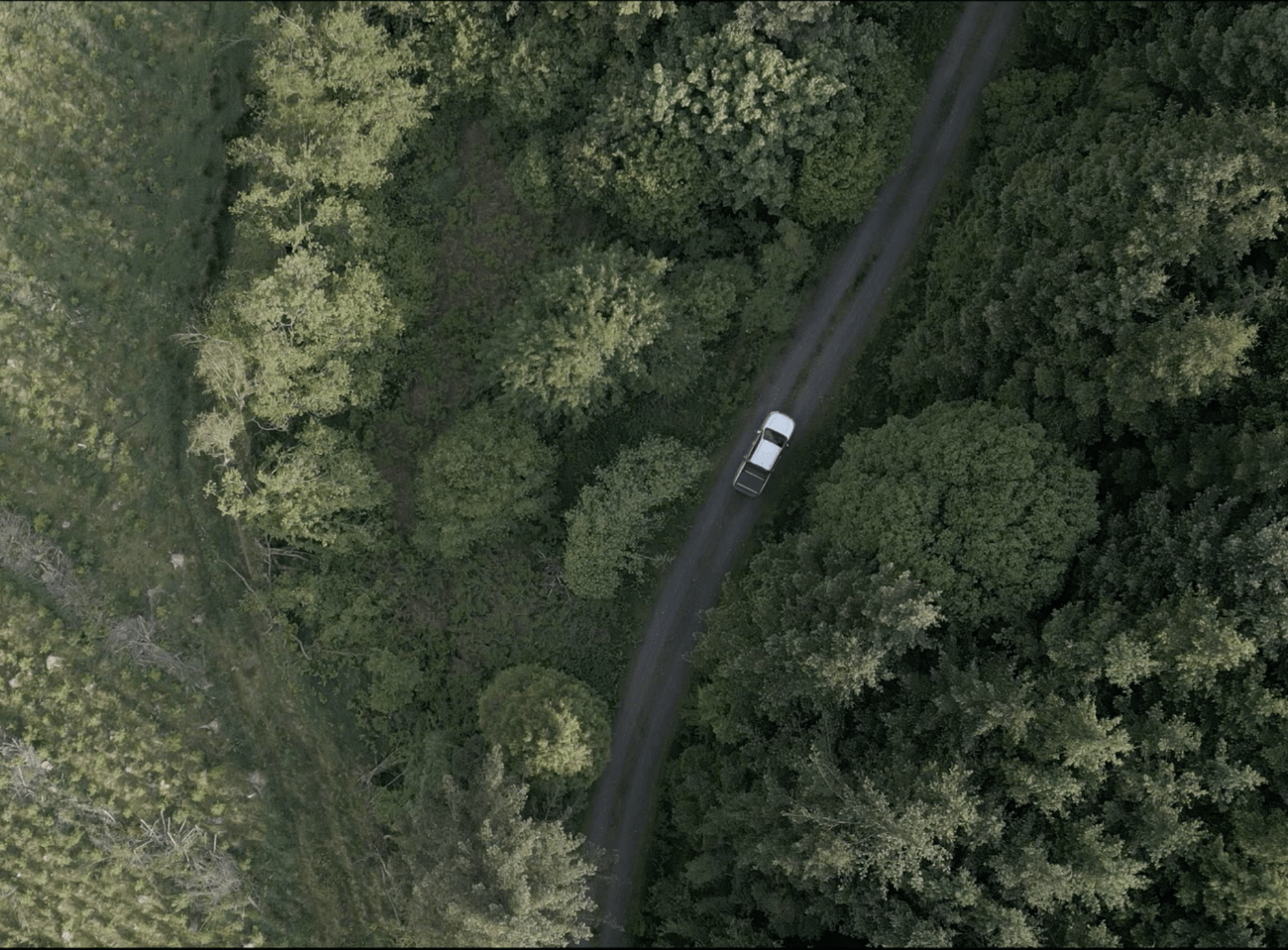
I had agreed to meet Paul on a layby near Abergavenny at 3am. His old Nissan pickup truck was already there, idling and belching diesel smoke out into the cold night sky. He was standing next to it, rifle slung over his shoulder, hunched silhouette framed by the dim orange headlights. He pulled deeply on the first of many brown, filterless cigarettes that day and waved.
‘Morning, Jack,’ he growled. ‘Want one?’, motioning to the leather pouch in which he keeps his treats. I declined. ‘Suit yourself.’
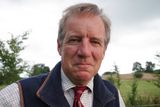
Paul is a licensed deer stalker, employed to patrol a few forests and estates in Monmouthshire to keep the deer populations under control. He has piercing blue eyes, forearms covered in old sailor’s tattoos, and a thick, lilting Welsh accent. He had agreed to take me with him today.
I had been introduced to Paul by a foraging guide I know called Chloe. A Duracell bunny in human form, she runs foraging tours in South Wales and is the region’s most knowledgeable and enthusiastic proponent of wild food. I texted her saying I wanted to go on a deer stalk, and I could practically hear her squeal back through the screen: ‘Well you have to meet Paul!’
I did meet Paul, a few days later in the village pub where Chloe told me he could be found most nights – “Every night,” Paul would later correct me with a wink.
“He might take some persuading,” Chloe warned. “But he’s a sweetheart deep down.”
I found Paul in the corner of the Pandy Inn. He was wearing a deerstalker hat and a green shirt tucked into green trousers tucked into brown muddy boots. Elsa, his dog, was curled up languidly at his feet. He had a tankard of cider in one hand and was staring glassily into the middle distance.
He didn’t take much persuading at all.
Paul’s only concern was that we might not find one. He wouldn’t want to take me out only to disappoint me. I had come during roe buck season – one of the trickier times of year for stalking. Roe are small, fleet-footed and scarce. “I’d be lucky to catch one myself, let alone with you following behind me,” he confessed, after a couple more ciders. “But we’ll try. Meet me the day after tomorrow, 3 o’clock in the morning.” He scribbled a road name on a scrap of till receipt. “And wear green.”
.
“You might as well leave your car here and get in with me.”
I bundled into the back of Paul’s truck and we began the long drive into the heart of the Black Mountains. The heater was oppressively hot, blowing soporific engine breath into the cab. I’d barely slept the night before – through a combination of nerves, a 2am alarm and the unmarked barrel of scrumpy cider we’d drunk by the tankard the night before. On the back seat – well, the centre armrest and eventually my lap - was Elsa, Paul’s labrador cross and hunting companion. Her hot breath tickled my ear as Paul scratched her under the chin. ‘I couldn’t do it without her,’ Paul explained. ‘She’s my eyes and my ears.’
The single-lane track wound through man-high hedgerows as we weaved deeper into the Welsh wilderness. Gnarled, ancient trees hung ominously overhead. The moonlight cast their shadows like long, skeletal fingers.

“Sometimes people stop me in the woods, you know, and ask me how I can do what I do for a living.” Paul said unprompted. “I answer them as calmly as I can, and try to explain why the animals need culling. Most don’t want to hear it, most just want to have a shout and a moan, but very occasionally I can get through to someone.”
‘Plus,’ he says, breaking into a throaty laugh, ‘I’ve got a rifle on me. If I lose my temper they can just call the police and I’ll have my licence taken away.’
We arrived at Haye Wood just after 4am. Deer are most active at dawn and, it being June, dawn came brutally early. I had taken Paul’s instructions to blend into the natural environment a little too literally. As I unpacked my box-fresh Crocodile Dundee hat, tactical gloves and camo snood, he arched an eyebrow. I’d managed to dress as a countryside full-kit wanker. He then handed me some more undeserved kit to complete the look: a thermal scope, a set of binoculars and a horn-handled walking stick.
“Stick close to me and don’t make any sudden movements. If I stop, stop. If Elsa stops, definitely stop. And if I get the gun out, hold your breath.”
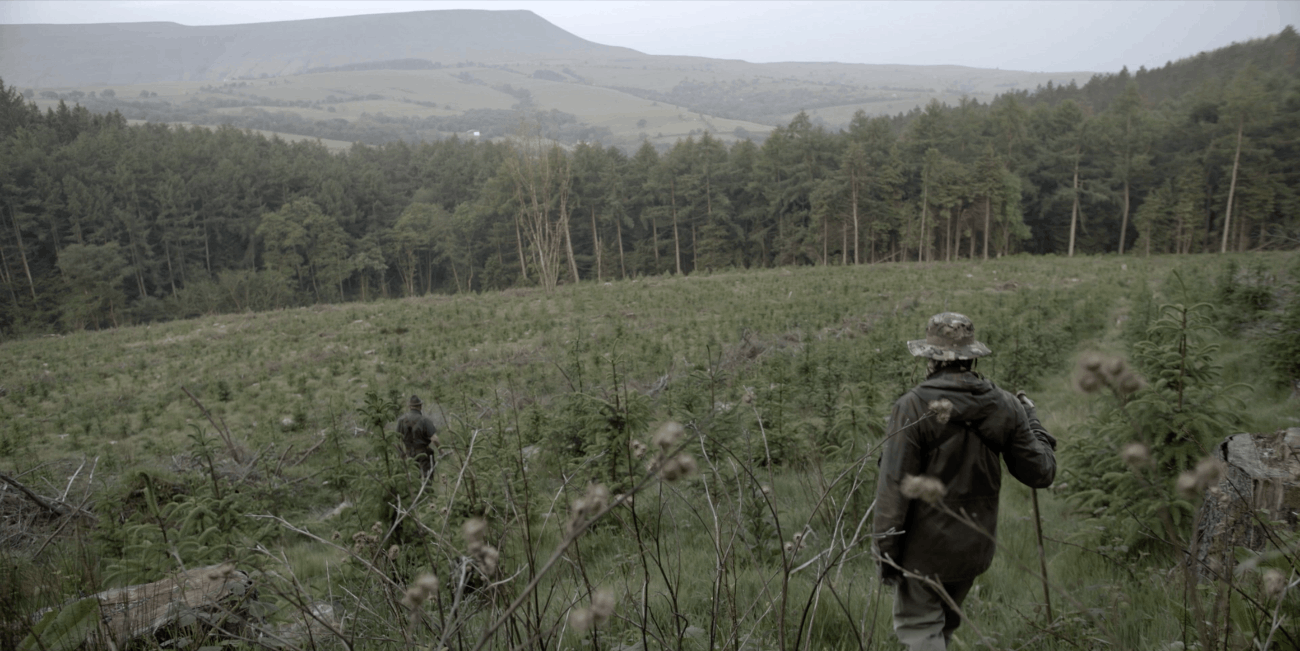
Paul slung the rifle over his shoulder and proceeded slowly, slowly down the winding forest path. We were flanked on either side by great majestic pines. He rhythmically placed one steel-toed boot in front of another, scanning the knotted canopies in the distance with his thermal scope. Elsa followed at his heels, nose held aloft like a snooty Victorian butler, scanning the breeze for a scent.
I did my best to match Paul’s every movement. If he stopped, I stopped. If he got out his binoculars, I got out my binoculars. It was a bit like a small child copying his dad without any real idea of what he’s doing. Once, I thought I’d located the white heat of something in the lens but… no. A sheep.

“Look,” he whispered, gesturing to a patch of leafless saplings. “The bucks thrash them to death with their antlers.”
There are over two million deer in the UK today, the highest number in a thousand years. Because of the rate at which they breed, to keep that number stable at two million, 750,000 need to be culled a year. Only half that target is being met. Ergo, numbers are on a vertiginous rise. Why is this a problem? Well, deer are a surprisingly destructive pest. They strip land of their vegetation, root up young saplings planted to repopulate the forests, and decimate the hedgerows and habitats of smaller mammals and birds (an illustrative point: the population of nightingales has declined by something absurd like 95% in the last decade.) There is a harmony to the woodland, and an unchecked deer population threatens that delicate balance.
“The problem is,” says Paul “there are no natural predators left.”
There was a time when deer would have been preyed upon by wolves, lynx, even bears. But humans have since hunted them to extinction. The only thing that kills a deer today is old age, illness, a road accident or culling. Limited food supply does not restrict reproduction; it only creates an emaciated, zombie-like herd of hungry and emboldened deer forced to venture ever closer to human contact, eventually becoming a hazard on winding country lanes. This is often the point at which the general public becomes aware of the overpopulation.
The morning wound on. The dawn chorus screamed at a hum as the sun slowly rose above the trees. Its light refracted through the treetops and cast a glittering mosaic on the forest floor. It was as if the forest was waking up with us. There is an untranslatable German word, Waldeinsamkeit, for the feeling of divine solitude in the woods. There is something grounding, something elemental about being enrobed by the forest, and I wondered to myself what a life spent in this kind of quiet contemplation must do for the soul.

Paul spotted his first deer at about five am. A gloved arm shot out to the side, motioning me to stop. He unfolded his hunting sticks and rested his rifle atop them. ‘Do you see it?’ he whispered. ‘No,’ I answered truthfully. ‘Right…. there,’ he said, guiding my eyes. ‘But it’s a doe. She’s not in season. We can’t take her today.’
This is a useful illustration of an important point: stalkers don’t go out into the woods intent on blasting every deer they see in the crosshairs. There are strict rules on which sex and species can be taken when, and even stricter quotas on the overall number that can be taken. Every kill is registered with the relevant local authority and general information on the herd’s movement, health and habits are fed into this database. It’s an oxymoronic fact that those employed to kill the deer are often the people who love them the most. It takes a special kind of dedication to spend every day of your life tracking an animal, and naturally you form an intimate bond with it.
‘It’s a bit of a climb now, I’m afraid,’ he said, motioning to a near-vertical ascent through the dark trees. ‘But we’ll have a better chance higher up.’ Elsa ran excitedly ahead, wagging her tail in anticipation of her favourite hunting spot.
We had been stalking now for two hours. It wasn’t the physically taxing, video-game like stalk that I’d seen on the moors of Scotland - days-long, crawling on your belly to get a great antlered rutting stag into view. It was more tracking than stalking, a special combination of patience and expertise. Paul saw things in the woods that only his eyes could pick out - a small quiver in the canopy or a flash of fur in the distance. Elsa smelt the phantasmic scent of their recent presence in the air. Together they formed an effective 1-2 punch, and it was fascinating to see them in action. At one point, I watched him communicate to her with nothing but his breath: short, sharp inhalations that she seemed to instinctively understand and alter her course.
As we rounded the corner, the most spectacular view rolled out in front of us. As far as the eye could see were treetops, stretching way out to the horizon before breaking into sheep-dotted pasture. In the far, far distance were snow-capped granite peaks. We were high up, a squirrel eye’s view of the trees. Paul stopped, savouring the view. ‘It never gets old, this does,’ he said to no one in particular, scratching Elsa behind the ear. ‘It’s absolutely beautiful.’
He turned to me. ‘If we’ve got any chance of finding one, it’ll be up here.’
I knew the drill by now. I fell into line behind Paul, matching him footstep for footstep. There was tension in the air. Paul had done his best to dampen my expectations, but I could tell he really wanted to deliver: his reticence had melted away over the morning and I sensed something like pride that this young lad from London was showing such a genuine interest in his livelihood.

And then it happened. Elsa sat still, dead still, alert and hunched forward like someone mugging for a fight. Her tail wagged, she started panting and a crackle of electricity shot through the air. Paul silently unfolded his sticks, slipped the rifle off his shoulder and looked down the barrel. ‘Do you see it?” he whispered to me, not checking to see if I was looking. “No,” I said again. “It’s there, in a ditch. I can’t get a clean shot on it.” He paused. “You wait here and I’ll walk down and come from a different angle.” He had clearly decided that I was too much of a noisy risk and ordered me to stay back.
Paul crept along the path, walking slowly like a condemned man to the gallows. I could see now where he meant. Deep in the valley below us was a small roe buck, munching happily away on his breakfast. Paul once again unfolded his sticks and took aim. I could feel my heartbeat in my throat. It felt like the whole valley was holding its breath whilst Paul steadied himself for the shot. Thirty seconds passed, a minute, then… bang! A shot echoed around the valley. Birds emptied from their treetop perches. Paul stood still, eyes down the barrel of the rifle.

He exhaled deeply and his face relaxed. He pulled out a cigarette. As I slowly approached him, he turned and raised a finger to his lips. He lit the cigarette and smoked it in silence, circular breathing the smoke out of his nostrils like a dragon.
“It’s a little ritual of mine,” he said after finishing. “If you approach the deer too soon after taking the shot, it will panic. But by the time I have finished this, the poor bugger will have bled out without ever realising what happened.”
“Should I shake your hand?” I asked, tentatively.
“Abso-bloody-lutely!” he roared, crushing my fingers in a vice-like grip. “I really didn’t think we’d find one today.”
“Off you go then girl,” he barked to Elsa, who had been sitting next to us like a coiled spring. She shot off down into the valley in search of the deer. “Without her, we’d be here all day.”
I followed Paul down to the kill site and found Elsa sitting there licking the blood from the wound, like a cow might do her newborn calf. It was tender, almost; protective, proud. Paul took a knee and started massaging the blood out of the still-warm buck. His eyes were bright, wide, starry, as if he had been frozen in amber by a sudden volcanic eruption. There was a blood trail over the grass, his tongue lolled out of his mouth, and one clean perfect bullet wound went straight through his heart. It was graphic. There was no getting around that. This was an animal that had been alive not minutes before and would still be had he not been shot by Paul. It looked beautiful, noble, cute.
I asked Paul how this compared to supermarket meat and he sighed, hoisting a knee up onto a nearby rock. “It doesn’t, honestly. I live by an abattoir and the sounds that come out of there…” He shook his head. “Those animals know what’s coming; they don’t know when, but they know. They are highly intelligent, emotional beings. They can smell the death. This poor bugger didn’t know what was coming.”
“And look,” he said, prising open its mouth to reveal teeth stuffed with grass and berries, “look what he’s been eating. A totally wild diet. And roe are notoriously picky eaters. They pick only the best of the best – and therefore so do we.’
“There are some people who will never want to eat meat and that’s fine. But those who will happily buy a piece of pork – a piece of flavourless pork at that – but have a problem with this. Well – I have no time for that.”
I think the aversion to venison speaks to a wider malaise in British society. We have lost any and all connection to where our food comes from, and shirk away from wanting to know about the gory aspects of husbandry and butchery. It is easy to dissociate beef, chicken or pork from the animal it came from. The mental, as well as the physical, work has been done for us far up the supply chain.
I, like Paul, reserve the most scorn for meat-eaters who will happily eat a watery, skinless chicken breast but turn their noses up at the idea of eating venison: “I can’t, it’s so cute, it was shot and killed!’ Well, what do you think happened to that chicken before it arrived skinned, butchered and wrapped for your convenience at a Co-Op hundreds of miles from where it was reared? It probably lived its entire short, rapidly-fattening life indoors, being fed artificial food ankle-deep in its own shit. It was then loaded onto a lorry and spent a few days sensing its impending doom, listening to the shrieks and wails of its kin being slaughtered by an apathetic employee, blithely dispatching thousands of animals every day. We’re familiar with the phrase ‘you are what you eat,’ but you are what you eat eats; that adrenaline and shitty feed is going into your body, too.
“Right, Jack, are you feeling strong?” Paul said, poking me in the ribs. “We’ve got to get him” – points at deer – “up there” - points at the road, up a near vertical grassy climb.
Between us, we dragged the deer back to where the car was parked, pausing to peel off sweaty layer after sweaty layer of clothing. Paul hoisted the animal up by the hind legs on a sort of rusty, mobile gallows that he had attached to the back of his truck. I hadn’t noticed it in the pitch black this morning; I laughed now thinking what motorists driving behind Paul must think it is.

First, he cut open the animal’s chest cavity and spilled its organs out onto the side of the road. He examined them for any signs of disease; the dark red liver, the pale green stomach, great helix-twist of intestine. “He’s in perfect health,” Paul remarked. “Well, other than the obvious.”
This was the part of the day I had been looking forward to least. But I felt it was important to experience and witness. I had long proselytized the virtues of eating venison but had never seen one killed and butchered. And even I, Mr F**ing Venison, found it a tough watch. As Paul hacked off its head, I found myself thinking how normal this would have been for most of human history. Eating meat was hard work. Brutal, long, physical work. And anyone who got to enjoy eating meat would be totally cognisant of the steps taken in order to put it on their plate. We have become lazy nowadays and prefer someone else, some place faraway, to do it for us. We have no conception of anatomy; we don’t ever stop to think that beef = cow. They exist in two different parts of our imagination. I can understand why people feel safer in this cognitive gap, but an important part of our connection to food has been lost.
This disconnect has led to our increasingly unconscious way of eating in the 21st-century. An industrialised and processed food system is wreaking havoc on our bodies and creaking healthcare system; diet-related illnesses are on the rise. A lot of what we eat can’t even be called food - it is, to borrow the words of Michael Pollan, “industrially-produced edible substance”. It is criminal that we don’t eat more of the wild, healthy, nutritious meat that Paul is butchering in front of me. Venison is carbon neutral; no farmland is devoted to its production (to be bloodlessly scientific, it extracts calories from non-arable land like forests and valleys); and the meat is a delicious byproduct of a culling that must take place anyway. (There is an interesting side-argument that venison is essentially vegan-proof: the animals need to be killed, what crueller waste than not to eat it.) Yet we Brits mostly don’t eat it. Half gets exported to Europe - particularly the gamey, offaly meat of rutting stag season - and the other half is sold locally or in expensive butchers in nearby cities. Venison is unfairly tarnished with the posho brush – Schoeffel-wearing Land Rover-driving bloodsport enthusiasts chowing down on Bambi. But its reputation as food of a certain class exists only because they are the ones with easy access to it. It needn’t be expensive. The public demand isn’t there and the infrastructure isn’t there. Why? Why would we rather eat shitty, sometimes-contaminated meat, sold at increasingly inflated supermarket prices, grown in conditions far more brutal and inhumane than I have witnessed today? The answer, I believe, is that it evaporates that state of no-knowledge most of us exist in when it comes to our food. This is something we should look long and hard at. We are missing out on one of the best things this country produces.
As Paul loaded the carcass into the back of his truck, I asked him what he would say to someone who said he couldn’t love deer if he spends his life killing them.
“That’s rubbish. I… I love deer. I could sit and watch deer all day long. I wish I could have a deer farm, but I can’t. I love deer but they need controlling. Somebody’s got to do it. Why not somebody that loves them rather than somebody that doesn’t?”