Unveiling the Patriotic Duty of Tree Planting Today
We are told we must plant trees and more trees but how should we plant? Do we plant our amenity woodlands to help conservation and wildlife?


A patriotic duty to plant trees, but how should we plan it?
Human intervention in land over centuries and the effect on nature is something that may have pricked our consciences as the accusation of its destruction has been levelled at us.
Scientists, politicians and others are searching for ways to repair our planet by biodiversity, decarbonising, restoring natural habitats and at the same time feeding ourselves. Growing trees for carbon capture and nature restoration are well publicised as “essential " and we are encouraged to plant.
The Great storm of 1703
Following a huge storm in 1703, described by the author Daniel Defoe in 1704, John Evelyn, the diarist and botanist, was commissioned to write a report on the state of England’s forests. He concluded there were not enough trees to build ships. He went on to state that to plant trees was a “patriotic duty.” He, of course, meant planting oak, beech and pine amongst other useful ship building timber. Some people might argue that the need for tree planting today is our “patriotic duty” once more.
A comment on wilding and biodiversity
I was interested to read that two research associates have done some work on the history of biodiversity. They say, “Many people today advocate enhancing biodiversity by minimising human influence on landscapes. Often this takes the form of “rewilding” which aims to let nature lead. Minimal human modified landscapes, but not all, have fewer different types of plants. Human disturbance often enhances biodiversity.” These are the words of Jonathon D Gordon and Brennan Fagan of the University of York in an article in the Conversation( July 2024) They go on to say, “The first farmers often made landscapes more biodiverse. Our research could have lessons for rewilding today.” Though perhaps surprising, their research reveals that in “many places, biodiversity thrives because of, not despite, thousands of years of human interaction with the Earth’s ecosystems.”
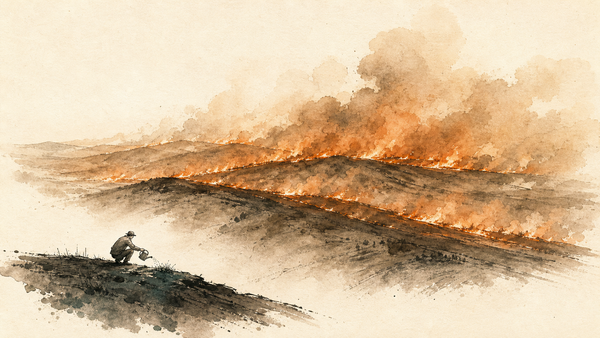
As an example, not recorded in the article, early settlers in the USA would clear a patch of woodland burning trees they did not need for tools or building. The ash beds were worked and used to grow crops, thus creating a biodiversity through alternative vegetation within the forest.
A Lesson from experts writing in the 1980s and today
The Government, Woodland Trust and others tell us of the virtues of planting large numbers of trees for amenity and commercial purposes to reduce carbon. The Woodland Trust have “an ambition to create quality native woods, plant native trees for the benefit of nature, climate and people now and for the future,” their website says.
The Woodland Trust recommends a density of 1600 trees per hectare. The slow growing trees (oak and beech) in blocks of twenty-five at no more than 2m spacing and other native breeds at 3m spacing (alder aspen crab apple field maple goat willow lime). They recommend shrubs on the outside along paths or glades but, some of the recent planting I have seen are new woodlands alongside existing woodlands with no gaps, rides or glades. Some too are just blocks of woodland


The planting design I have described contrasts with designs recommended over several decades by the Game and Wildlife Conservation Trust.
Perhaps, our researchers, Jonathon D Gordon and Brennan Fagans’ comments on “how the first farmers made landscapes more biodiverse” has a relevance to wildlife conservation today. Farmers or foresters allowing space in their tree planting schemes is the relevance I am suggesting. The Game Conservancy and Wildlife Trust (GWCT) have done extensive research into habitat and planting amenity woodlands for many years. For example, Charles Cole who worked for the Trust edited a conservation textbook The Complete Book of Game Conservancy in 1984 where he talks about tree planting in large and small areas to entice gamebirds and wildlife. He advises, and I summarise, low level hedges on the outside, a gap of about seven metres or more for a tractor to pass and allow grass and wildflowers to grow and then a few rows of conifers with a gap behind. The centre is the important element with hardwoods widely spaced and an extensive wide central ride. Nigel Gray’s Book Woodland Management for Pheasants and Wildlife written in 1986 gives a similar message. Again, I summarise, a warm outside hedge. He recommends a Chinese honeysuckle (lonicera nitida) then a 7-metre vegetation gap for grasses and wildflowers, three rows of conifers with some rowan, bird cherries, crab apple for food, a hardwood interior and most important a wide ride of twenty metres with grass. The aim of the design is to provide shelter, some warmth, food and an element of protection from aerial predators. Most important, they both say the interior trees should be planted wide apart to allow undergrowth. In Woodlands for Pheasants and Wildlife, a GWCT green guide written by Alex Keeble and Joe Dimbleby in 2022, a forty-five-metre-wide instant spinney is described. In the centre a single row of forest trees is planted with cover crops on either side. Then, going out on either side is another line of forest trees, with another cover crop then, medium height trees and food bearing trees with a tall hedge. a perimeter ride and outside hedge.
Ultimately the trees will need to be thinned or clear felled and, for that reason, the type of trees should be chosen for practical use, such as building.
"Nature treats well who treat her well." John Ruskin
These concepts are still advocated today, by government agencies and other forestry experts. Some experts are particularly keen on woodland edges as they are important for species such as bats, insects and other creatures. The bigger the area of the edge next to the wood the better.
Planting as a patriotic duty should be done not by planting in large blocks which will become overgrown dark and bleak, but with more thought to what serves conservation and the environment best.