All hail the mighty oak!
Can alcohol secure the future of the English oak?


Ask a random stranger to name a type of tree and it may be the oak that springs to their mind. With its familiar leaf, egg and cup acorn and majestic profile used in all manner of images, logos, pub signs and products, together with its folkloric and idiomatic familiarity, it’s perhaps not surprising.
A Symbol of Strength
The English Oak as a motif has long been seen as a symbol of strength, long life, might from humble beginnings and of fortitude through the ages. It is woven into the fabric of our culture, associated with Royalty, worshipped in antiquity and revered in song and verse. Its timber built the nation’s Navy as well as churches, cathedrals and fine houses.

Today it remains a powerful symbol of Englishness, appearing on our currency, used in the logos of National Trust and numerous wildlife charities, by financial organisations and political parties to imbue solidity and growth and by educators to imply what can be achieved by nurturing and protecting emergent shoots – “from tiny acorns, mighty oaks grow”. But what is this tree and how has it become so intertwined with our sense of ourselves and what is its place in the landscape?
On the face of it, the common oak (Quercus robur) is very common indeed! Many sources have it as the most common tree in England and certainly it features in the top 10 most common in the majority of surveys. It thrives in all manner of environments from lowland to uplands, rural woodland to urban parkland. More correctly named the pedunculate oak, it is a member of the Fagaceae family which includes beech and chestnut. It is native to most of Europe and Western Asia and is cultivated across the world where similar climate exists.
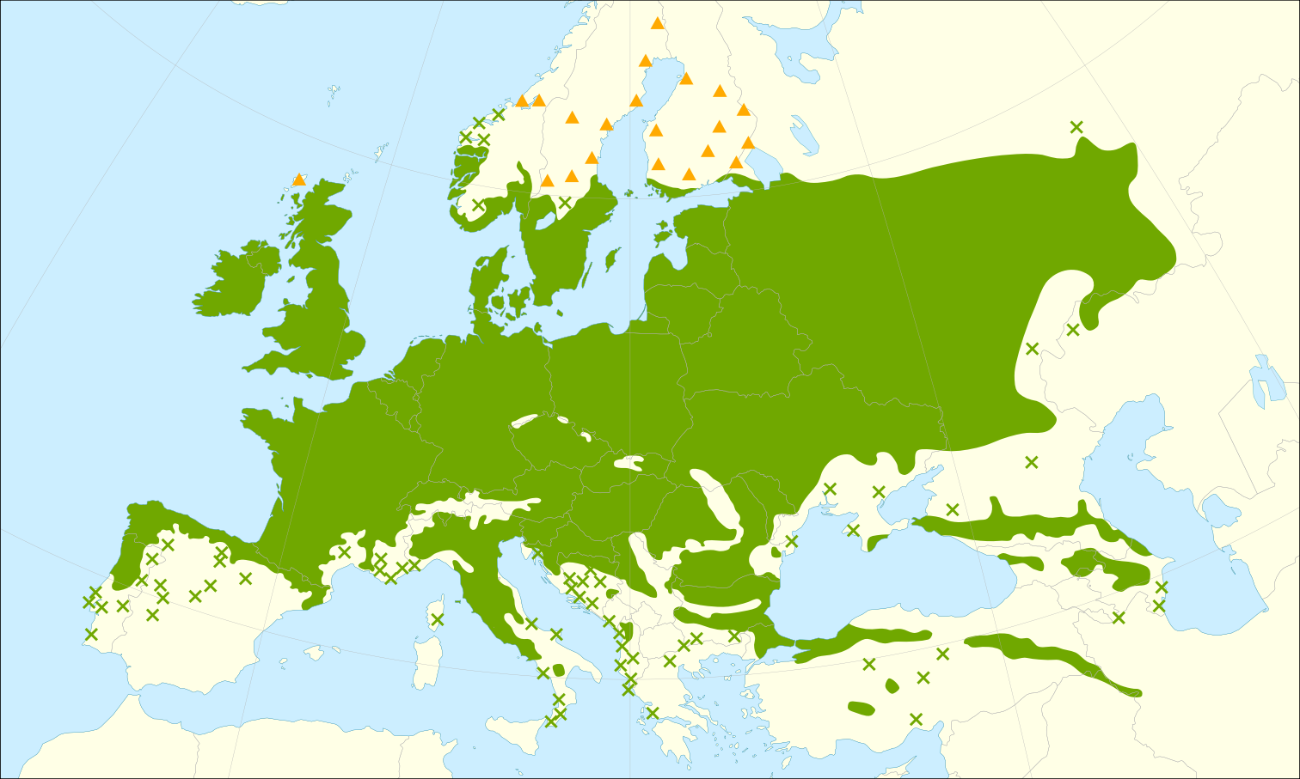
Often confused with the sessile oak (known as the Irish Oak, Welsh Oak and Cornish Oak depending from whence you hail) which is similar in appearance and has a similar range but on closer inspection, the Sessile oak has longer leaf stalks with smoother, less lobed leaves and the acorns sit on very short stems, almost cupped on the branch. The English oak is generally broader with a wide spreading crown while the Sessile tends to straighter, narrower trunks.
Longevity personified
It’s a big tree, growing to 40m or more, easily identifiable as a mature specimen by its broad, lobed canopy and massive spreading lower limbs. Famed for achieving great age, typically living for 600 years but in extreme cases, trees in the UK are recorded at over 1,000 years old, the oldest being claimed as either the Bowthorpe Oak in Lincolnshire or the King Offa’s Oak in Windsor at over 1,200 and 1,300 to 1,500 years old respectively. In fact, any oak over 400 years old is deemed “ancient” and these venerable time travellers can boast an impressive girth of 10 to 15 meters.

Many of these old trees have suffered scars over the centuries, lightning strikes and gale damage, now propped and chained to support their great mass. So long lived are they that people saw them as able to absorb whatever the fates could hurl at them and built houses in their shadow, confident that lightning would be absorbed by the mighty boughs and leave the properties unscathed. Slow growing and dense, the timber obtained from the tree is prized for its strength and load bearing qualities as well as its durability and resistance to decay and infestation.
Its size can produce massive beams of great tolerance for large spans in ships and buildings and its light, honey colour and open, straight grain makes it an appealing wood for furniture. The oak is often held to be the most beneficial tree to biodiversity, hailed as the ‘cathedrals of the natural world’. Claims abound that there are 2300 species (excluding the microbial and fungal) associated with the tree and whilst some of these claims may be a little tenuous or generous in their embrace, it is hard to deny how many plants and creatures make a good living on the shoulders of these giants.
How very English!
But why do we seem to have so many of them here in England? Their range is wide and conditions here are no more or less favourable than in many places they call home. It’s often claimed that they were actively planted to provide timber for the Navy, to build the wooden walls of Old England but the time from planting to use is too long. The same holds for building and tool making. I’ve seen claims that boughs were forced to make the shaping of beams and plough frames easier but again, the timescales don’t make sense.
The rewilders will tell you that it harks back to times when the nation was a coast-to-coast ancient forest of mixed broadleaf and predominantly oak but this isn’t borne out when compared to the extensive forests of Europe and Asia.
I came across a website – The Ancient Oaks of England by the department of biology at Oxford University, representing a summary of a research project undertaken by Aljos Farjon (RBG Kew).
“England has more ancient oaks than all other European countries combined. If we count for example all oaks with a girth (circumference of trunk) >9.00 m there are 115 in England and only 96 in the rest of Europe. In England, there are more than 25 sites with large numbers of ancient and veteran oaks, while Germany, Denmark, Romania and Sweden have one or a few and no such sites exist in the rest of Europe. The two species involved, pedunculate oak (Quercus robur) and sessile oak (Q. petraea) are among the commonest native trees of Europe and occur in all countries. The map shows the distribution of more than 3,300 native oaks with girths >=6.00 m in England.”
- https://herbaria.plants.ox.ac.uk/bol/ancientoaksofengland
They posit an interesting reason for this concentration of oak on our shores. Put simply, hunting.
Forest - wooded area kept for hunting (Middle English)
It begins with the Norman Conquest, that date we probably all remember, 1066. William the 1st, flushed from victory over the hapless Harold, viewed his newly acquired territories as his personal property and playground. He gave out large parts to his vassals, to repay them for their support in his adventures.
Indeed, the Norman church I see every morning (fog permitting) from my window, St Materianas, is a reminder of this carving up of the country under its new ruler.
I think I’m right that this area, along with many others locally, was gifted to his half-brother, Robert, Count of Mortain making him the first Earl of Cornwall in all but name.
“The Count was described unflatteringly ‘as a man of heavy, sluggish disposition.’ But this did not discount ‘the courage of his race.’ He was a respected commander and landlord, always aware to avoid the scandal that so easily surrounded his brothers and nephews.”
- DaveDoesHistory
I could live with that!
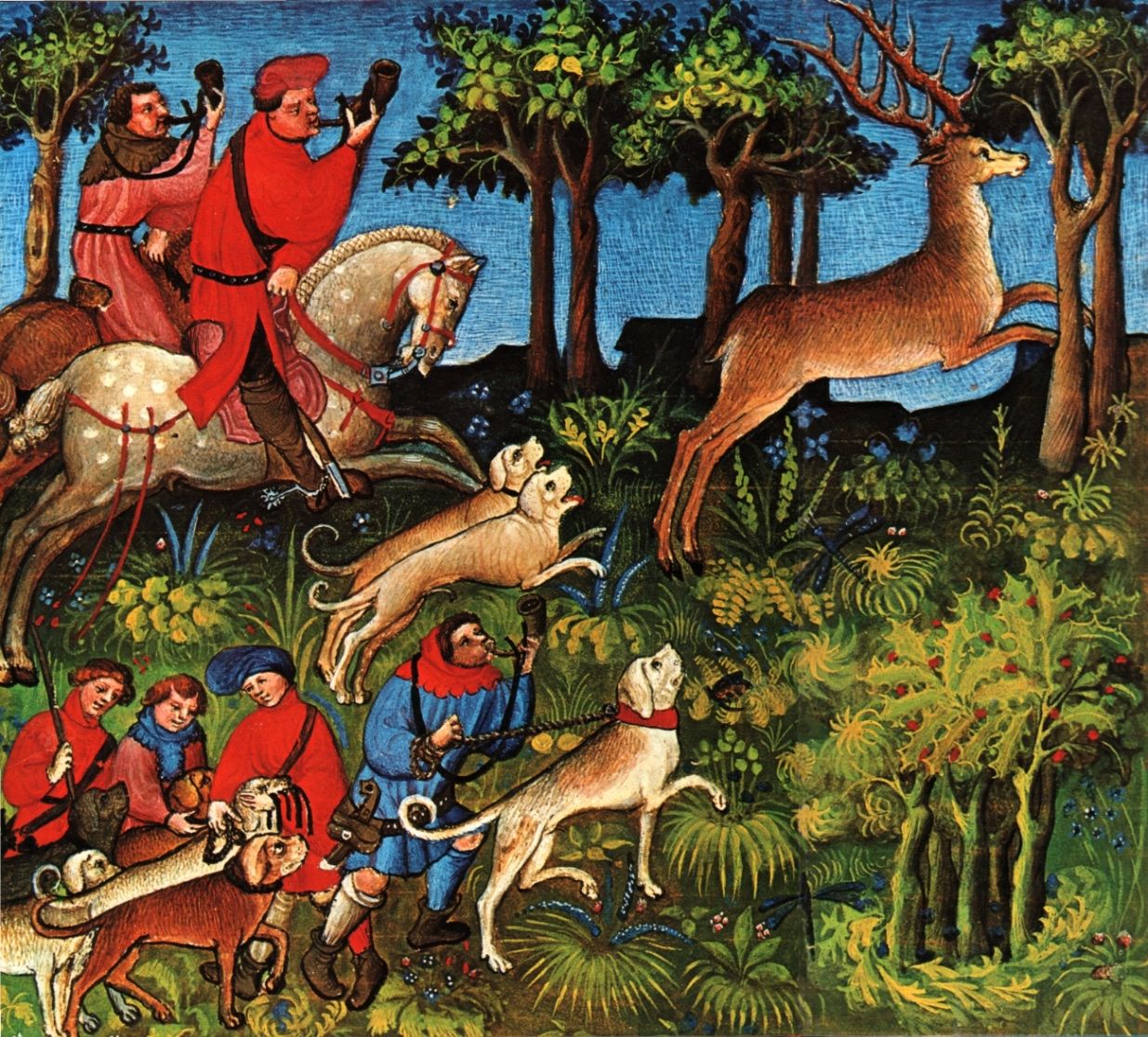
But back to the oak. William saw his new playground as an ideal place to pursue his passion for hunting. It’s widely agreed he introduced the fallow deer to the country and set about creating a landscape suitable for la Chasse. Royal forests were created giving exclusive rights to “venison and vert” or the deer and the trees.
Indeed the word forest itself, now meaning a wild place densely inhabited by trees, stems from the King’s reserve or hunting ground, with some sources suggesting that ‘foreigner’ has its origins in someone being from beyond the forest. So the theory goes that trees were planted to create hunting grounds, about a quarter of the country was such. As time went on, population grew and assarts or farming became prevalent but the hunting grounds passed to clergy and nobles and forest law became separate from common law.
Many created deer parks to suit the introduced fallow and it became easier, both practically and legally, to exclude commoners from these parks. Towards modern times, private land ownership has been largely swept away in mainland Europe by wars and revolution but has remained relatively stable in Britain and into the last century, the fashion for rearing and shooting pheasant has also favoured the broadleaf woodland and in particular, the oak. So, unsurprisingly in such a small island, the ‘wilderness’ we see around us is actually the result of ancient management practices and pursuits with the oak, being long lived and in its element, rising to the top of the pile.
It probably didn’t hurt that it was also a fantastically adaptable and useful commodity and that it required time to reach useful maturity. Such is the stuff of legend.
A Barrel of Fun
And then there are barrels. Well, casks to be precise as all barrels are casks but not all casks are barrels! From Egyptian times, wooden casks have been used to store and transport goods. The Romans shipped wine across their empire in wooden casks and soon discovered that the lowly soldiers manning the distant outposts were enjoying finer drinks than the Emperor himself due to the magical process of wood, time, motion, temperature and air acting on booze.
The cooper was an invaluable tradesman in any community, the Worshipful Company of Coopers founded in 1298 being one of the oldest Livery Companies. The name derives from Dutch ‘Kuper’ in turn from Latin ‘Cupa’ tun or barrel. So if you have a Cooper or even a Hooper in your address book, thank their forebears for the dram in your hand.
Oak was favoured due to its malleable properties, allowing it to be bent and shaped under heat and steam to produce watertight vessels. The chemistry of the wood, with its tanins and vanillins not only reduced microbial spoiling of the contents but also imbued agreeable flavours, especially in booze! And here I go a little off piste.
New Barrels for Old?
Scotch, as defined by the Scottish Whisky Association must be produced in Scotland, made only from cereals, water and yeast and matured for at least three years in oak casks. The market is worth between £3.4 billion and £7.6 billion, depending where you draw the line.
In the US of A, particularly in the Bourbon belt, to call a bottle of hooch a bourbon, it must have certain aspects to its production, not least of which is that it must be aged in new make oak barrels for a period of time that varies state to state. Spot the difference? New Make Barrels. At present, the USA makes 4 million new barrels every year and whilst the industry is highly automated, it still employs thousands of skilled staff.
The whiskey part of the industry is worth and estimated $30 billion and the cooperage, ie the physical making of the barrels, a further $1.4 billion! It also has reserve plantations of some 30 million acres of white oak planted just for future cooperage needs.

The UK imports many of the second use barrels from the US to mature spirits and whilst these barrels can be made to function for 100 years, what would it look like if, by sweep of a bureaucratic pen, all UK aged spirits had to be matured in a new make cask from British oak? Immediately, those tree planting projects would actually have a purpose beyond some spreadsheet mathematical carbon capture “can down the road kicking “ exercise. An old industry would have to be jump started into life with apprentice coopers and hoopers recruited and trained and finally, we might see the current lip service towards planting trees actually have not only a purpose but a rationale for existing beyond the hype.
An actual generational plan to plant trees, care for them so they stay alive and grow and harvest them to provide a quality product and fund the continual replacement and rotation whilst creating a solid point of quality assurance and a touchstone of heritage and provenance.
Saving the planet one dram at a time!
Yeghes Da!