Get Stuffed!
Taxidermy is experiencing a resurgence in popularity - are stuffed animals cool again?


A few months ago, I was sitting at the kitchen table immersed in some tedious paperwork. The dogs were sleeping and the house was quiet. All of a sudden there was a sharp thud on the window and the dogs, startled by the noise, shot up, barking at each other to prove how brave and prepared they were for any intrusion into their reverie. Jolted out of my admin coma, I wandered over to see what the fuss was all about and what had caused the excitement. There on the paving slab below the window lay the most delicate and beautiful goldcrest, stone dead from the impact, its lifeless form was at once both beautiful beyond compare and tragic by the pointless loss of life.
Securing the hounds, I went outside and picked the lifeless bird up. It lay in my hand, neck twisted unnaturally, still warm, the spark of life gone. I sat for a moment, turning it gently in my hands, studying the perfection of its form, the colours vibrant on its tiny body. Weighing about the same as a 20 pence coin and at 9cm long, I was holding one of the smallest birds in the world and the smallest in the UK.
When it became undeniable that there wasn’t going to be a miraculous Green Mile moment of resurrection, with no clear plan in my mind, I brought the unfortunate creature into the kitchen, gently slipped it into a Ziploc bag and popped it in the freezer.
Guilty pleasures
Some 20 years ago, when my parents downsized and moved to the bungalow across the lane, my father asked if I wanted the cased stuffed animals he’d had set up over the years. The badger he’d found by the side of the road, the kestrel killed by the cold and a hapless stoat standing on it’s hind legs and now in a glass dome, I somewhat sotto voce said yes knowing they would be consigned to my study, hidden from my wife’s view. My fascination with taxidermy was kindled but it was something of a dirty secret, stuffed animals were very much out of style and somewhat frowned upon by the chattering classes.
5 years ago, I added to my meagre collection with a head mount of my very first roe buck. I’d planned ahead and arranged the commission prior to the stalk and whilst he would certainly win no medals, he was my first buck and he was a good old boy to take. I remember every moment of that day every time I look at him on the wall.
Stuffed with history
I don’t want to get sidelined into why we seek trophies or why we hang the heads of corpses on our walls or put dead animals in glass cases to gawp at. Rather I want to delve a little into taxidermy a bit as a science and an artform in its own right.
Taxidermy the word is derived from the Greek ‘taxis’, meaning arrangement and ‘derma’ meaning skin. Techniques for the preservation of animal skins are ancient, used for clothing, tools and building materials. The ancient Egyptians are identified by many as the origins of taxidermy with their techniques of mummification as part of burial and ceremonial rights but to me, taxidermy is far more rooted in the curiosity about nature than any religious or symbolic preservation. Unlike mummification, it utilises techniques of skinning, tanning, stuffing, mounting and presenting.
Perhaps the first origins of true taxidermy could be seen in the 16th century when the first examples of collections of natural history began to emerge. Dutch, French and Austrian nobles made the first attempts to present animals in upright, natural poses. Their subjects ranged from skinned birds, filled with preservative spices, wired and mounted through to more ambitious projects of men like Austrian Baron von Herberstein who mounted the skin of a European bison for display at his home, to the four stuffed crocodiles still preserved today at city hall in Nimes.
The infamous Swedish Lion
Some of the early attempts to set up animals in a life-like pose were, shall we say, less than awe inspiring. One of the most famous examples is the Lion of Gripsholm Castle, more commonly known as simply the Swedish Lion. Presented to King Frederick 1st of Sweden by the dey of Algiers, Baba Adbi in 1731, this was one of the first lions to be recorded in Scandanavia. Whilst alive, it was kept in a cage as a curiosity for the royal court. In death it was stuffed and mounted, the resulting piece so un-lion like as to be comical and it has been roundly mocked ever since. Maybe the people tasked with the mounting had never seen a lion before or perhaps they wanted to accentuate the profile to emphasise the creature’s ferocity and paid little heed to the head on view.

But it was the 18th and 19th centuries that saw taxidermy really flourish. Coinciding with the period of great discovery and the Age of Enlightenment, the newly founded scientific institutes’ clamour for empirical evidence and application of scientific method led to collectors being sent to the corners of the world to collect specimens for presentation to the men of learning back home. These specimens required preservation for the arduous journeys home. Indeed, Darwin’s famed voyages on the Beagle in the 1830’s returned nearly 500 bird skins for study.

In an age of the gentleman scientist, many private individuals began to amass collections of taxidermied animals and birds, some for private study, some for curiosity and some, like Lionel Walter, 2nd Baron Rothschild’s Tring museum became major private collections and eventually public museums.
The Victorian era was the golden age of taxidermy and ornotholgist John Hancock is considered to be the father of the modern practice, his display of mounted birds at the Great Exhibition of 1851 generated considerable interest in scientists and also the public and were regarded as the first lifelike and artistic specimens on display. This exhibit caught the imagination of the public and soon mounted animals and birds were proudly on display in the majority of middle and upper class homes with even Queen Victoria in possession of an impressive collection. During this era, people began to have their beloved pets mounted as a form of remembrance and a fashion developed for anthropomorphic taxidermy, a particularly Victorian whimsy where animals were dressed in human clothes or posed in human circumstances.
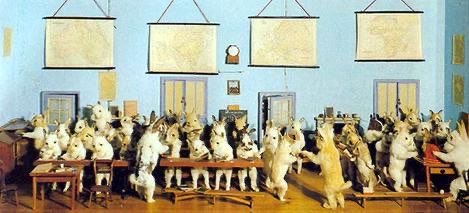
The best known practitioner of this style was Walter Potter, famous for his 1930’s piece, "Rabbit School" and probably his best known, "The Death and Burial of Cock Robin". This style went in all manner of diverse directions with frogs playing pool, two headed lambs and four legged chickens, boxing squirrels and foxes in tweed. The craze quickly encouraged amateurs to have a go and it is fair to say that some of their efforts were rather less than lifelike!
The Demise of the Art
However, as photography began to be easily available to the public and the age of personal travel came into the budget of the masses, taxidermy as a way of exhibiting unfamiliar and exotic species became less appealing. Most of the big museums had filled their collections and domestically it became more and more frowned upon to take potentially rare creatures from the wild purely to have them mounted. Post second world war and into the latter half of the 20th century, concerns for dwindling species in the wild and many governments passed increasingly restrictive wildlife protection acts. Taxidermy largely became the domain of hunting trophies and it was now unusual to see pieces displayed in average homes.
Bad Taxidermy
With the birth of the internet and perhaps more importantly the internet meme, a renewed if rather kitsch interest began, particularly in the realm of bad taxidermy with several sites and pages springing up dedicated to examples of bad taxidermy spotted around the world. Rat pencil cases, pole dancing squirrels, alligator cowboys and the Baphomet bunny among the many examples you can find on line that are both highly amusing and at the same time somewhat disturbing!
Women leading the resurgence
Maybe this is the spark that has seen a resurgence in the popularity of taxidermy in recent years but there has certainly been an uptick in interest in the subject amongst the general public here at home and in the US as well. This new interest also seems to be attracting more women to try their hand at this ancient art. Larry Blomquist, owner of one of the largest taxidermy studios in the US, now retired but still organises the World Taxidermy Championships said recently “There definitely has been a resurgence in interest in taxidermy in the general public… we get calls on a weekly basis. While women have been involved in taxidermy for many, many years, I do see more females interested now than we saw 20 or 25 years ago”.
Social media has doubtless played a major part in spreading the word as has the rise of ethical taxidermy, using only animals that have died naturally. The works of Damien Hirst and Polly Morgan also give lead to the renewed interest and many of the new wave of female taxidermists like Emilie Woodford and Sarah Burhouse see taxidermy as an opportunity for artistic expression and also to challenge stereotypes. They see their work as homage to nature and resonates with a deeper respect for nature rather than how it has been depicted as something morbid or creepy, reframing it as the merging of art and science.
And taxidermy is beginning to become sought-after in-home decoration again. From cased insects with their iridescent colours to artificial displays of wild bird eggs and mounted birds and animals, it is becoming less unusual to find pieces in suburban homes. A rising trend in the US is taxidermy pillows where the mounted creature resembles the feel of a plushy toy rather than a rigid specimen in a glass dome.
Modern techniques using foam forms and newer methods of articulation are leading to amazingly artistic and naturalistic mounts being achievable and affordable.
As for the poor goldcrest in my freezer, I wasn’t sure if anyone was prepared to work on such a small specimen but a quick rummage around some of the many taxidermy groups online had me in touch with Sarah Keen up in Sheffield and after a short email exchange and a look at some of her work, a deal was struck and a small insulated package was on its way to her. In what seemed like no time at all, maybe a fortnight, the tiny little bird was back, so perfect and lifelike I felt the polycarbonate cube was more to prevent it from flying away than protecting it from damage. And the cost? £125 plus the shipping. I presented it to my father for his birthday and we still marvel at the skill and patience Sarah must have to work on something so tiny and delicate. Taxidermy isn’t for everyone but perhaps take another look at this rejuvenated artform, put out of your mind memories of mouldering foxes leaking sawdust in stained glass cases and see if there’s a space in your home for a little bit of magic!