Sniping in the Dark
Discovering the secrets of the snipe


Back in September, I wrote an article here about the winter migration of birds into the UK. Now with Spring making its presence felt more and more each day, those winter birds have largely left and the spring and summer visitors are imminent.
These days, the concept of migration is well established in people’s minds and accepted as fact. But how did we come to discover that birds migrate, often over great distances? Whilst there are suggestions that ancient civilizations knew of migration as long ago as 3,000 years in Polynesia and Micronesia. In Samoan tradition, for example, Tagaloa sent his daughter Sina to Earth in the form of a bird, Tuli, to find dry land, the word tuli referring specifically to land-finding waders, often to the Pacific golden plover. However, as late as 1870, common belief held that absent birds could be explained by hibernation, burying themselves in mud or even relocation to the moon!
The Arrow Stork
One of the first examples of irrefutable proof that many birds travelled great distances seasonally was the Rostocker Pfeilstorch or ‘arrow-stork’. This white stork was observed in the German city of Rostock, alive but with an arrow impaled through its neck. The arrow was of African design and made from a hardwood only found on that continent.
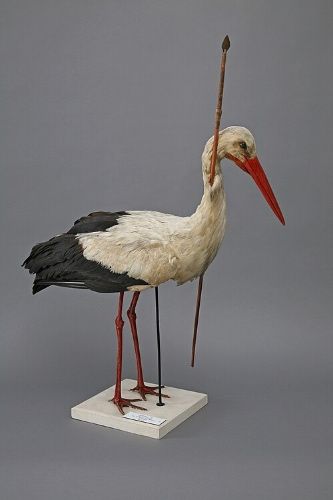
Throughout the 1800’s, as science was developing, the early myths and wive’s tales began to be overturned by hard observation. John James Audobon tied silver threads to the legs of Eastern Phoebe nestlings and observed them returning as adults the next breeding season. Whilst climbing a hill outside Madison, Wisconsin, historian and amateur ornithologist Orin Libby counted 3,800 calls by migrating birds over the course of five hours on one September night. Many of the calls seemed “almost human,” he will later write, “and it was not difficult to imagine that they expressed a whole range of emotions from anxiety and fear up to good-fellowship and joy.” These calls will eventually be dubbed “nocturnal flight calls" and be used as one way of monitoring bird migration.
But it wasn’t until 1899 that Hans Christian Cornelius Mortensen, a Danish teacher and ornithologist, began attaching metal rings around the legs of local starlings and using the recovered rings to track and record their movements. He is believed to have ringed over 6,000 birds in his lifetime.
The Ringing Scheme in Britain began in 1909, though actually originated as two schemes: one run by British Birds, instigated by the editor Harry Forbes Witherby and one at Aberdeen University, started by Arthur Landsborough Thomson. A third scheme, organised by Country Life magazine also started at this time, but the rings were not uniquely numbered. In the early years of the Scheme, these pioneers set out to answer some of the more basic biological questions of the day. Where do our summer visitors spend the winter, and where do our winter visitors breed?
When a swallow, ringed in the UK was recovered near Natal in South Africa in 1912, a distance of some 7,200km, Witherby noted in British Birds vol.6
“That this Swallow breeding in the far west of Europe should have reached so far to the south-east of Africa as Natal, seems to me extraordinary”.
The power of this data to not only prove where birds migrate to but also how long they live, where they rest en route and where they return to and pair up with has provided invaluable data that helps drive efforts to protect and monitor many species today. In the UK alone, around 1 million birds are ringed each year by over 3,000 licensed and trained individuals.
The Lizard in the Darkness
It was two of these individuals I had the great fortune to spend a night with last week down on Lanarth Farm, near Coverack on the Lizard peninsula in Cornwall, one of the most southerly points in the UK. Doctor Andrew Hoodless and his field assistant Bleddyn Thomas work for the GWCT and are heading up the Snipe Appeal.
Andrew is the Director of research at the GWCT and his primary research interests are wader ecology and migration, wetland management and predation of ground-nesting birds. He manages projects evaluating the effectiveness of agri-environment schemes for breeding waders on wet grassland and for Northern lapwings on arable land, developing solutions to reduce predator impacts on waders and assessing the effects of pheasant releasing on woodland flora and invertebrates. He has studied the Eurasian woodcock for over 20 years, with current work focused on distribution, migration and sustainable hunting.
As is somewhat ubiquitous for such adventures, we met in a lay-by in a single track lane a long way from the beaten track. It is at times like these I am pleased to be somewhat rotund as it makes me far more awkward to kidnap!
In the shadow of the satellite dishes of Earth Station at Goonhilly, we made our introductions and then, Andrew and Bleddyn weighed down with poles, nets and catching bags, me with cameras and spare batteries, made our way into a wet, windswept, rough grazed pasture. The aim was to try to catch some snipe to record and tag.
As we sploshed through the wet ground at the gate, we put up a couple of snipe, their distinctive rasping ‘scaipe scaipe’ call as they shot into the air and zig-zagged across the field gave us confidence we were at least in the right place! The chaps had spent a few days on Lanarth Farm already and had scoped out this field as a likely place to snag a snipe or two. They had selected this field as it hadn’t been heavily drained or grazed and with the rain we’ve suffered this winter was abundant with wet splashes and standing water. We’d enjoyed a few days of pre Spring sunshine and whilst the evening remained dry and the skies bright, the weather reminded us that winter wasn’t quite done with us and a stiff breeze stirred the trees and dropped the temperature to a chilly 6 degrees C.
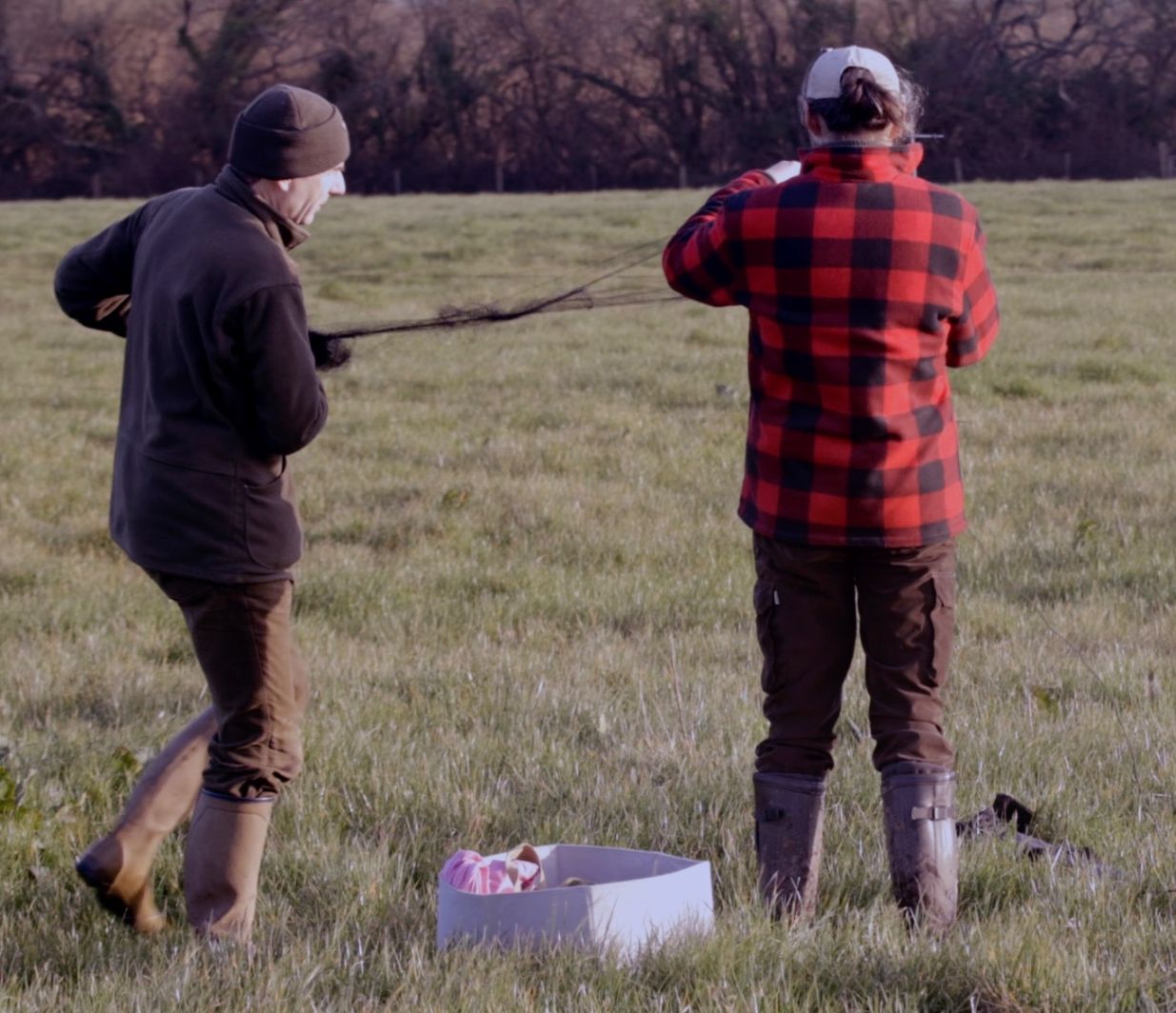
Their plan was to string lines of mist nets perpendicular to the wind across likely looking splashes, set so they were taught top, bottom and middle but created billowing pockets like sails on a tall ship to catch any snipe as they came in at dusk to spend the night feeding between the tufts of meadow grass. The gusting wind made this rather tricky and by the time the nets were laid, the sun was dipping fast and they were concerned that the wind was changing direction. Apparently the birds will come in to land into the wind and feed facing the wind to allow them to spring rapidly into flight if disturbed. I began to realise that this was no turkey shoot as we packed away our things and retreated back to the lane to wait, out of sight, until the birds would hopefully come to feed as the darkness fell.
On a calmer night, we may have been able to hear birds calling as they came in but the wind carried any sounds beyond our inadequate lug holes. The only calls we heard were a pair of Canada geese and we all secretly hoped we wouldn’t be facing extricating one of these belligerent sods from a net in a wet field in the pitch dark!
As we stood in the lane in the dark, we whispered hoarsely to each other and I asked Andrew what the issue was with snipe. He told me that there were indications that the birds are in long term decline both in the UK and across their range in Northern Europe. His extensive work with woodcock on this site and others including the Avon Valley project over the years had provided valuable data on their populations and supported the veracity of continued harvest of surplus and awareness of UK breeding and migration patterns. He had been itching to apply the techniques so successful with woodcock to snipe but until very recently, the radio transmitter tags used to track the birds were simply not small and light enough to be used effectively.
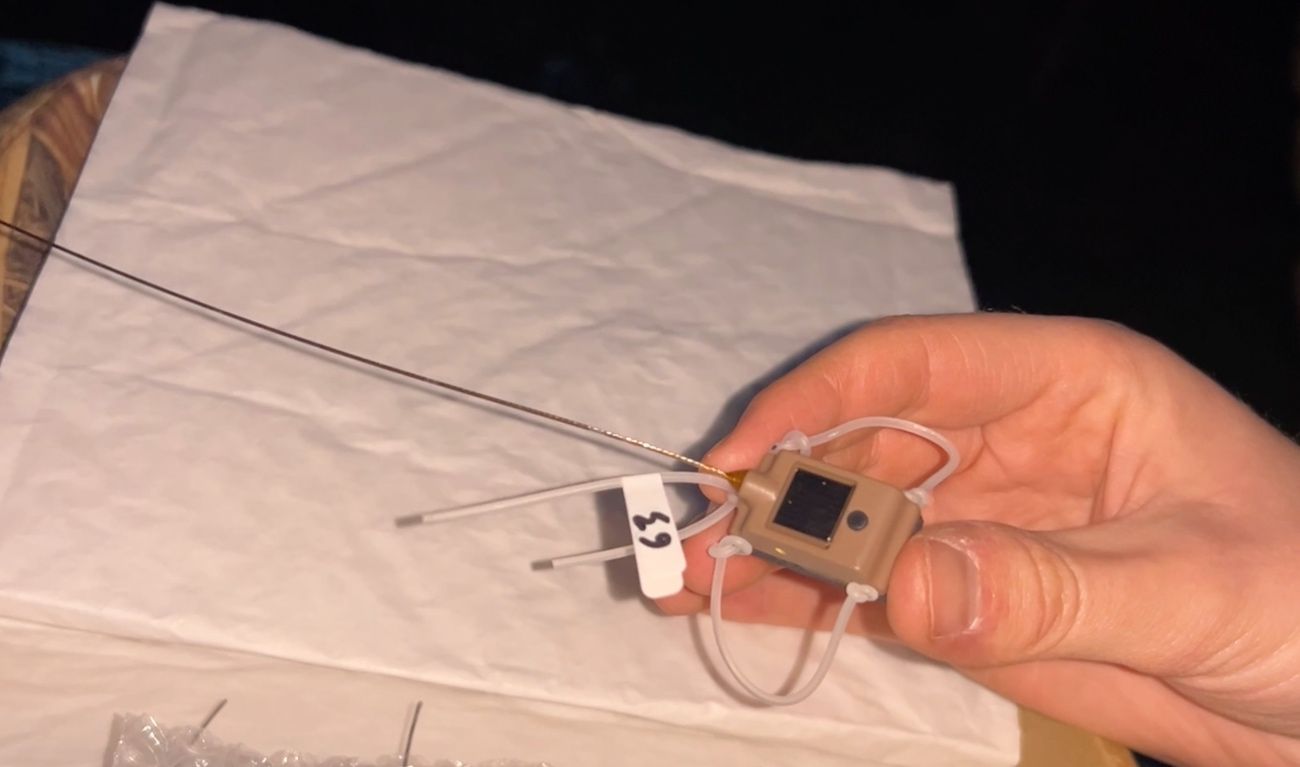
Last year, however, a new model had become available. No bigger than your thumbnail and weighing 2.5 grams, these solar powered technological marvels can be attached to healthy birds by silicon rubber strands and will transmit location data about their hosts for years. Costing a whopping £1,700 each plus data costs, they certainly aren’t cheap and obviously restrict the number of birds that can be tagged.
The light had completely gone now and Bleddyn suggested we go and check the nets. I had thought we’d leave the nets out all night like a trawler but I’m told that if the birds are to come in, it would be at dusk and remain on the field, feeding till dawn unless disturbed. The welfare of any caught birds was paramount and time they spent caught in the fine nets be as short as possible. We stood quietly in the gateway, surveying the fields with thermal monoculars, looking for possible heat signatures. I’d rather hoped to see the lines of nets lit up like fairy lights but we saw nothing. We cautiously approached in darkness, Andrew was keen to keep light to a minimum to avoid startling any captured birds. As we carefully studied each net in turn, our hopes began to fade when all of a sudden, Bleddyn rang out “Got one!!” Quickly and carefully, we made our way over to him and there, in the bottom of the net was a rather indignant but fat and healthy snipe!
Andrew worked slowly and methodically, teasing the small bird out of the fine net and just watching how delicately he held the bird and how deftly and methodically he worked showed his skill and experience. The snipe was docile in his hands. Having tried many times over the years to get just a little bit closer to these birds , both with gun and camera, to limited success, I was amazed at how calm it was and how little resistance and no sign of alarm or panic at being caught and handled. Andrew told me that snipe and particularly woodcock are very passive when being handled.
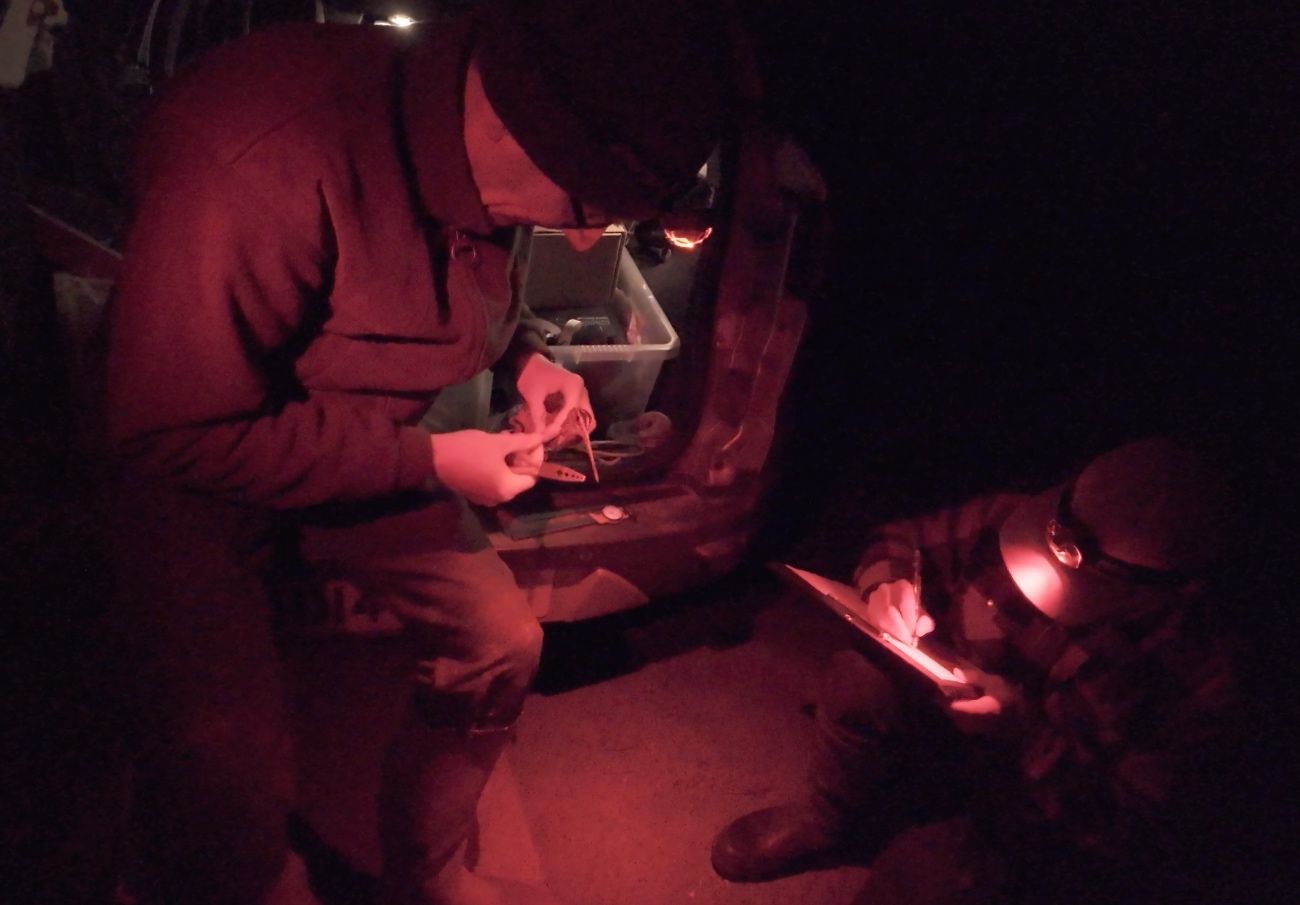
Once free of the net and after a quick once over to make sure it was in good health, he popped it into a soft cloth bag and we headed back to the cars. Here, under red light so as not to dazzle the snipe, an array of measurements were taken. Weight, length of bill, length of tarsus, tail feather length and count of wing coverlet feathers. All to try to ascertain the birds age and sex, all meticulously recorded. Unlike many species, sexing and ageing snipe outside of the breeding season is not an exact science and certainly beyond the casual observer. Females tend to have longer bills than males but it is within a range and there is overlap. Males have distinctive outer tail feathers but these are often moulted or showing signs of wear at this time of year. Juveniles have slightly different wear patterns and markings to certain feathers but again these are not always definitive. Andrew assessed this bird as a young adult female and I was more than happy to take him at his word.
A leg ring was attached and its number recorded. Then it was assessed for tagging. Weight is the dominant determining factor here. First the bird needs to be in the upper range of expected weight of between 90 to 140 grams and the tag should be no more than 3% of that bodyweight to minimise the impact of carrying around the extra load. All birds, but particularly small, prey species such as the snipe, walk the razor’s edge of being light enough to fly fast and avoid predation yet have sufficient fat and muscle to survive harsh conditions. A perilous existence at its best and certainly not one that should be put at risk by the addition of a knapsack of electronics.
This bird at 123 grams was assessed as suitable and the soft silicone rubber harness was slipped over the bird's legs to secure the tiny tracker unit on its back, just above the pelvis. The silicone tight enough not to become dislodged when the bird preened, loose enough so as not to restrict movement yet secure enough that this bird, fattened somewhat for the migration journey to come, didn’t simply slip out of the straps as it lost weight. Andrew and Blebbyn just took all these considerations in their stride yet it struck me how much training and practice goes into this kind of operation.
With the data recorded and the ring and tag attached, our snipe was returned to the soft cloth bag and quietly taken back to the field and released into the pitch black night.
Lamping for Snipe!
The time for netting had passed but the night was young and Andrew wanted to show me the other technique they use for capturing sample birds, lamping! Armed with thermal monoculars, a bright ‘dazzling’ lamp and a modified long handled landing net, we headed into the black void into a field we’d passed earlier in the evening. 20 or 30 acres of wet, squelchy bog, festooned with knee high clumps of soft rush. Andrew and Blebbyn had clearly done this many times before as they transected the quagmire, advancing ten yards, stopping, Andrew at the front with the long handled net in hand, Blebbyn at his shoulder, thermal spotter to his eye. He scanned around then tapped Andrew’s arm and they moved forward ten yards. I was gently flailing around in their wake, dim red head torch hinting at clumps of rushes, my feet finding them and making me stumble. They crisscrossed this field like they were on roller skates, whilst I crashed and fumbled behind them like a marionette with my strings all tangled. I stopped and just observed. Blebbyn spotted a heat signature and directed Andrew to it. He flicked on his high power spotlight and keyed in on the reflected eye shine. I too saw the faint glow through my own rather less sophisticated thermal unit and watched transfixed as Andrew raised the net, fully extended, high above his shoulder. Positioning himself upwind of the snipe, he cautiously approached and just as he brought the net down in a smooth arc, the bird spooked and leapt into the air, wings a blur as it raced off into the darkness. Undiminished, they pressed on, quartering and turning, changing angles of sight to try to spot any birds obscured by the tussocks. I too scanned the field, looking for the red highlights in the monochrome eyepiece of my thermal. Suddenly, I spotted one, no wait, two snipe, tucked under a tussock. Though my thermal doesn’t have the best resolution, I could make out the small birds, their long slender bills, aware something odd is happening but unsure what it was.
They walked rather than flew, circling the tussock, trying to ascertain what threat lay unseen in the darkness. I needed to tell the guys that there were two potential targets just ahead of them to the left but they were twenty yards ahead of me and my hissing whispers were carried away by the wind. Luckily, Bleddyn had already spotted them. Andrew’s lamp flicked on and he circled upwind again. One snipe broke cover and made good its escape. The second hesitated and Andrew deftly brought the net down and it was caught.
A Bird in the Hand
Back at the car, Andrew and Blebbyn made their measurements and recorded the results. At 104 grams they decided this young bird was slightly underweight for tagging so they affixed a leg ring and gently returned it to the marsh for release. Under the soft red light from Andrew’s headtorch, the snipe was removed carefully from the soft cloth bag and gently placed on the wet ground. We took a step back, the snipe just sat, blinked a couple of times and was off into the darkness.
It was 1:30 am and I had a two hour drive home so I made my excuses and headed back north. The guys were planning to stay till just before sunrise, they wanted to try to get a couple more birds tagged from this site before they headed up to the next site in Scotland for the project.
I felt elated, the adrenaline was up and the night had all the elements of a hunt.
Driving home, it struck me that there are people like Andrew and Blebbyn up and down the country committing their skills and time to the meticulous collection of data. Recording and collating years worth of information on all manner of living things. From citizen science projects like the RSPB Big Garden Birdwatch and the GWCT Farmland Bird Count to highly focussed and academic studies like the snipe appeal and the curlew project, the output informs our understanding of the natural world and shapes policy and opinion of how we protect and sustainably exploit species and manage the habitats they rely on to thrive.
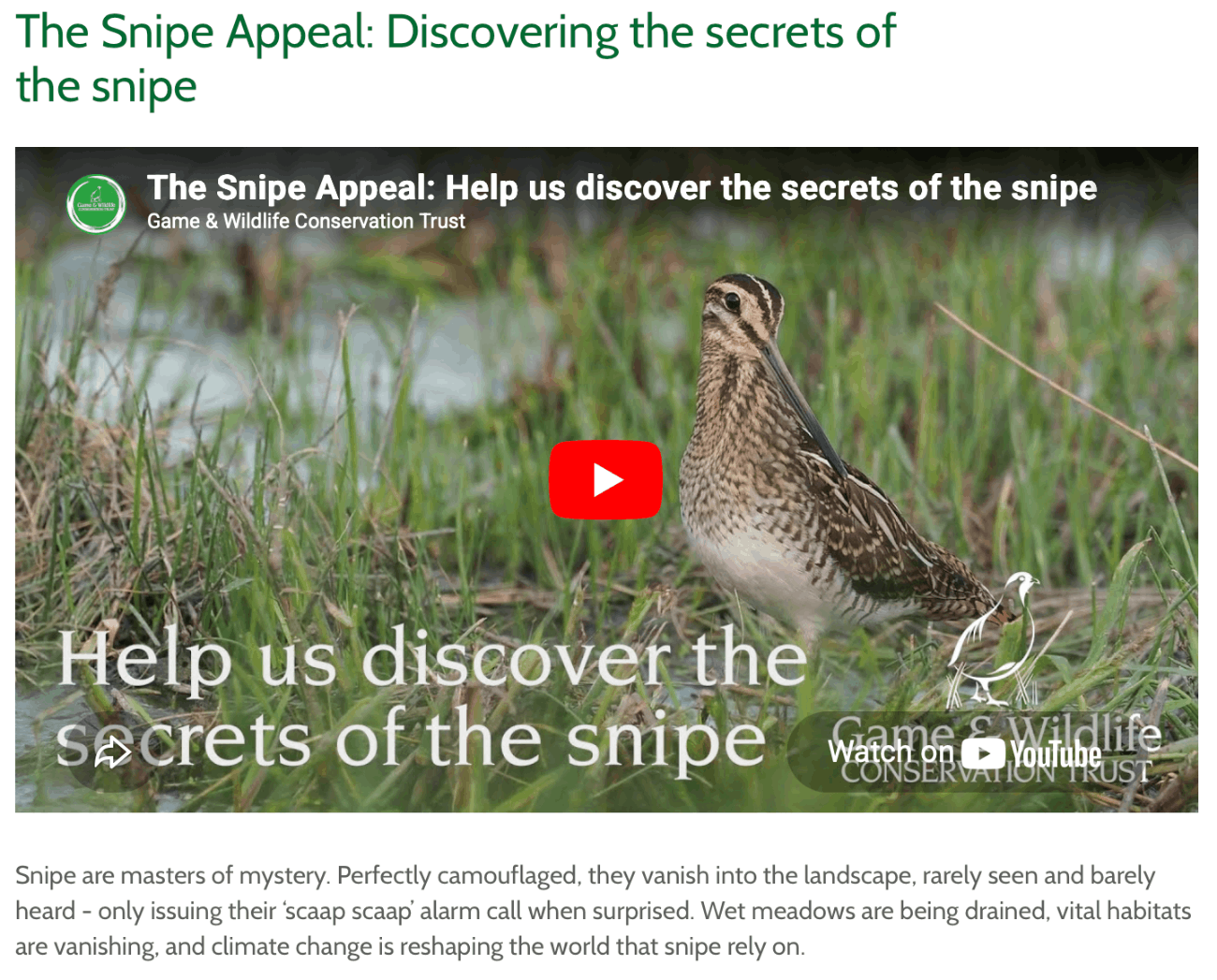
The GWCT Snipe Appeal is in its second year with tagging locations in Scotland, Ireland and here in Cornwall. The aim is to tag 20 birds across these locations each year for at least 3 years and ideally 4-5. This should start to provide the sort of data sets that can begin to build a picture of where these birds are migrating to and where they are breeding, allowing the team to look at breeding conditions and success or failure at these sites and help support actions to improve habitat and breeding success.
So when next you see maps of migrating cuckoos or distributions of butterflies, remember that there is an army of dedicated people devoted to finding out and consider supporting them by joining the organisations, making a donation or even volunteering your skills and time.
I could never have imagined just how satisfying, exciting and fascinating sploshing around a marshy field in total darkness could be but I’m hooked and planning a trip to the North York moors to see the work on the Black Grouse just as soon as I can!